Radhe Radhe · श्रीमद्भगवद्गीता
The Bhagavad Gita, verse by verse
अठारह अध्याय, सात सौ श्लोक। Sanskrit, Roman, हिंदी and English meaning, and one short reflection on each verse, written fresh for Laladham.
प्रसिद्ध श्लोक Most searched verses
अठारह अध्याय The 18 chapters
अर्जुनविषादयोग
Arjuna Vishada Yoga · Arjuna's despair
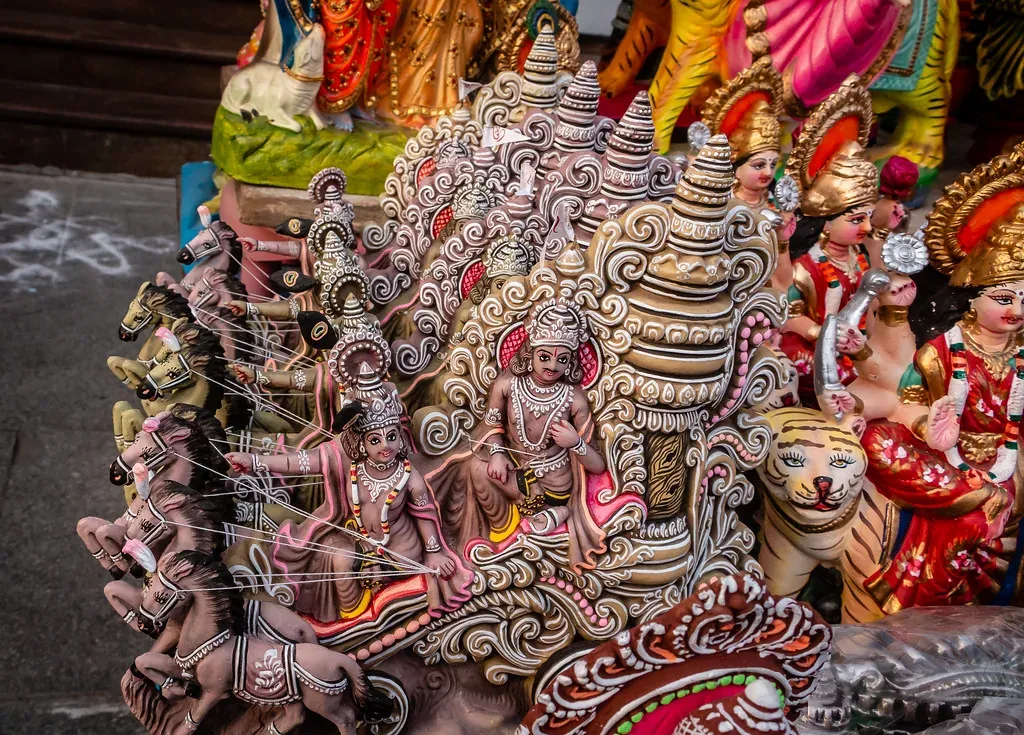
The Gita opens on the field of Kurukshetra, but not with a battle cry. The blind king Dhritarashtra asks his minister Sanjaya what his sons and the Pandavas have done, gathered on that field of dharma. Sanjaya describes Duryodhana walking over to his teacher Drona and reading out the names of the great warriors on both sides. The speech sounds confident, yet it is full of comparison and worry. Then Bhishma blows his conch, the armies answer with a roar of drums and horns, and Krishna and Arjuna reply with their own conches from a chariot of white horses.
2सांख्ययोग
Sankhya Yoga · The yoga of knowledge
The second chapter has seventy-two verses, and it is where the Gita really begins. Arjuna has dropped his bow in the middle of the battlefield, and the chapter opens on his tears. He lays out his case plainly: how can he fire arrows at Bhishma and Drona, whom he honours like fathers, and what would a kingdom be worth if bought with their blood? Then comes the verse on which the whole book turns. He stops arguing, admits that his mind is clouded, and asks Krishna to teach him as a student takes refuge with a teacher.
3कर्मयोग
Karma Yoga · The yoga of action
Chapter 3 begins with Arjuna's confusion. In chapter 2 Krishna praised a steady, wise mind and also told him to fight. To Arjuna the two instructions seem to pull against each other, so he asks: if understanding is higher than action, why push me into this dreadful deed? The forty-three verses of this chapter untangle that doubt. Krishna begins in verse 3 by saying there were always two paths, that of knowledge and that of action, and in verses 4 and 5 he adds that nobody can drop work altogether, because nature keeps everyone moving.
4ज्ञानकर्मसंन्यासयोग
Jnana Karma Sannyasa Yoga · Knowledge and the renunciation of action
The fourth chapter, with forty-two verses, opens with a surprise: Krishna says the teaching he has been giving Arjuna is not new. He says he first spoke this yoga to the sun god Vivasvan, who handed it to Manu, who gave it on to Ikshvaku, and so down a line of royal sages. Over a long stretch of time the thread broke and the knowledge faded, and so he is renewing it now, for a friend who is ready to hear it.
5कर्मसंन्यासयोग
Karma Sannyasa Yoga · Renunciation and action
The fifth chapter has twenty-nine verses, and it grows out of a single worry. Krishna has just praised acting and also praised the knowledge that burns deeds away, and Arjuna cannot tell which of the two he is being asked to follow. So he asks plainly: is it better to give up action, or to practise yoga through action? Tell me one thing, he says, and make it certain. The rest of the chapter is Krishna's patient reply.
6आत्मसंयमयोग
Atma Samyama Yoga · The yoga of meditation
Chapter 6 has forty-seven verses, and it is where the Gita turns to the practice of meditation. Krishna picks up the thread from chapter 5 and says that the true renouncer is not someone who has stopped working, but someone who does what is right without leaning on the reward. In the very first verse he says so, and in the second he shows that renunciation and yoga are really one road, since nobody becomes a yogi without letting go of the mind's endless plans.
7ज्ञानविज्ञानयोग
Jnana Vijnana Yoga · Knowledge and realisation
The seventh chapter, thirty verses long, is where Krishna stops speaking only about the Self and begins to speak about himself. Arjuna has so far heard about duty, action and the unchanging soul. Now the Lord promises a knowledge that is complete and that comes with direct experience, so that nothing further remains to be learned once it is understood. He asks only that Arjuna keep his mind on him and take him as support.
8अक्षरब्रह्मयोग
Akshara Brahma Yoga · The imperishable Brahman
Chapter eight has twenty-eight verses, and it opens with Arjuna asking questions rather than Krishna teaching. The last verses of chapter seven had used several technical words, and Arjuna wants each of them explained: Brahman, adhyatma, karma, adhibhuta, adhidaiva and adhiyajna. He also asks the question that gives the chapter its shape, how those who have mastered themselves can know the Lord at the moment of death.
9राजविद्याराजगुह्ययोग
Raja Vidya Raja Guhya Yoga · The royal knowledge
Chapter 9 is called the Yoga of the Royal Knowledge and the Royal Secret, and it has thirty-four verses. Unlike most chapters, nobody asks a question. Krishna simply decides that Arjuna is ready for the most private part of his teaching, and he says why: Arjuna does not go hunting for faults. The first thing he promises is that this knowledge can be tested in experience and is easy to practise, which is an unusual claim for a secret.
10विभूतियोग
Vibhuti Yoga · Divine glories
Chapter 10 is called the Yoga of Divine Glories, and it runs to forty-two verses. After the secret teaching of chapter 9, Krishna speaks again, and says why: Arjuna is dear to him and he wishes him well. He begins by saying that neither the hosts of gods nor the great sages know where he comes from, since he is their origin. Whoever knows him as unborn and without beginning is freed from confusion and from wrong (verse 3).
11विश्वरूपदर्शनयोग
Vishvarupa Darshana Yoga · The universal form
Chapter 11, of fifty-five verses, is called the vision of the universal form. By now Arjuna's confusion has lifted, and what he feels is something warmer than relief: he wants to see. He has heard from Krishna how the world begins and ends, and now he asks, with careful courtesy, to be shown the Lord's own form, if Krishna thinks he is able to bear it. Krishna agrees at once, but says that ordinary eyes will not do, and gives him a divine sight for the purpose.
12भक्तियोग
Bhakti Yoga · The yoga of devotion
Chapter 12 opens with a plain question from Arjuna, who has only just come out of the terrifying vision of the universal form in chapter 11. Some people worship Krishna as a person they can love, staying constantly in touch with him. Others turn toward the imperishable and the unmanifest, a reality with no face. Which of them understands yoga better? The chapter has twenty verses, and every one of them is part of a patient, practical reply.
13क्षेत्रक्षेत्रज्ञविभागयोग
Kshetra Kshetrajna Vibhaga Yoga · The field and its knower
Chapter 13 opens with Arjuna asking for the underlying map: what is nature, what is the conscious self, what is the field and its knower, and what is knowledge itself. Krishna answers with a plain image. This body is a field, and whoever knows it as an object of experience is its knower. He adds that the same knower is present in every field, so the question is never only about one person. The chapter has thirty-five verses in this reading.
14गुणत्रयविभागयोग
Gunatraya Vibhaga Yoga · The three gunas
Chapter 14 has twenty-seven verses and is given to the three gunas, the three strands of nature called sattva, rajas and tamas. Krishna starts by promising the best of all knowledge, the knowing by which sages reached perfection. In verses 3 and 4 he paints a picture of creation in the language of a family: great nature is the womb and the Lord is the father who gives the seed, so that every living thing has the same parents.
15पुरुषोत्तमयोग
Purushottama Yoga · The supreme person
The fifteenth chapter begins with a picture that is easy to remember: a tree growing upside down. This is the ashvattha, with roots above and branches below, and the hymns of the Veda for its leaves. Krishna tells Arjuna that the three gunas feed its branches and that sense objects are its tender buds. Its roots also creep downward into the human world, tying people to what they have done. No one standing inside the tree can see where it begins or ends, which is exactly how ordinary life feels.
16दैवासुरसम्पद्विभागयोग
Daivasura Sampad Vibhaga Yoga · Divine and demonic natures
In chapter 16 Arjuna asks nothing. Krishna speaks of his own accord, and what he offers is a contrast of two temperaments, the divine and the demonic. There are twenty-four verses. The first three list twenty-six qualities of the divine kind: fearlessness, a cleansed heart, giving, self-restraint, truth, non-harming, forgiveness, compassion and freedom from conceit. They read like a portrait of a decent, steady person rather than of a saint on a mountain.
17श्रद्धात्रयविभागयोग
Shraddhatraya Vibhaga Yoga · The three kinds of faith
Chapter 17, with twenty-eight verses, is named for the threefold division of faith. It follows directly from the last verses of chapter 16, where Krishna said that a person who ignores the guidance of the sacred texts and follows only whim finds neither happiness nor success. Arjuna raises the natural worry: what about people who do not know the rules, yet worship sincerely? Where do they stand? The whole chapter is Krishna's answer, and it is less about rules than about what a person's heart is built from.
18मोक्षसंन्यासयोग
Moksha Sannyasa Yoga · Liberation through renunciation
The eighteenth and last chapter has seventy-eight verses, and it gathers up everything before it. Arjuna opens with a plain request: what exactly is the difference between sannyasa and tyaga, renouncing and relinquishing? Krishna answers that the two words had been used loosely. Sannyasa, he says, is setting aside actions driven by wanting. Tyaga is giving up one's grip on the fruit of every action, while still doing the work. Acts of offering, giving and self-discipline are not to be dropped, because they cleanse a person; they simply need to be done without clinging.
Verse numbers follow the common Gita Press numbering: 701 numbered entries, of which tradition counts 700 (the question that opens chapter 13 is left out of the traditional count). Other editions may differ by a verse in chapters 1 and 13. The Sanskrit is the public-domain text; every translation and reflection on these pages is original to Laladham.
Where the Gita was spoken, and where Krishna grew up. The Gita was heard at Kurukshetra; the Krishna who spoke it was raised in Braj, at Mathura and Vrindavan. Laladham picks you up in Delhi and runs the whole trip, Kurukshetra, Mathura and Vrindavan included.
Plan my trip