Someone at the gate says the jhanki is over, a driver asks if you will do the parikrama on foot, the menu at the corner shop lists makhan mishri. Here is what each of those means, the way it is explained to a friend over chai.
55 wordsHindi spelling for eachTips from people who live here
84 Kos Parikrama ८४ कोस परिक्रमा
The 84 Kos Parikrama is the long circuit around the whole Braj region, covering about 250 kilometres.
It is said to pass through the twelve forests, more than a thousand villages and a handful of sacred hills and lakes, and on foot it takes weeks. Many seekers now do it by car in a few days, stopping at the main places, and that is perfectly respected. Dates are fixed by the lunar calendar and a few groups start together at one point. If you only have a weekend, pick a section rather than the whole thing.
Aarti is a ritual of waving a lit lamp in front of a deity, accompanied by singing and bells.
A flat lamp with a few wicks, camphor or ghee, is turned in slow circles while the congregation sings. It is repeated several times a day at most temples and once at dusk on the river ghats. After the lamp goes round, it is carried through the crowd and people hold their palms over the flame, then touch their eyes and forehead. You are welcome to join, and it is usual to leave a small coin or note in the plate. Nobody checks the amount.
Annakut is a festival of a mountain of food, offered to Govardhan hill on the day after Diwali.
Annakut literally means a heap of grain. On Govardhan Puja morning, temples and houses across Braj pile rice, kadhi, sabzi and sweets into a small hill shape, in memory of the day villagers offered food to the hill instead of to Indra. Afterwards the food is shared out to everyone present. If you are anywhere near Govardhan that day, expect heavy traffic and plan your walking time before nine, since the lanes fill fast.
An ashram is a spiritual community where residents live simply around worship, study and service, and often host guests.
In Vrindavan, ashrams range from a courtyard with a dozen rooms to a large campus with its own temple and kitchen. Some are open to any visitor, some only to disciples, and some take bookings by phone. Rooms are plain, with fan or cooler, and a clean bed. There is usually a gate time at night, and meals are sattvik. Ask what donation is expected rather than assuming, and behave as a guest in a home.
A bhajan kutir is a small hut or room set aside for quiet chanting and meditation.
It can be a one-room cell in the corner of an ashram or a thatched hut in a grove. Some seekers stay for weeks, doing japa from the first hour of morning. Visitors are not usually welcome to simply walk in; ask at the ashram office first. If you do get to sit inside, expect silence, a mat on the floor and a bell. Take off your shoes and turn your phone fully off.
Bhog is the food cooked for and first offered to the deity before anyone else eats it.
Everything served in a Braj temple kitchen is made with the deity in mind: no onion, no garlic, cooked with ghee and a lot of patience, and tasted by the deity before it is tasted by you. Banke Bihari, Radha Raman and the rest each have their own favourite items, and bhog menus change with the season: lighter in summer, richer in winter. You can usually watch the offering at the front of the hall, and then wait for the same food to return to you as prasad.
Braj Bhasha is the sweet regional dialect of Hindi spoken around Mathura and used in many devotional poems.
Hindi speakers from Delhi will follow most of it, but the sounds soften: a drawn-out vowel here, a different ending there. Old bhajans and the verses of Surdas are in Braj Bhasha, and so is the everyday chatter of shopkeepers in the lanes. The sing-song rhythm is part of the charm. Learning two or three phrases, and saying them with a smile, opens more doors than any guidebook.
Chappan bhog is an offering of fifty-six different dishes, set out before the deity on festival days.
The story behind the number is that Krishna held up Govardhan hill for seven days and nights, and Mother Yashoda, who fed Him eight times a day, made up the missed meals when the rain stopped: seven days times eight meals gives fifty-six. The spread covers sweets, savouries, grains, fruits and drinks. Temples set it out on special days, and the prasad is shared among whoever stands in the courtyard. It is a lovely, slightly chaotic scene, so go with an empty stomach.
Charanamrit is the sacred water, often with tulsi and milk, that was used to bathe the deity's feet.
A priest or servitor pours a little into your cupped right palm, usually from a small silver spoon or lota. You sip it, then touch your damp palm to your head. It tastes faintly of tulsi and sometimes of milk or ghee. If you have a stomach that complains easily, it is fine to touch it to your head and skip the sip. Nobody is watching to check, and the gesture counts. Keep your palm clean, and do not wipe it on clothes you are about to enter another temple in.
Dandavat parikrama means going around a sacred place by lying flat on the ground, rising, and repeating.
The seeker lies fully stretched, marks the ground at the fingertips, stands, walks to that mark and lies down again. A loop of Govardhan done this way takes days, sometimes weeks, and people do it for a vow. You will see them along the road with a bag of water and a cloth beneath them. If you pass one, give way, do not photograph their face, and do not offer money unless they ask. A cup of water is the easy courtesy.
Darshan is the act of seeing the deity in a temple, and being seen by Him in return.
In Braj you do not simply visit a temple, you go for darshan. The deity is treated as a living person who wakes, is dressed, eats, rests and receives guests, so the doors open and close on a fixed daily rhythm. You stand in the crowd, fold your hands and look. Sometimes it lasts a minute, sometimes it feels like a second. Timings shift between summer and winter and on festival days, so check on the day, and plan the big temples early or late rather than at the busy middle hours.
Deep daan is the offering of a lit lamp, set on the steps of a ghat or floated on water as a prayer.
A small clay lamp with ghee or oil is lit and placed at the water's edge, or set adrift on a leaf boat. In the evening the whole row of ghats glows, and the reflection doubles it. Stalls sell the lamps for a few rupees, and the flame is easily put out by wind, so shield it with your palm. Please take the leaf plate away from the water if it does not float off, and do not leave plastic behind.
A dharamshala is a simple, low-cost guest house for visitors, historically built by a trust or a community for pilgrimage travel.
Many belong to a business community or a caste trust, and the rooms are open to anyone while space remains. Expect a basic room with a bed, a fan, a bathroom down the corridor sometimes, and a gate that shuts early. They are close to the main temples, which is the real advantage. In festival weeks they fill months in advance, so call the office, not a booking site, and ask for the check-in rule.
An e-rickshaw is a small battery-powered three-wheeler, the commonest way to move around the lanes of Vrindavan.
It seats about four to six, goes at walking-plus speed, and is allowed where cars cannot go. Drivers know the temples by name. Agree the fare before you step in, and say whether you want a shared seat or the whole vehicle. Late evening, drivers get fewer and quotes go up. At the end of the ride, ask them to wait if you need a return trip, since catching a free one in a temple crowd can take a while.
Ekadashi is the eleventh day of each lunar fortnight, kept by many Vaishnavas as a day of fasting and extra prayer.
It falls twice a month, and devotees avoid grains and beans, eating fruit, milk, sabudana, or potatoes cooked with rock salt. Temples in Vrindavan run longer programmes, and kirtan carries on late into the night. Restaurants add a vrat menu on those days. If you are hosting someone who observes it, ask the night before, since the dates move with the moon and your phone calendar may be off by a day.
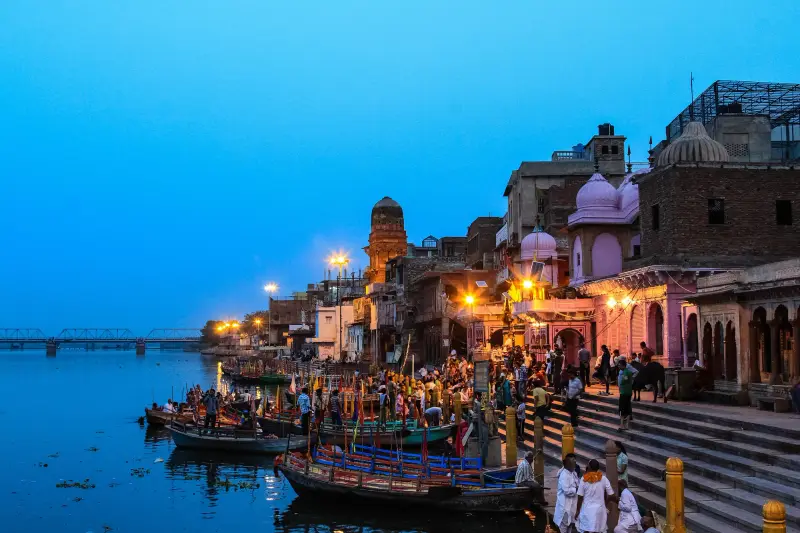
A ghat is a flight of steps leading down to a river or pond, used for bathing, prayer and evening rituals.
Mathura is traditionally counted as having about twenty-five along the Yamuna, and Vrindavan has several more, each with its own story. You will find boatmen, flower sellers, priests and people simply sitting. The steps at low season go a long way down to the water, so mind your footing. Early morning and evening are the lovely hours, and midday is hot with little shade. Bathing is a personal choice, and the water condition varies, so look before you step in.
A goshala is a shelter where cows are kept and cared for, many of them abandoned or old.
Krishna is the cowherd, so cows carry a special regard in Braj, and you will find goshalas around Govardhan, Barsana and Vrindavan. Visitors can walk in, watch the animals, and pay for a day's fodder, with the staff handing over a receipt. Wear shoes you do not mind, since the ground is muddy. Be wary of anyone on the road who stops you outside and asks for money for a goshala, and give inside the gate instead.
A Govardhan shila is a small stone from Govardhan hill, worshipped at home as a form of Krishna.
Families keep one on the household altar and bathe it with milk or tulsi water daily, treating it as a living deity. Stones with natural lines or marks are especially valued. Small ones are sold at shops near Govardhan and Vrindavan. I could not confirm a single official rule on collecting stones from the hill itself, so the safe approach is to buy from a shop and ask what the seller knows about the stone's origin.
Huranga is the rough-and-tumble Holi at Dauji Temple in Baldeo, played the day after the main Holi.
Here the women get the upper hand. The men of the village are drenched in colour, their shirts get pulled off and rolled into whips, and they get playfully lashed. Onlookers sit on the temple rooftop and the ground is a deep puddle of tinted water. It is a short ride from Mathura, but things sell out fast, so go early and keep your phone sealed in a plastic bag.
Janmashtami is the festival of Krishna's birth, celebrated at midnight on the eighth night of the dark fortnight in the monsoon months.
Mathura is where He was born, so the city goes all out: temples are decorated for days, the Janmabhoomi is overwhelmed, and the main moment arrives at midnight with an abhishek, bells and a shower of flower petals. Crowds are dense and vehicles are restricted. The date shifts each year, and some temples celebrate on different days, so check the calendar before booking. Plan to stay close to the temple, rather than commute in.
A jhanki is a brief glimpse of the deity, shown when a curtain is drawn aside or a scene is revealed.
The word means a peek, and that is exactly how it feels. In the middle of a packed hall the curtain moves, the deity is there for a breath, and you are expected to take it all in at once. People who arrive expecting a long, quiet look are sometimes surprised. The honest tip is to stop worrying about the person pushing behind you, keep your eyes on the face, and let the first glimpse be enough. Many seekers say the second and third glimpses matter more than the first.
Jhulan is the festival of the swing, when deities are seated on decorated swings through the rainy month of Sawan.
From Hariyali Teej to Raksha Bandhan, Braj hangs swings from temple ceilings and house balconies, and Radha Krishna are rocked gently while women sing monsoon songs. Banke Bihari's golden swing is the best known, and the crowd that day is huge. Elsewhere the swings are a lot calmer. Roads can be wet or flooded that month, so carry an umbrella and shoes with grip.
Kachori sabzi is the classic Mathura breakfast: a crisp fried lentil kachori with spiced potato curry.
The shops open before most temples do, and the line of locals at the counter tells you which one to trust. You get two kachoris on a leaf plate with a ladle of tangy potato curry and perhaps a little chutney. It is heavy, so plan a lighter lunch. Often it is followed by jalebi or a cup of tea. Eat where the oil looks fresh and the pace is quick.
A kanthi mala is a necklace of tulsi wood beads that marks a person as a Vaishnava devotee.
It sits close around the neck and is usually given by a guru as part of initiation, so some devotees feel strongly about who wears it. Visitors can buy a mala from a shop as a souvenir, and wearing it with respect is what matters. Vegetarian food and no alcohol are the usual expectations when you wear one. Shop in the lanes near the major temples for good quality tulsi, and check that the beads are wood and not plastic.
Kartik is the lunar month around October and November, held especially dear in Braj for lamps and Damodar worship.
The air has turned dry and cool, the rains are gone, and the whole month has a gentler feeling. Seekers rise early, bathe in the Yamuna, and light a lamp each evening for Krishna as Damodar, the child tied to a mortar with a rope. Many stay the entire month. The weather is among the most comfortable of the year, which also makes it a busy time, so book your stay earlier than you would for other months.
Kirtan is group devotional singing, usually led by a call-and-response and carried by a two-headed clay drum called a mridang.
The mridang is played with both palms and gives kirtan its deep pulse, joined by hand cymbals called karatals and sometimes a harmonium. A leader sings a line and the room repeats it, getting faster and louder. Temples and ashrams hold kirtan in the morning and evening, and ISKCON makes it a daily practice. You do not need to know the words. Clapping on the beat and listening is already taking part.
A kos is an old Indian measure of distance, roughly three kilometres, still used when speaking about Braj.
The exact length changed over the centuries and between regions, so nobody will give you the same figure twice. In Braj you will hear it in the phrase 84 kos, in the names of ghats, and when a local says a place is two kos away. For planning, ask for the distance in kilometres, since taxis and apps go by those.
A kund is a sacred pond or stepped water tank, often connected to a particular leela of Krishna.
Radha Kund and Shyam Kund are the famous pair near Govardhan, and the legend is that they were dug and filled by the two themselves. Smaller kunds sit tucked behind temples, with steps going down on all sides. Water levels shift across the year: full in monsoon, low and green in late summer. People sprinkle a little water on the head, not always bathe, and the steps can be slippery, so wear shoes you can slip off quickly.
A kunj is a leafy grove or bower, the kind of place where Radha and Krishna are said to have met.
Names like Nidhivan, Seva Kunj and Nikunj Van appear all over Vrindavan. The trees are low and twisted, and the story is that they turn into gopis each night to dance. Entry is allowed during the day only and the grounds are shut after sunset. Monkeys are bold here, so keep your bag zipped and glasses in a pocket. Quiet is expected, and that single rule makes the place feel older than it is.
Lathmar Holi is the playful festival in Barsana and Nandgaon where women strike men with sticks while singing.
The tale is that Krishna and His friends once came from Nandgaon to tease Radha and her friends in Barsana, and were chased off with sticks. Today men from one village come to the other, shielded by cloth and sing taunting verses, and the women answer with lathis and laughter. It is loud, colourful and packed. Leave valuables at home, wear clothes you do not love, and book transport well ahead since roads around both villages close.
A leela is a divine play or episode from the life of Krishna, such as stealing butter or lifting Govardhan.
Every corner of Braj is tied to one: the tree where the clothes were taken, the ghat where the serpent was subdued, the lane where butter pots were stolen. Locals often explain a place by its leela, so it helps to learn a few names before you arrive. They also keep the visit from feeling like only sightseeing. Reading the short story at the gate while you stand there is the best way I know to understand a place.
Makhan mishri is fresh white butter served with rock sugar crystals, Krishna's favourite food as a child.
The butter is pale, light and slightly sweet, and the mishri adds a crunch. In Gokul and Mathura it is offered as prasad, and some stalls sell little cups to visitors. It is a sweet reminder of the butter thief stories told to children across Braj. Eat it the same day, since the butter does not travel well in the heat, and ask where it comes from if you have a delicate stomach.
Mangala aarti is the first lamp offering of the day, done in the dark before sunrise to wake the deity.
This is the one most seekers plan for and few manage twice. The temple is lit by lamps, the air smells of ghee and incense, and the courtyard is cooler than it will be again until night. Many temples hold it between about four and five in the morning, though the hour moves with the season and some temples keep it only on special days. At Banke Bihari the aarti of this kind is a once a year affair, on Janmashtami night. Ask your hotel the evening before, and carry a light shawl.
Mathura peda is a soft, grainy, brown milk sweet made by slowly roasting khoa with sugar, the town's best-known gift.
The brown colour comes from roasting the milk solids until they caramelise, and it has a texture that is less smooth than a plain white peda. Shops near the Krishna Janmabhoomi sell boxes by weight, and the old shops will usually let you taste first. Buy fresh on the day you leave, since it keeps for a few days without refrigeration but tastes best in the first two. Ask for a box with a sealed cover if you are flying.
A panda is a hereditary priest who guides visitors through rituals at a ghat or sacred site, for a donation.
Families of pandas have served at Mathura's ghats for generations, and some keep family records of visitors. A good one explains the ritual and does it properly. Some others pressure visitors into expensive offerings. Decide in advance what you are willing to give, ask the rate before the ritual begins, and feel free to say no politely and walk on. The receipt, not the sum, is the safest guide.
At Banke Bihari Temple a curtain is drawn across the deity every few moments, so His gaze is never held for long.
Stand inside the hall and you will see a servitor pull the curtain shut, wait, then open it again, over and over. The old explanation is that the deity's eyes are so compelling that devotees could lose themselves, so the curtain gives rest to both sides. The hall stays tightly packed, so keep bags small. If the crowd is heavy, the lane outside is often quieter than the hall, so go on a weekday morning.
Parikrama is a ritual walk around a sacred place, always keeping the sacred centre on your right side.
In Braj it can mean circling a temple, a kund, a whole town like Vrindavan, or the hill of Govardhan. You walk, often barefoot, chanting or just quietly. The Vrindavan parikrama marg is roughly ten kilometres and the Govardhan loop is about twenty-one, so choose by how your knees feel. Start early, carry water, and know that there are tea and rest stops along the way. Nobody counts how fast you finish.
A phool bangla is a pavilion of fresh flowers built around the deity, most famously at Banke Bihari Temple in the hot months.
Temple workers build a frame in the sanctum, then cover it with garlands of jasmine, marigold and rose, so the deity appears seated in a small cool garden. It is a way to give relief in the heat. The scent reaches the lane outside. It is not on show every day, and the flowers change daily, so crowds are heavier on the days the bangla is announced. Ask locally which evenings it is on.
Poshak is the set of clothes worn by a deity, stitched fresh and changed through the year.
Walk through any Vrindavan market and you will see tiny silk and zari outfits hanging in rows, sized from a thumb-high Laddu Gopal to a full temple idol. Families who keep a small Krishna at home dress Him daily, change the colour with the season, and treat the wardrobe seriously. If you are buying one, measure the idol at home first and carry the number with you. Shopkeepers will help, but sizes are not standard from shop to shop.
Prasad is food, sweets or flowers that have been offered to the deity and are then handed back to devotees.
Take it with your right hand, eat it there if you can, and never throw any of it away. Most temples give a small dry sweet or a spoon of laddu, and larger places such as ISKCON serve a full meal at a fixed hour. If you are buying a packet from a stall to offer inside, watch what the shop is including, since not every packet is made to temple standards. Some temples do not allow outside offerings at all, so the stall outside usually knows the day's rule.
Raas is the circle dance of Krishna with the gopis, remembered every year on Sharad Purnima and staged in dance-dramas.
The tradition says that on an autumn full moon night Krishna multiplied Himself so that every gopi felt He danced with her alone. Troupes in Vrindavan perform it as a devotional theatre with young performers in costume, to song and drum. Performances are usually held in the evenings at an open hall, not a theatre, and the audience sits on the floor. Sit near the front if you can, since the faces tell most of the story.
Radhashtami is the birthday of Radha, observed about two weeks after Janmashtami, with the biggest celebration in Barsana.
Barsana's hilltop temple of Radha Rani is the centre. The path up is lined with stalls, singers and groups carrying decorated flags, and the temple hosts a morning abhishek and then a stream of darshan. Vrindavan's Radha temples celebrate too, often with a special offering. Weather is usually still warm and humid, so start the climb early and carry water. The date follows the lunar calendar and moves each year.
Radhe Radhe is the everyday greeting in Braj, calling the name of Radha instead of saying hello.
It is said when you meet, when you part, when you thank and when you bump into someone in a crowded lane. The elderly woman selling flowers says it, the rickshaw driver says it, and a stranger on the parikrama path will say it as you pass. Replying with the same two words is enough. Some people say Jai Shri Radhe, which is equally welcome. It also gets a smile out of people who were about to scold you for stepping on their mat.
Rajbhog is the main midday meal offered to the deity, usually the grandest food offering of the day.
Think of it as the lunch hour of the temple. A full thali of sabzi, dal, rice, puri and sweets is placed before the deity, the curtain is drawn for the offering, and then darshan resumes with the deity looking noticeably settled. Soon after, the temple closes for the afternoon rest, which is why a visit at one in the afternoon often ends in a locked door. The hour differs from temple to temple and through the year.
A sadhu is a person who has given up ordinary life for spiritual practice, and baba is the respectful way to address one.
In Braj you meet them on ghats, beside the parikrama path and in tiny roadside shrines, wearing saffron, white or sometimes just a cloth. Greet them with folded hands and Radhe Radhe. Many will bless you without asking for anything, a few will ask for a donation, and some will be fake. If you give, give small and by choice. Ask before taking a photograph, and accept a no without argument.
Sandhya aarti is the temple's dusk lamp offering, when bells, drums and the whole courtyard come alive.
Of all the daily rituals this is the easiest to enjoy as a first-timer. The light is soft, the crowd is relaxed after the day, and the singing is loud enough to carry you along even if you do not know the words. A brass lamp is waved in circles before the deity, then brought out so you can pass your hands over the flame and touch them to your eyes. Come a little before time, stand toward the back for a clearer view, and keep your phone away.
A sarovar is a large sacred lake, usually with stone steps on its edges and a temple nearby.
It is a bigger cousin of the kund. Examples are Mansi Ganga at Govardhan, Kusum Sarovar, Pavan Sarovar at Nandgaon and Prem Sarovar at Barsana. They are quietest in the early hours and look best after the rains, when water reaches the steps. Evening visits are common, with lamps lit on the stairs during Kartik. Many have a small domed pavilion and a cenotaph nearby, and the surroundings are often better photographed from the far bank.
Sattvik food is plain vegetarian cooking without onion, garlic or other heavy ingredients, as served in temples and many Braj kitchens.
Almost every restaurant near the main temples is sattvik, and most proudly say so on the board. The dal is lightly spiced, the sabzi is simple, and desserts are made with milk and ghee. If you are used to a lot of heat you may miss it for a day or two, and then you will not. Carry your own chilli sauce if you need it. Evening food stalls often use onion, so ask before ordering.
Shayan aarti is the last ritual of the day, when the deity is put to rest for the night.
The word shayan means sleep. After a final offering and a soft, slower aarti, the curtain is closed and the temple is locked until the next morning. In some temples the deity is laid on a small bed, with fan, water and a cloth. It is a gentle, almost domestic moment, and it is one of the quietest times to be inside a large temple. Because it closes the day, the hour changes with the season, so ask at the gate rather than relying on an old board.
Shringar is the daily dressing and adornment of the deity in fresh clothes, jewellery and flowers.
Behind the curtain, servitors bathe the deity, change the poshak, place the jewellery and make a garland. The colour of the clothes often follows the day of the week or the festival, so the same deity looks quite different from one visit to the next. You usually cannot watch the dressing itself, only the result when the curtain opens. A small practical point: if you want to offer a garland, buy it fresh from the stalls outside, since temples have rules about what may be taken in.
A tilak is the sacred mark on the forehead; Vaishnavas of Braj wear two vertical lines, often made from clay.
The clay is commonly gopi chandan, a pale yellow earth, applied with a fingertip or a small metal stamp. You will often be offered one at a temple gate or by the priests on the ghat. Accept it with a nod and keep your head still. Some ask a small coin, which is fine. You do not have to wear it afterwards, though many visitors enjoy keeping it for the day.
Tulsi is holy basil, a plant treated as sacred in Braj and offered in every Krishna worship.
Almost every home in the region keeps a pot of it in the courtyard and waters it at dawn. Leaves go into charanamrit and onto the plate of every bhog, since Krishna is said to refuse food that has none. The scent is sharp and clean. Do not pluck leaves from a street plant just for a souvenir, as they are often someone's daily worship, and ask first if you want one.
A van is a forest, and Braj is traditionally described as having twelve sacred forests tied to Krishna's childhood.
Madhuvan, Talvan, Kumudvan, Bahulavan, Vrindavan, Kamyavan, Khadiravan, Lohavan, Bhandirvan, Bhadravan, Belvan and Mahavan make the traditional list, though some are now villages or fields with only a grove or temple remaining. Some are close to Vrindavan, others lie across the river or toward Rajasthan. Plan a driver for a day, since public transport links are thin, and carry cash for the small temple gates.
The Vishram Ghat aarti is the river-side lamp ceremony on the Yamuna in Mathura, held each dusk.
Priests stand on the steps with large brass lamps, bells ring, conches sound, and small lamps float downstream as the sky turns orange. It lasts about half an hour, and the best views are from the steps on the left or from a boat just offshore. Arrive early to find a seat. Boat men may quote higher prices at dusk, so agree beforehand. It is a good last stop of a Mathura day.
Yamuna snan is a ritual bath in the river Yamuna, especially at the ghats of Mathura and Vrindavan.
Early morning in Kartik, Bhai Dooj and other festival days draw big crowds to the steps. Many people only sprinkle water on the head or touch it to their eyes. River quality varies by season and stretch, and some visible stretches are not clean, so look at the water, bring a towel, and use a ghat with a safe slope. Children and elders should step in with a hand held.