Family · व्रत
करवा चौथ
Karwa Chauth
Karwa Chauth is a sunrise-to-moonrise fast kept by married women of North India: sargi before dawn, Gauri puja with the karwa at dusk, katha, then arghya to the moon.
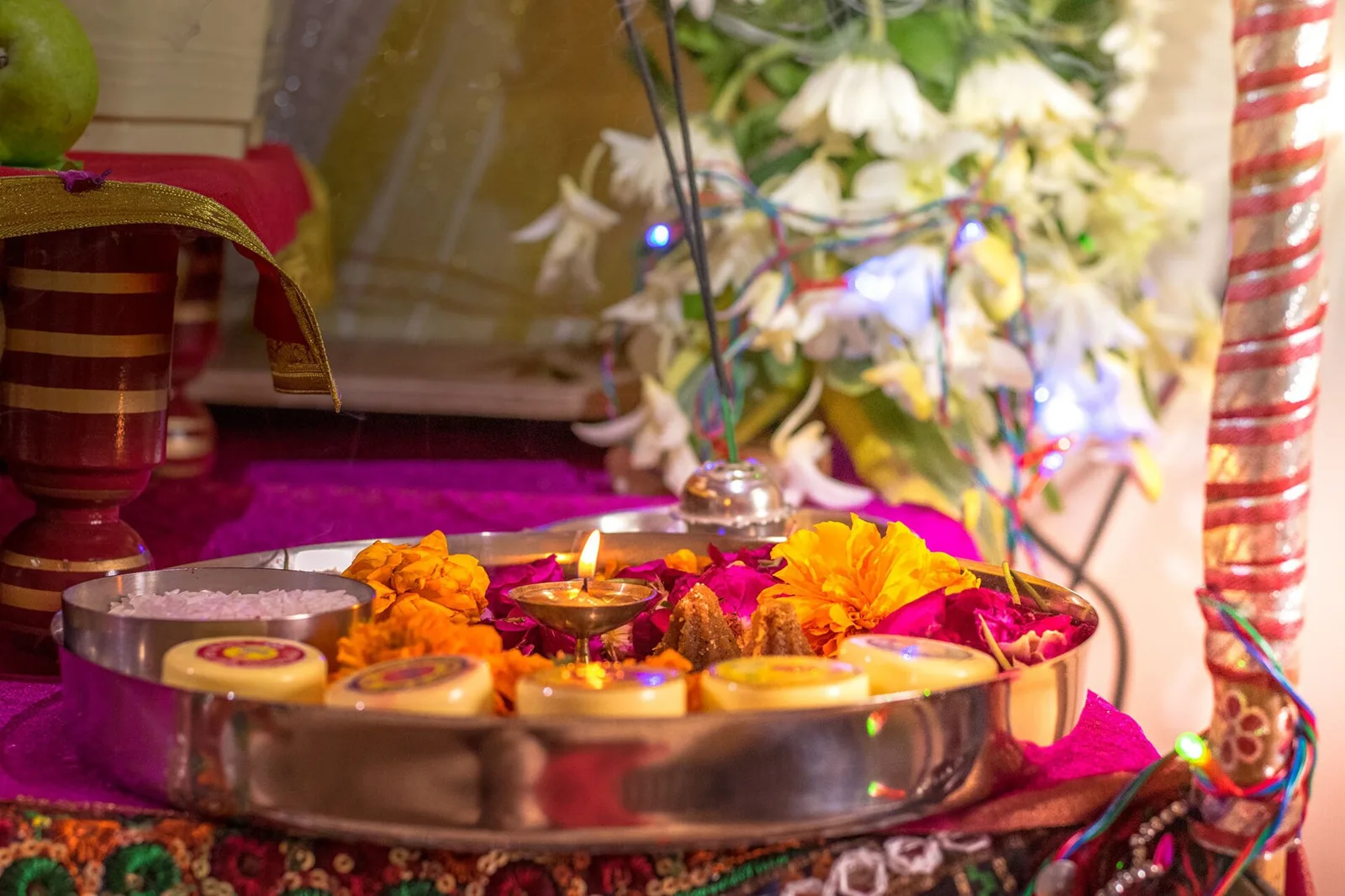
Chaturthi of Kartik Krishna Paksha (north Indian purnimanta count), a few days before Diwali. The fast runs from the pre-dawn sargi until moonrise. Puja is done in the evening after sunset, and moonrise differs by city and by year, so check drikpanchang.com for your own city.
Mainly married women, and unmarried girls who wish for a husband of their choice. Some families now have husbands keeping the fast with their wives. Pregnant, unwell or elderly women may take fruit or water on a doctor's advice and still join the puja.
Whole day for the fast; the evening puja and katha take about 1 to 1.5 hours
सामग्री Samagri checklist
Puja thali
Offerings and bayana
Sargi and shringar
तैयारी Before you begin
- Wake before sunrise, bathe and eat sargi in the last hour of the night, around 4 to 5 AM.
- Prepare the puja spot facing east or north on a clean raised seat, with Gauri and Ganesh in front.
- Draw the karwa on the wall in geru and rice paste if your family follows that custom, or use a printed calendar picture.
- Fill the clay karwas with wheat and place sugar powder in the lid.
- Dress in your best, wear the sixteen shringar and keep the thali ready before sunset.
पूजा विधि Step by step
आचमन Achaman, sipping water to purify
about 2 minutes
Sit on your asan facing east or north with a small cup (a copper or steel panchpatra if you have one) of clean water and a spoon. Pour a little water into your right palm and sip it three times, each time with one name of Vishnu, without a sound of slurping. Then wash the right palm, touch your lips, and touch water to the eyes, nose, ears and heart with the fingers, as your family does. Take only a small sip each time, not a mouthful. Do it before sankalp, and again whenever you leave the seat and return.
ॐ केशवाय नमः। ॐ नारायणाय नमः। ॐ माधवाय नमः।
Om Keshavaya namah. Om Narayanaya namah. Om Madhavaya namah.
Meaning: Salutations to Keshava, Narayana and Madhava, three names of Vishnu, one for each sip. Many Vedic households say 'svaha' in place of 'namah' for these three sips, and the Sandhya text does the same.
ॐ गोविन्दाय नमः
Om Govindaya namah
Meaning: A fourth name of Vishnu, said as the hand is washed after the three sips.
सरगी Sargi before dawn
about 20 minutes
The sargi comes from your saas, with love. If she is far, a jethani or a sister can step in. Eat slowly in the last hour of the night: sevaiyan or phirni, fruit, dry fruit and something with ghee. Keep it light on spice and oil. Then say your intention to keep the day fast with no water.
व्रत संकल्प Vrat sankalp
about 5 minutes
After the morning bath, sit before the family deity or the Gauri picture. Hold a little water and akshat in the right palm, speak the sankalp and let the water fall in a plate. Then the day is kept without food and without water until the moon is seen.
मम सुखसौभाग्य पुत्रपौत्रादि सुस्थिर श्री प्राप्तये करक चतुर्थी व्रतमहं करिष्ये।
mama sukha-saubhagya putra-pautrādi susthira śrī prāptaye karaka-caturthī vratam ahaṃ kariṣye.
Meaning: For my happiness and a lasting marriage, for children and grandchildren and steady prosperity, I undertake the Karak Chaturthi fast.
गौरी-गणेश की स्थापना Setting up Gauri and Ganesh
about 10 minutes
Late afternoon, make Gauri from yellow clay and seat Ganesh in her lap, or place a Shiv-Parvati-Ganesh picture. Put her on a wooden seat over a small chowk, cover her with a chunari and give a bindi and small shringar items. Place the filled karwa beside her with a swastika of roli on it.
गणेश-गौरी स्मरण / आवाहन Ganesh and Gauri invocation at the start
about 5 minutes
Every puja begins by remembering Ganesh so that no obstacle comes in the way, with Gauri (Parvati) beside him. Place a small mound of rice or a betel nut wrapped with red thread (moli) on a leaf or a small plate as Ganesh, and a second smaller one as Gauri. If you have a Ganesh murti, use that. Bow, offer a little water, a dot of roli or sandal, rice and a flower to each, and pray that they stay till the puja is finished. When the main puja is over, offer them water again and say they may go where they please.
वक्रतुण्ड महाकाय सूर्यकोटि समप्रभ। निर्विघ्नं कुरु मे देव सर्वकार्येषु सर्वदा॥
Vakratunda mahakaya suryakoti samaprabha. Nirvighnam kuru me deva sarvakaryeshu sarvada.
Meaning: O curved-trunked, large-bodied one with the brilliance of a crore suns, make all my works free from obstacles, always. This is the Ganesh smaran verse already on our bhajan pages. For the avahan (invitation) proper, families use different verses, so recite the Ganesh verse of your own household.
गौरी पूजन Gauri puja with the mantra
about 15 minutes
At dusk, before moonrise, offer roli, akshat, flowers, dhoop and the diya to Gauri, Ganesh and the painted or clay karwa. Women usually sit together in a circle for this. Pray for his long life and the good of your home, and recite the verse below while offering.
नमः शिवायै शर्वाण्यै सौभाग्यं संतति शुभाम्। प्रयच्छ भक्तियुक्तानां नारीणां हरवल्लभे॥
namaḥ śivāyai śarvāṇyai saubhāgyaṃ santatiṃ śubhām. prayaccha bhaktiyuktānāṃ nārīṇāṃ haravallabhe.
Meaning: Salutations to Shivā and Śarvāṇī. O beloved of Hara, grant good fortune and fortunate children to women who come to you with devotion.
कथा श्रवण Hearing the katha
about 20 minutes
Place 13 bindis on the karwa. Keep 13 grains of wheat or rice in your hand and listen to the katha, read by the eldest woman or the family priest. The common tales are Veervati, the sister of seven brothers who broke her fast to a false moon, and Karva, who tied a crocodile with cotton thread and faced Yamraj. After the tale, let the grains fall into the thali.
थाली फेरना Passing the thali round
about 10 minutes
In many homes the women sit in a circle and pass their puja thalis from hand to hand seven times, singing the traditional Karwa Chauth song. It is a social part of the evening, meant to bring the neighbourhood together. Where this is not done, simply move the karwa clockwise round the Gauri seat.
बायना और आशीर्वाद Bayana for the mother-in-law
about 5 minutes
Turn your hand over the karwa from you towards you, touch the feet of your mother-in-law and give her the karwa with the bayana, the halwa-puri, sweets, saree or cloth and some money. If she lives elsewhere, send it or give it to an elder woman of the family. Seek her blessing of saubhagya.
चंद्र दर्शन Moon darshan through the sieve
about 5 minutes
When the moon is up, go to the terrace or courtyard with the thali. Put a lit diya inside the sieve, look at the moon through it first, then look at your husband's face the same way. Keep the dupatta over your head. Do not break the fast before the moon is actually seen, even if the time on a chart has passed.
चंद्र अर्घ्य Arghya to the moon
about 5 minutes
Take water from the spouted karwa and pour it slowly towards the moon in a thin stream, with folded hands. Offer akshat and sweets on the plate and bow. Ask for peace in the home. No separate moon mantra could be confirmed from two sources, so say your own words or the Chandra prayer of your family.
पारण Parana, breaking the fast
about 15 minutes
Your husband gives you the first sip of water from his hand, and a first piece of sweet. Touch his feet and ask his blessing. Then sit for the evening meal. Many homes cook a light satvik meal, with puri, halwa and a seasonal sabzi. The mother-in-law's blessing is taken again before eating if you have not already done so.
उजमन Ujaman, concluding the vow
about 1 hour
Some families do an ujaman after the vow has been kept for several years, or when a wish comes true. Put four puris and a spoon of halwa at 13 places in a thali, add a saree, blouse piece and money, and give it as bayana to the mother-in-law. Then feed 13 married women and send them off with bindi, shringar items and dakshina.
आरती विधि How to do aarti
about 5 minutes
Aarti comes near the end of the puja, after the offerings. Stand in front of the deity with a thali holding a ghee lamp (or camphor), a small bell, a flower and a little water. Ring the bell with the left hand and wave the thali with the right, always clockwise: in front of the deity, the thali goes from your left to your right in a full circle. Many households do about four circles at the feet, two at the navel or belly, one at the face and then seven or so around the whole form, going from feet upward. Sources do not agree on these counts, so follow your family; the clockwise circle is the part all agree on. Camphor is lit last and waved the same way, and one verse (karpur-gauram or the nirajan verse) is said while it burns. Sing the aarti of the deity with everyone, clapping softly in time. Then take the aarti: hold your hands over the flame and touch them lightly to your eyes and forehead, and pass the thali to others. Walk once round the deity clockwise and bow. Afterwards set the lamp back in the shrine; whether it burns on or is put out gently depends on your family custom, and a lamp that goes out in the middle can simply be relit.
कदलीगर्भसम्भूतं कर्पूरं तु प्रदीपितम्। आरार्तिकमहं कुर्वे पश्य मे वरदो भव॥
Kadali-garbha-sambhutam karpuram tu pradipitam. Aratikam aham kurve pashya me varado bhava.
Meaning: Camphor born from the heart of the plantain, now lit, I wave in aarti: look on me and be a giver of boons. Two drikpanchang pages give the first line as 'kadali-garbha-sambhutam karpuram tu pradipitam'; the second line is as it is commonly printed.
क्षमा प्रार्थना / पूजा समापन Kshama prarthana, asking forgiveness and closing
about 3 minutes
At the very end, after aarti and pradakshina, stand or sit with folded hands and ask pardon for every lack in the puja: wrong words, missed steps, thin devotion. This is not a formality; it is said that even a puja done with errors becomes complete by this prayer. Then offer a little water and flowers, say 'sarvam shri bhagavat arpanam' (all this is offered to the Lord), and take the water on the kalash as prasad. Do not rush away; sit a minute in silence. Close by saying the deity may go where he or she pleases (utthapan or visarjan) only if you called the deity into a fresh murti. A home murti or picture that lives on your altar is not sent away: you only bow and cover the offerings.
आवाहनं न जानामि न जानामि विसर्जनम्। पूजां चैव न जानामि क्षमस्व परमेश्वर॥ मन्त्रहीनं क्रियाहीनं भक्तिहीनं सुरेश्वर। यत्पूजितं मया देव परिपूर्णं तदस्तु मे॥
Avahanam na janami na janami visarjanam. Pujam chaiva na janami kshamasva Parameshvara. Mantra-hinam kriya-hinam bhakti-hinam Sureshvara. Yat pujitam maya deva paripurnam tad astu me.
Meaning: I do not know how to invite you, how to send you off, or how to worship; forgive me, O Supreme Lord. Whatever I have worshipped with lack of mantra, lack of action and lack of devotion, O Lord of the gods, let it be made complete. Two sources agree on this pair of verses; one prints 'tava archanam' (your worship) in the first line in place of 'pujam'.
आरती और विसर्जन Aarti and closing
After the katha, light a ghee diya on the thali and do a short aarti of Gauri, Ganesh and Shiva-Parvati with everyone present. The aarti thali is then passed to everyone sitting, and each one takes the flame to her eyes.
The next morning, let the clay Gauri rest at the puja spot for the day. Put the soil, flowers and wheat from the karwa at the foot of a tree or in a plant pot, and keep the karwa for the next year if it is intact. The karwa with water and a few coins is given to a Brahmin woman or a sister of the family.
क्या करें · Do
- Eat sargi before sunrise and keep the thali ready by afternoon.
- Dress in bright colours, red and orange are favoured.
- Listen to the katha completely with attention.
- Keep water and a sweet near the thali for parana.
- Touch the feet of elders before eating.
क्या न करें · Avoid
- Do not break the fast before you see the moon.
- Do not rush the puja to match a chart: wait for the actual moon.
- Do not argue or lose temper on this day.
- Do not skip the katha even if the evening is crowded.
परंपराएँ Variations and Braj
- The vrat is kept mainly in Uttar Pradesh, Punjab, Rajasthan and Gujarat, and the details of sargi, the thali song and the wall drawing differ from home to home.
- Where the wall drawing is made, the karwa is painted in rice paste on a geru square; elsewhere a printed picture or a clay Gauri takes its place.
- The evening circle with seven rounds of the thali is a Punjabi-style custom; in other homes the karwa is only passed clockwise once.
- Some modern families have husbands fast alongside their wives. This is a recent addition and not in the older katha tradition.
In Mathura and Vrindavan the evening katha is often heard in a courtyard with neighbours, and the Yamuna ghats such as Vishram Ghat are busy with women lighting diyas at dusk. Follow what your own family does at home; this note describes the mood, not a rule.
प्रश्न Questions, answered
What time is the Karwa Chauth puja and when is the moon?
Evening after sunset, in a window of about an hour and a half, usually somewhere between 5:30 and 7:30 PM. Moonrise is later, around 7:45 to 8:30 PM in most of North India, and shifts for every city. Look up your city on drikpanchang.com.
Can I drink water during Karwa Chauth?
The traditional fast is nirjala, no food and no water from sunrise to moonrise. If you are ill, pregnant or on medicines, take medical advice. Many priests accept a vow of fruit or water in need.
Why is the moon seen through a sieve?
The common explanation is that it keeps the sight of the moon steady and also recalls the katha of the sister who was tricked by a false moon. With the diya inside it, the sieve makes you check carefully before breaking the vow.
Who gives the sargi?
Your saas gives it. If she is away, an elder relative of the house may stand in, and if nobody can, prepare it yourself with a quiet prayer.
Can unmarried girls keep Karwa Chauth?
Yes, many girls keep it with a wish for a suitable match, and the day's rules stay the same.
What is the difference between Karwa Chauth and Sankashti Chaturthi?
Both are chaturthi fasts ending at moonrise, but Karwa Chauth is kept for the husband and Gauri, once a year in Kartik, while Sankashti is a Ganesh fast on every Krishna Paksha chaturthi.
कुल की परंपरा सर्वोपरि है। Where your family custom differs, follow it, and ask your priest when in doubt.
Check locally
- Moonrise time and the puja muhurat for your city on drikpanchang.com, as it changes every year.
- Whether your family keeps karwa clay pots, a picture on the wall, or Gauri in clay.
- Whether your family uses a moon mantra, none could be confirmed here from two sources.
- Whether water is allowed in your tradition and who should give the sargi.
व्रत कथा Read the katha
Doing this in Braj? Seekers often bring a puja to Vrindavan, Govardhan or Mathura. A Laladham driver who knows the ghats and the timings is one message away.
Plan my trip