Durga · व्रत
अहोई अष्टमी
Ahoi Ashtami
Ahoi Ashtami is the mothers' fast for their children, kept from dawn to the first stars of Kartik Krishna Ashtami, with Ahoi Mata drawn on the wall and a katha heard at dusk.
Ashtami of Kartik Krishna Paksha in the north Indian purnimanta count, about four days after Karwa Chauth and a week or so before Diwali. The fast follows the day on which Ashtami holds at sunrise. Puja is at dusk and the fast is opened when the stars are seen. Look up the muhurat and star time for your city in a panchang.
Mothers, mainly those with sons, though many families now keep it for all children. A woman who has no child yet may keep it with the wish for one. The fast is not meant for children themselves.
Whole day for the fast; the dusk puja and katha take about 1 hour
सामग्री Samagri checklist
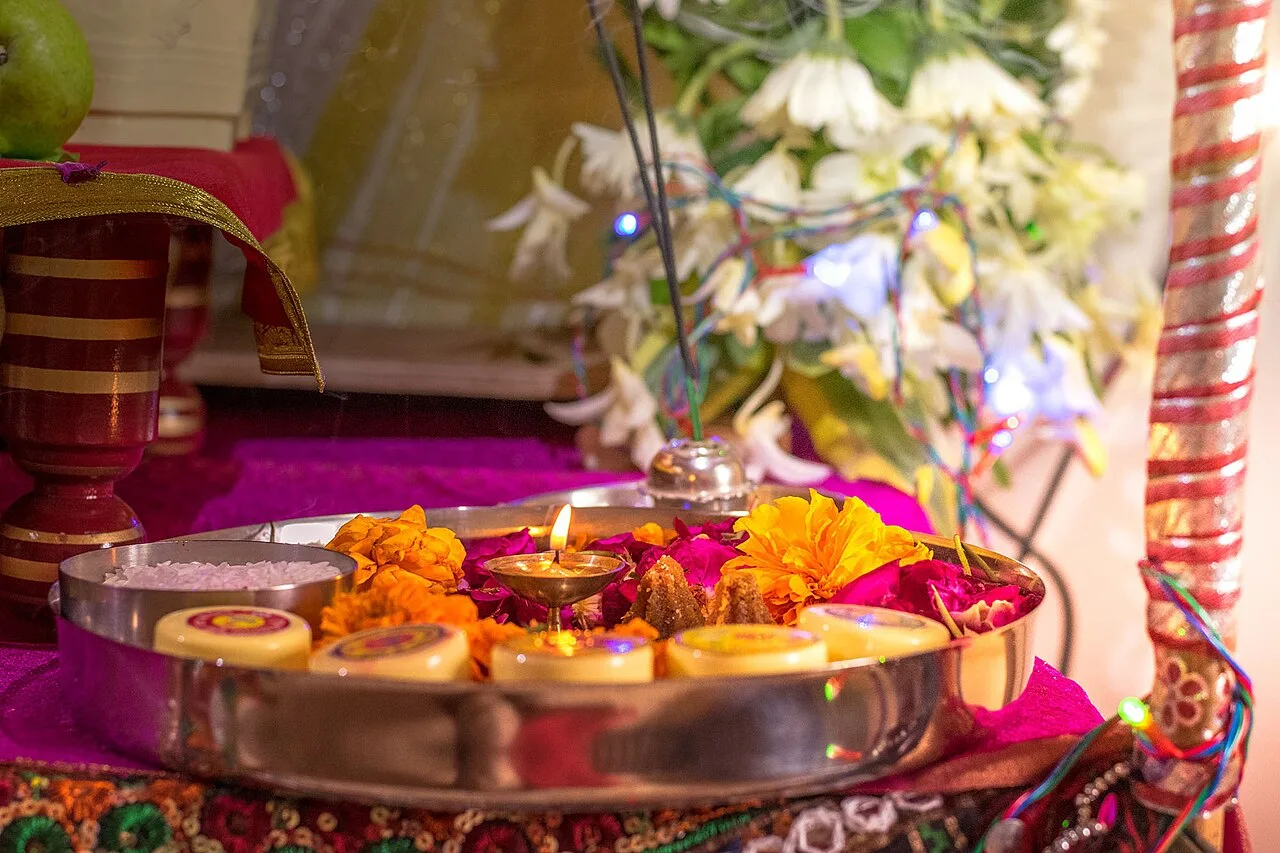
Puja thali
Offerings
Silver Ahoi (optional)
तैयारी Before you begin
- Bathe at dawn, put on clean clothes and take the sankalp for your children's long life and health.
- Choose a clean wall that faces north or east for the Ahoi drawing.
- Keep a lota of water on a seat of leaves or a pata where the katha will be told.
- Tell the family that the meal for the evening waits until the stars are seen.
- Keep the arghya water ready before sunset.
पूजा विधि Step by step
आचमन Achaman, sipping water to purify
about 2 minutes
Sit on your asan facing east or north with a small cup (a copper or steel panchpatra if you have one) of clean water and a spoon. Pour a little water into your right palm and sip it three times, each time with one name of Vishnu, without a sound of slurping. Then wash the right palm, touch your lips, and touch water to the eyes, nose, ears and heart with the fingers, as your family does. Take only a small sip each time, not a mouthful. Do it before sankalp, and again whenever you leave the seat and return.
ॐ केशवाय नमः। ॐ नारायणाय नमः। ॐ माधवाय नमः।
Om Keshavaya namah. Om Narayanaya namah. Om Madhavaya namah.
Meaning: Salutations to Keshava, Narayana and Madhava, three names of Vishnu, one for each sip. Many Vedic households say 'svaha' in place of 'namah' for these three sips, and the Sandhya text does the same.
ॐ गोविन्दाय नमः
Om Govindaya namah
Meaning: A fourth name of Vishnu, said as the hand is washed after the three sips.
प्रातः संकल्प Morning sankalp
about 5 minutes
After the bath, stand before the family deity with a little water and akshat in your palm. Say in your own words that you keep the Ahoi Ashtami fast for the long life and wellbeing of your children, then let the water drop into a plate. No standard Sanskrit sankalp could be confirmed across two sources, so speak simply and with devotion. The day is spent without food.
अहोई माता का चित्र Drawing Ahoi Mata on the wall
about 30 minutes
On a clean wall draw Ahoi Mata with geru or kumkum. The picture is usually an eight-cornered shape (aath kone) with a porcupine called seh and her young ones beside it. Some families embroider the same design on thick cloth and hang it, while others use a printed picture. Plaster the floor in front with gobar if you can, or wipe it with water.
कलश की स्थापना Water lota and kalash
about 5 minutes
Put a kalash or a lota filled with water at the base of the picture, with a cloth around its neck and a small cup of rice beside it. This water is later poured as arghya, so keep it covered. Place the karwa you will use for arghya near it.
गणेश-गौरी स्मरण / आवाहन Ganesh and Gauri invocation at the start
about 5 minutes
Every puja begins by remembering Ganesh so that no obstacle comes in the way, with Gauri (Parvati) beside him. Place a small mound of rice or a betel nut wrapped with red thread (moli) on a leaf or a small plate as Ganesh, and a second smaller one as Gauri. If you have a Ganesh murti, use that. Bow, offer a little water, a dot of roli or sandal, rice and a flower to each, and pray that they stay till the puja is finished. When the main puja is over, offer them water again and say they may go where they please.
वक्रतुण्ड महाकाय सूर्यकोटि समप्रभ। निर्विघ्नं कुरु मे देव सर्वकार्येषु सर्वदा॥
Vakratunda mahakaya suryakoti samaprabha. Nirvighnam kuru me deva sarvakaryeshu sarvada.
Meaning: O curved-trunked, large-bodied one with the brilliance of a crore suns, make all my works free from obstacles, always. This is the Ganesh smaran verse already on our bhajan pages. For the avahan (invitation) proper, families use different verses, so recite the Ganesh verse of your own household.
अहोई माता का पूजन Evening worship of Ahoi Mata
about 15 minutes
At dusk, a ghee diya burns in front of the picture. Offer roli, akshat, flowers and fruit. Ahoi Mata is seen here as a form of Parvati. The silver Ahoi is worshipped with roli, akshat, milk and cooked rice. Offer doodh-chawal as the main bhog, then halwa-puri.
कथा Hearing the katha
about 20 minutes
Take seven grains of wheat and a coin in your palm and sit with the other women to hear the katha. In the best known tale, a merchant's wife kills a seh's young one with her spade while digging clay, and her seven sons then die one by one. The elders tell her to atone with a fast on this Ashtami and a picture of the seh, and she is blessed again with sons. Another tale tells of Chandrabhan and his wife in Datia, who fasted by a kund near Badrikashram after losing every child, and were told by a voice to keep this vrat.
सेह की माला Silver seh and the string
about 5 minutes
If your family has a silver Ahoi, it is worshipped and then strung with moli. Many women add a new silver bead or coin each year, and the string is worn around the neck after the katha and till Diwali, when it is opened and put away. Skip this step if your house has no such practice.
बड़ों का आशीर्वाद Elders' blessing
about 3 minutes
After the puja touch the feet of the senior woman of the house, and ask for her blessing for your children. Give her a small gift of sweets if possible.
तारों को अर्घ्य Arghya to the stars
about 5 minutes
When the first stars are seen in the evening sky, pour water from the karwa in a thin stream towards them with folded hands. Many guides give a time about an hour after sunset. In some homes the moon is also offered water, but moonrise on this night is very late, so the stars are the usual sign to close the fast.
व्रत पारण Breaking the fast
about 20 minutes
Take the prasad of doodh-chawal first, then eat the evening meal. Many homes cook puri, halwa and a seasonal vegetable. Give a portion of the food, uncooked wheat or money to a needy person or to a cow if you can.
उद्यापन Udyapan, when the vow is closed
about 30 minutes
A mother whose son has been married, or who has kept the vrat for many years, may close it with udyapan. Lay out seven places on a thali with four puris each and some halwa, add a yellow saree, a blouse piece and money, and give it to the senior woman. She keeps the clothes and shares the food with the neighbours, or sends it to a daughter's house.
आरती विधि How to do aarti
about 5 minutes
Aarti comes near the end of the puja, after the offerings. Stand in front of the deity with a thali holding a ghee lamp (or camphor), a small bell, a flower and a little water. Ring the bell with the left hand and wave the thali with the right, always clockwise: in front of the deity, the thali goes from your left to your right in a full circle. Many households do about four circles at the feet, two at the navel or belly, one at the face and then seven or so around the whole form, going from feet upward. Sources do not agree on these counts, so follow your family; the clockwise circle is the part all agree on. Camphor is lit last and waved the same way, and one verse (karpur-gauram or the nirajan verse) is said while it burns. Sing the aarti of the deity with everyone, clapping softly in time. Then take the aarti: hold your hands over the flame and touch them lightly to your eyes and forehead, and pass the thali to others. Walk once round the deity clockwise and bow. Afterwards set the lamp back in the shrine; whether it burns on or is put out gently depends on your family custom, and a lamp that goes out in the middle can simply be relit.
कदलीगर्भसम्भूतं कर्पूरं तु प्रदीपितम्। आरार्तिकमहं कुर्वे पश्य मे वरदो भव॥
Kadali-garbha-sambhutam karpuram tu pradipitam. Aratikam aham kurve pashya me varado bhava.
Meaning: Camphor born from the heart of the plantain, now lit, I wave in aarti: look on me and be a giver of boons. Two drikpanchang pages give the first line as 'kadali-garbha-sambhutam karpuram tu pradipitam'; the second line is as it is commonly printed.
क्षमा प्रार्थना / पूजा समापन Kshama prarthana, asking forgiveness and closing
about 3 minutes
At the very end, after aarti and pradakshina, stand or sit with folded hands and ask pardon for every lack in the puja: wrong words, missed steps, thin devotion. This is not a formality; it is said that even a puja done with errors becomes complete by this prayer. Then offer a little water and flowers, say 'sarvam shri bhagavat arpanam' (all this is offered to the Lord), and take the water on the kalash as prasad. Do not rush away; sit a minute in silence. Close by saying the deity may go where he or she pleases (utthapan or visarjan) only if you called the deity into a fresh murti. A home murti or picture that lives on your altar is not sent away: you only bow and cover the offerings.
आवाहनं न जानामि न जानामि विसर्जनम्। पूजां चैव न जानामि क्षमस्व परमेश्वर॥ मन्त्रहीनं क्रियाहीनं भक्तिहीनं सुरेश्वर। यत्पूजितं मया देव परिपूर्णं तदस्तु मे॥
Avahanam na janami na janami visarjanam. Pujam chaiva na janami kshamasva Parameshvara. Mantra-hinam kriya-hinam bhakti-hinam Sureshvara. Yat pujitam maya deva paripurnam tad astu me.
Meaning: I do not know how to invite you, how to send you off, or how to worship; forgive me, O Supreme Lord. Whatever I have worshipped with lack of mantra, lack of action and lack of devotion, O Lord of the gods, let it be made complete. Two sources agree on this pair of verses; one prints 'tava archanam' (your worship) in the first line in place of 'pujam'.
आरती और विसर्जन Aarti and closing
After the katha, wave the thali flame before the Ahoi picture and sing the Ahoi Mata aarti of your house, or a Devi aarti in its place. Then pass the flame to all the women present.
The wall drawing stays until Diwali in many homes and is then wiped off or covered with the Diwali whitewash. The silver Ahoi on its string is taken off at Diwali and kept safe for the next year. The leftover doodh-chawal is given to the family as prasad and nothing is thrown away.
क्या करें · Do
- Keep the arghya water covered until the stars show.
- Draw the picture only on a clean wall.
- Listen to the katha with grains in your palm.
- Be gentle with animals on this day, since the katha is about a seh.
- Seek elders' blessing after the puja.
क्या न करें · Avoid
- Do not dig the earth with a spade, nail or sharp tool on this day: the katha warns about it.
- Do not eat or drink before the stars are seen.
- Do not argue at home.
- Do not skip the katha because the evening is busy.
परंपराएँ Variations and Braj
- The picture is called Ahoi or Ahoi Aathe in different houses, because Ashtami is the eighth day and the shape has eight corners.
- Families with a daughter only often keep the vrat for all children, though the old texts speak of sons.
- Where a silver Ahoi is kept, a coin or bead is added each year and the string is worn until Diwali.
- Some homes show the moon too for arghya, but the usual practice is to wait for the stars.
- In Braj, this same Ashtami midnight is the great Radha Kund snan of couples, apart from the mothers' fast.
For seekers in Braj, Ahoi Ashtami night is the famous Radha Kund snan at Govardhan. Couples who long for a child bathe in Radha Kund at midnight, and couples whose wish was granted come back to give thanks. Thousands arrive and the bathing runs through the night, with the main Nishita window from about midnight. Couples stand in the water, offer a white pumpkin (kushmanda or petha) dressed in red cloth, and pray to Radha Rani. This is in addition to the mothers' fast and not a part of the home puja. Expect crowds and plan your trip a day ahead.
If you want to be at Radha Kund for the midnight bath, Laladham can pick you up in Delhi and look after the whole trip, from the drive to Govardhan to your stay and return. Plan this trip
प्रश्न Questions, answered
At what time can I open the Ahoi Ashtami fast?
At the first stars after sunset, about an hour or so later in most cities. Moonrise comes very late that night, so the moon does not decide the timing. A local panchang gives the time.
Is Ahoi Ashtami kept without water?
Most mothers go hungry and thirsty all day, opening at star sighting. If you are unwell or pregnant, follow your doctor and still join the puja.
Who is Ahoi Mata?
Ahoi Mata is the protector of children, understood as Parvati. The picture shows a seh, a porcupine, with young ones.
Can I keep the fast for daughters too?
Many families keep it for every child, sons and daughters alike. Ask your elders what your house follows.
What is the Radha Kund bath on Ahoi Ashtami?
At midnight on the Ahoi Ashtami night, couples take a dip together at Govardhan, near Mathura, hoping for a child. Those whose wish came true return to give thanks.
How is it different from Karwa Chauth?
Karwa Chauth is for the husband and ends with moon sighting. Ahoi Ashtami is for children and the fast opens at star sighting. Both fall in Kartik Krishna Paksha.
कुल की परंपरा सर्वोपरि है। Where your family custom differs, follow it, and ask your priest when in doubt.
Check locally
- Star-sighting time and puja muhurat for your city on drikpanchang.com.
- Whether your family keeps a silver Ahoi and a string, and when it is opened.
- Which katha your house reads, and whether the vrat is kept for all children.
- Radha Kund snan midnight window and crowd arrangements for the year, before you travel.
- No standard Sanskrit sankalp or mantra could be confirmed from two sources, so none is given.
व्रत कथा Read the katha
Doing this in Braj? Seekers often bring a puja to Vrindavan, Govardhan or Mathura. A Laladham driver who knows the ghats and the timings is one message away.
Plan my trip