Durga · पर्व और त्योहार
घर पर दुर्गा पूजा
Durga Puja at Home during Navratri
A household way to keep the nine days: daily Durga puja, Saptashati path, kanya pujan, and a closing havan. What is firm, and what to ask your priest.
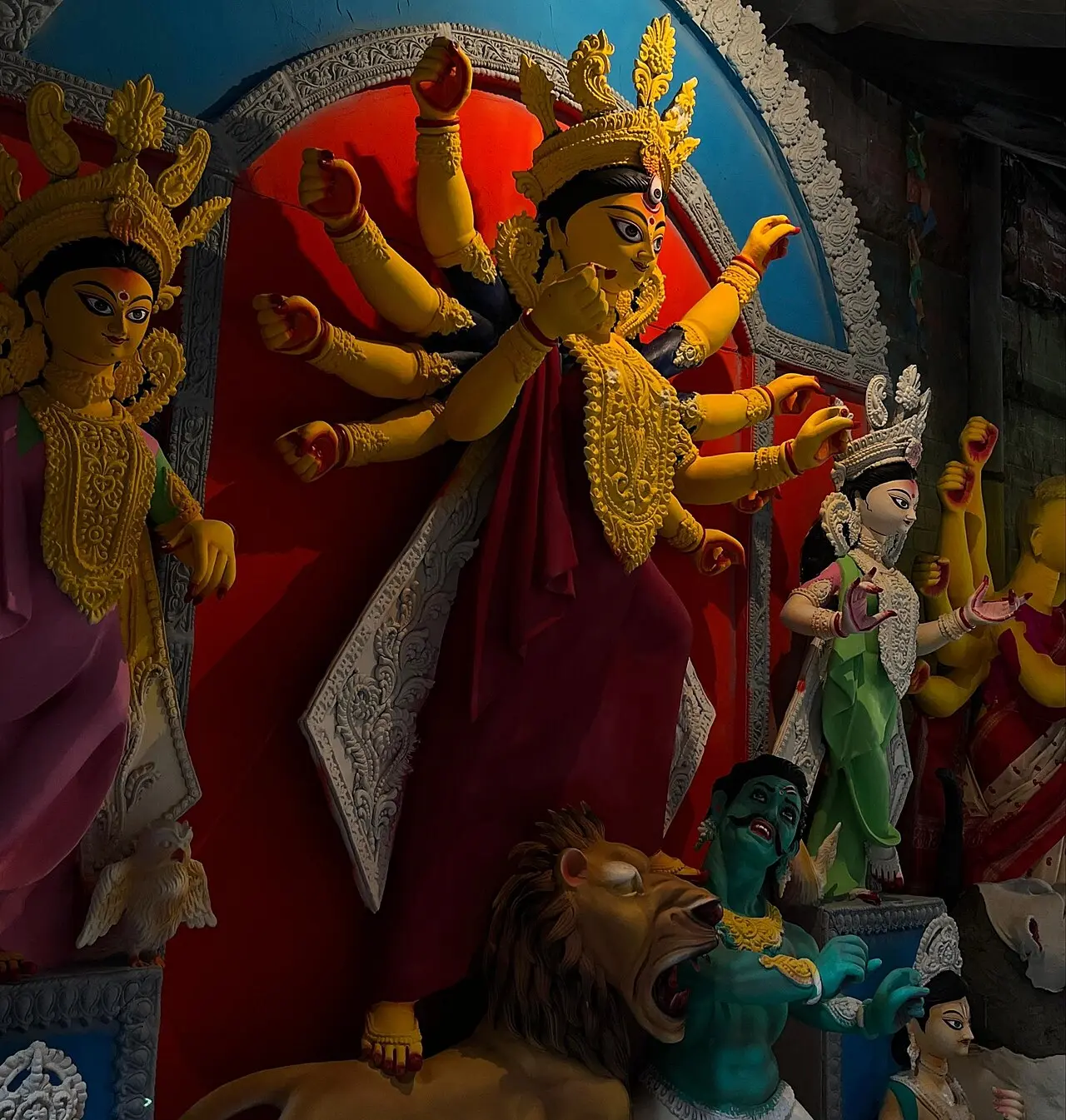
Daily from Pratipada to Navami in Chaitra or Ashwin, with girls honoured on Ashtami or Navami and a closing fire on the last day. Use a panchang for your city for the exact tithi change, because Ashtami and Navami can fall together in some years.
Any household member. Anyone reading the Saptashati should be bathed and quiet in mind. Those who fast keep it by their own capacity and health.
about 45 minutes daily; kanya pujan and havan about 2 hours
सामग्री Samagri checklist
Daily thali
Saptashati path
Kanya pujan
Havan
तैयारी Before you begin
- Clean the place of worship and wipe her image. Place the Saptashati in the east, on a stand with a red cloth.
- Decide before day one how you will read: all thirteen chapters in nine days, or in one, three or seven sittings. The sources list all of these.
- Bathe, wear clean clothes, and sit facing east or north.
- Ask the girls' families beforehand if you plan kanya pujan, and fix a time.
- Keep the home free of meat, alcohol, onion and garlic during the nine days, the usual rule for this vrat.
पूजा विधि Step by step
आचमन Achaman, sipping water to purify
about 2 minutes
Sit on your asan facing east or north with a small cup (a copper or steel panchpatra if you have one) of clean water and a spoon. Pour a little water into your right palm and sip it three times, each time with one name of Vishnu, without a sound of slurping. Then wash the right palm, touch your lips, and touch water to the eyes, nose, ears and heart with the fingers, as your family does. Take only a small sip each time, not a mouthful. Do it before sankalp, and again whenever you leave the seat and return.
ॐ केशवाय नमः। ॐ नारायणाय नमः। ॐ माधवाय नमः।
Om Keshavaya namah. Om Narayanaya namah. Om Madhavaya namah.
Meaning: Salutations to Keshava, Narayana and Madhava, three names of Vishnu, one for each sip. Many Vedic households say 'svaha' in place of 'namah' for these three sips, and the Sandhya text does the same.
ॐ गोविन्दाय नमः
Om Govindaya namah
Meaning: A fourth name of Vishnu, said as the hand is washed after the three sips.
दीप प्रज्वलन Lighting the lamp
about 5 minutes
In the morning, put the ghee lamp in front of the image of Devi and light it. Offer roli and akshat to the picture and the kalash, tie a fresh moli on the kalash if needed, and offer a red flower.
देवी ध्यान Meditation on Devi
about 2 minutes
Close your eyes for a moment and picture Durga seated on a lion, with weapons in her hands. Then ask her to accept your daily worship. A short prayer in your own words is fine.
कवच पाठ Reading the Devi Kavach first
about 10 minutes
Read the Durga Kavach before the Saptashati itself. A well-known belief says the Saptashati should not be started without it. Read slowly and clearly, since drikpanchang notes that the text is meant to be said aloud.
सप्तशती पाठ Durga Saptashati path
about 30 to 90 minutes
The Saptashati has 700 verses in 13 chapters in three parts: first, middle and final episode. Read the portion you chose for today. Many printed editions also give the Argala, Keelak and Ratri Suktam before the chapters, and Navarna mantra japa within the path. Their exact order differs by tradition, so follow the order of the book you use.
आरती और क्षमा Aarti and forgiveness
about 10 minutes
When the day's reading is done, do the aarti with camphor and ask Devi to forgive any slip in pronunciation or counting. Offer batasha as bhog and share it.
अष्टमी या नवमी की तैयारी Preparing for Ashtami or Navami
about 1 hour
On the day before, wash the pots, buy the puri and chana ingredients and plan the halwa. Make the food fresh on the day without tasting it first. Offer a portion to Devi before the girls eat.
कन्या स्वागत Welcoming the girls
about 20 minutes
Ask the girls to sit on clean seats. Gently wash their feet with water and dry them with a clean cloth. In the same way wash the boy's feet first, since he stands in for Bhairava. Give each girl a tilak of roli and akshat, tie moli on the wrist and offer a flower.
कन्या भोज Serving the girls
about 30 minutes
Serve puri, black chana and halwa with love and without hurry. The usual number is nine, one per Navadurga. If you cannot find nine, fewer is accepted, and one source says that feeding a cow for the missing ones is also counted as good.
उपहार और विदाई Gifts and farewell
about 10 minutes
After the meal give fruit, clothes, toys or a small dakshina. Touch the girls' feet and see them to the door with respect, as you would a guest of the house.
हवन Havan
about 45 minutes
Many families perform havan on Navami to close the nine days, and those who keep the nine-day fast break it when havan, worship and the girls' meal are over. Light the fire in the kund with mango wood and camphor. Offer ghee, sesame and barley with the mantras of your priest or your Saptashati edition. Close with a purnahuti of coconut. Since sources here do not give one fixed set of mantras, a priest's guidance matters most on this step.
क्षमा प्रार्थना / पूजा समापन Kshama prarthana, asking forgiveness and closing
about 3 minutes
At the very end, after aarti and pradakshina, stand or sit with folded hands and ask pardon for every lack in the puja: wrong words, missed steps, thin devotion. This is not a formality; it is said that even a puja done with errors becomes complete by this prayer. Then offer a little water and flowers, say 'sarvam shri bhagavat arpanam' (all this is offered to the Lord), and take the water on the kalash as prasad. Do not rush away; sit a minute in silence. Close by saying the deity may go where he or she pleases (utthapan or visarjan) only if you called the deity into a fresh murti. A home murti or picture that lives on your altar is not sent away: you only bow and cover the offerings.
आवाहनं न जानामि न जानामि विसर्जनम्। पूजां चैव न जानामि क्षमस्व परमेश्वर॥ मन्त्रहीनं क्रियाहीनं भक्तिहीनं सुरेश्वर। यत्पूजितं मया देव परिपूर्णं तदस्तु मे॥
Avahanam na janami na janami visarjanam. Pujam chaiva na janami kshamasva Parameshvara. Mantra-hinam kriya-hinam bhakti-hinam Sureshvara. Yat pujitam maya deva paripurnam tad astu me.
Meaning: I do not know how to invite you, how to send you off, or how to worship; forgive me, O Supreme Lord. Whatever I have worshipped with lack of mantra, lack of action and lack of devotion, O Lord of the gods, let it be made complete. Two sources agree on this pair of verses; one prints 'tava archanam' (your worship) in the first line in place of 'pujam'.
आरती और विसर्जन Aarti and closing
On each of the nine days do the aarti at the end of the path. Light camphor on the plate, move it in a clockwise circle before the Devi image, ring a bell, and sing the Durga aarti of your family. On Navami do it again after the havan.
After Navami, the kalash and barley are handled as your Pratipada rite directed. Ash is kept in a clean cloth or mixed into a plant pot, not thrown on the road. Flowers go to running water or a plant bed. Wrap the Saptashati in red cloth and shelve it high.
क्या करें · Do
- Keep the body and mind clean through the nine days.
- Read the Kavach before the Saptashati.
- Feed the girls with respect and keep the food fresh.
- Keep to the same time of day for the path.
क्या न करें · Avoid
- Do not keep ill will towards anyone while reading, as one source says directly.
- Do not taste the bhog before it is offered.
- Do not invite girls who are not comfortable, and never force a child to stay.
- Do not keep meat, alcohol, onion or garlic in your meals on these days.
परंपराएँ Variations and Braj
- In much of north India kanya pujan is on Ashtami; in other homes it is on Navami. Some families do it on Saptami or on every day of the nine.
- Bengal's Durga Puja runs from Shashthi to Dashami at pandals and is a different tradition from the home Navratri puja of the north.
- Some families split the Saptashati by day in a fixed way, others read it fully in one day. The traditions named in the sources include the Tryangam and Navangam methods.
- Gujarat keeps the nine nights with garba around a lamp and kalash, while a Devi path is optional.
- South Indian homes may arrange golu steps with dolls during the nine nights.
Braj is Krishna's land, yet Devi is part of his story: the baby girl exchanged for Krishna in Gokul is remembered as Yogamaya. Ask a local priest which Devi shrine near you is kept busy during Navratri.
प्रश्न Questions, answered
Do I have to read the whole Durga Saptashati?
No. The sources allow the whole text in one day or across nine days, and mention methods that spread it over one, three or seven sittings. Choose what you can complete with clear pronunciation. Ask a priest if you want a short form.
How many girls should I call for kanya pujan?
Nine is usual. Fewer is fine. Some homes call up to eighteen. The girls are generally between two and ten years old.
Ashtami or Navami for kanya pujan?
Either. It follows the worship of Mahagauri on Ashtami or Siddhidatri on Navami. Your family custom decides.
Why is a boy invited as well?
He is taken as Bhairava and honoured first. Not all families follow this.
When do I break the nine-day fast?
Sources say once the fire rite and the feeding of girls are done, normally on Navami or as your family practises. Confirm with a panchang whether Navami ends early.
Can women read the Saptashati during their periods?
Customs on this differ widely by family and by teacher. Ask your own elders or priest. This page does not give a ruling.
कुल की परंपरा सर्वोपरि है। Where your family custom differs, follow it, and ask your priest when in doubt.
Check locally
- The exact order of Kavach, Argala, Keelak, Ratri Suktam, Navarna japa and chapters in your edition and tradition.
- Havan mantras and offerings: ask your family priest, since no single set is confirmed here.
- Whether Ashtami and Navami fall on the same day in your panchang this year.
- Your family's rule on who may read the Saptashati and when.
व्रत कथा Read the katha
Doing this in Braj? Seekers often bring a puja to Vrindavan, Govardhan or Mathura. A Laladham driver who knows the ghats and the timings is one message away.
Plan my trip