Saraswati · पर्व और त्योहार
सरस्वती पूजा
Saraswati Puja on Vasant Panchami
Welcome spring and ask Saraswati for clear speech and a steady mind: yellow offerings, books and pens at her feet, and a simple morning puja for the whole family.
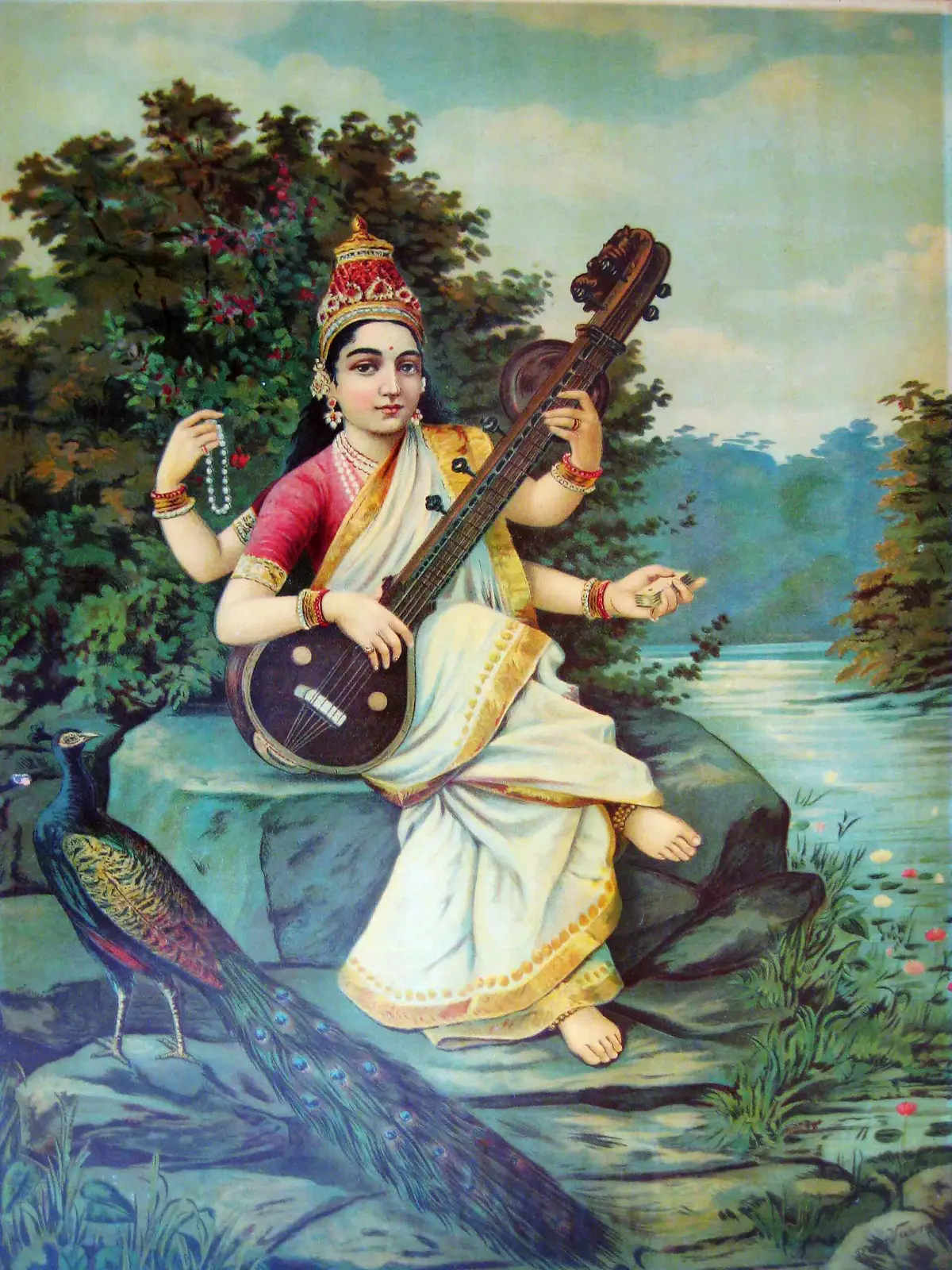
On Vasant Panchami, the fifth tithi of Shukla Paksha in the month of Magha, in the morning, as long as Panchami runs. Dates move each year, so check a panchang (drikpanchang.com) for your city. One source notes that there is no strict hour, but the morning is considered ideal.
Everyone. Students, teachers, musicians, writers and parents who want to begin a child's first letters. Children can do the offerings themselves.
about 45 minutes
सामग्री Samagri checklist
Seat and image
Puja thali
Offerings
Learning tools
तैयारी Before you begin
- Rise early. Bathe and wear clean clothes, yellow if you have them.
- Clean the house, and tidy the shelf or table where books are kept so that the tools of study can be placed with care.
- Set the picture of Saraswati facing east, if the room allows, and make a small kalash with a coconut on mango leaves if your family does that.
- Cook the yellow sweet before the puja so that it can be offered fresh.
पूजा विधि Step by step
आचमन Achaman, sipping water to purify
about 2 minutes
Sit on your asan facing east or north with a small cup (a copper or steel panchpatra if you have one) of clean water and a spoon. Pour a little water into your right palm and sip it three times, each time with one name of Vishnu, without a sound of slurping. Then wash the right palm, touch your lips, and touch water to the eyes, nose, ears and heart with the fingers, as your family does. Take only a small sip each time, not a mouthful. Do it before sankalp, and again whenever you leave the seat and return.
ॐ केशवाय नमः। ॐ नारायणाय नमः। ॐ माधवाय नमः।
Om Keshavaya namah. Om Narayanaya namah. Om Madhavaya namah.
Meaning: Salutations to Keshava, Narayana and Madhava, three names of Vishnu, one for each sip. Many Vedic households say 'svaha' in place of 'namah' for these three sips, and the Sandhya text does the same.
ॐ गोविन्दाय नमः
Om Govindaya namah
Meaning: A fourth name of Vishnu, said as the hand is washed after the three sips.
स्थान शुद्धि Clearing and setting the seat
about 5 minutes
Wipe the picture of Saraswati and place it on the yellow cloth. Put a small mound of akshat in front of it. Place the books, pens and instruments close by on a clean cloth, not on the floor.
संकल्प Sankalp, the vow of intent
about 3 minutes
Sit facing east or north. In your right palm take water, a few whole rice grains (akshat), a flower and, if you like, a coin. Hold your right wrist with your left hand. Say the sankalp slowly: it names the cosmic time, the place, the Hindu year, month, fortnight, tithi, weekday and nakshatra, then your gotra, your name and the puja you are about to do. Where the blanks below say 'अमुक', fill your own details; for the panchang parts use a panchang for your city. At the end let the water fall on the ground or into a copper plate, then begin the puja. If you do not know your gotra, many priests say to use 'Kashyap' as the gotra of an unknown line; confirm this with your family priest.
ॐ विष्णुः विष्णुः विष्णुः। अद्य ब्रह्मणो द्वितीये परार्धे श्रीश्वेतवाराहकल्पे वैवस्वतमन्वन्तरे अष्टाविंशतितमे कलियुगे कलिप्रथमचरणे जम्बूद्वीपे भरतवर्षे भरतखण्डे अमुकदेशे अमुकनामसंवत्सरे अमुकमासे अमुकपक्षे अमुकतिथौ अमुकवासरे अमुकगोत्रोत्पन्नः अमुकनामाहं अमुकपूजनं करिष्ये।
Om Vishnur Vishnur Vishnuh. Adya Brahmano dvitiye parardhe Shri-Shvetavarahakalpe Vaivasvatamanvantare ashtavimshatitame Kaliyuge Kaliprathamacharane Jambudvipe Bharatavarshe Bharatakhande amuka-deshe amuka-nama-samvatsare amuka-mase amuka-pakshe amuka-tithau amuka-vasare amuka-gotrotpannah amuka-namaham amuka-pujanam karishye.
Meaning: Vishnu, Vishnu, Vishnu. Today, in the second half of Brahma's life, in the Shveta-Varaha kalpa, in the Vaivasvata manvantara, in the 28th Kali yuga, in its first quarter, in Jambudvipa, Bharata-varsha, Bharata-khanda, in this place, in this named year, month, fortnight, tithi and weekday, I of this gotra and this name will perform this puja. This is the commonly given template: the cosmic-time lines agree in the sources we read, but the wording differs a little between books (one source says 'second half of the second watch' in place of 'second half of Brahma's life'), and a puja often adds a line naming the wish, such as long life, health or prosperity. Use the line your priest gives.
Say that you are worshipping Saraswati on Vasant Panchami for wisdom, good speech and success in learning.
कलश Kalash
about 5 minutes
Fill a small kalash with water, place mango leaves in the mouth and a coconut on top. Tie moli at the neck. Keep it to the right side of the picture.
तिलक और पुष्प Tilak and flowers
about 5 minutes
Apply a small tilak of kumkum and haldi to the picture, and offer yellow flowers. Sprinkle a little water over them. These two steps are the common ones in the guides.
दीप धूप Lamp and incense
about 3 minutes
Light the diya and incense and show them to the goddess. Keep your hands folded for a moment and ask for steady attention in study.
सरस्वती वंदना Saraswati vandana
about 5 minutes
Sing or read the well-known Saraswati vandana, the one that praises her as white as jasmine and the moon, seated on a white lotus with a veena in her hands. The text is left off this page because its wording could not be matched across two sources here. Use a printed book, or say a short prayer in your own words.
पुस्तक और वाद्य पूजन Worship of books, pens and instruments
about 5 minutes
Place a dot of haldi or kumkum on a few books, a pen and each musical instrument. Leave them near the goddess until the puja ends. The guides add a warning: never treat books or instruments with disrespect, and do not step over them.
नैवेद्य Naivedya
about 5 minutes
Offer the yellow sweet and fruit on a clean plate with betel leaf and supari beside it. Touch water to the plate's edge and fold your hands.
आरती विधि How to do aarti
about 5 minutes
Aarti comes near the end of the puja, after the offerings. Stand in front of the deity with a thali holding a ghee lamp (or camphor), a small bell, a flower and a little water. Ring the bell with the left hand and wave the thali with the right, always clockwise: in front of the deity, the thali goes from your left to your right in a full circle. Many households do about four circles at the feet, two at the navel or belly, one at the face and then seven or so around the whole form, going from feet upward. Sources do not agree on these counts, so follow your family; the clockwise circle is the part all agree on. Camphor is lit last and waved the same way, and one verse (karpur-gauram or the nirajan verse) is said while it burns. Sing the aarti of the deity with everyone, clapping softly in time. Then take the aarti: hold your hands over the flame and touch them lightly to your eyes and forehead, and pass the thali to others. Walk once round the deity clockwise and bow. Afterwards set the lamp back in the shrine; whether it burns on or is put out gently depends on your family custom, and a lamp that goes out in the middle can simply be relit.
कदलीगर्भसम्भूतं कर्पूरं तु प्रदीपितम्। आरार्तिकमहं कुर्वे पश्य मे वरदो भव॥
Kadali-garbha-sambhutam karpuram tu pradipitam. Aratikam aham kurve pashya me varado bhava.
Meaning: Camphor born from the heart of the plantain, now lit, I wave in aarti: look on me and be a giver of boons. Two drikpanchang pages give the first line as 'kadali-garbha-sambhutam karpuram tu pradipitam'; the second line is as it is commonly printed.
प्रसाद वितरण Sharing prasad
about 5 minutes
Give the prasad first to the youngest in the house, then to the elders. Eat the prasad before the day's meal if you are fasting till the puja. Parents may use the day to begin a toddler's first letters, a custom that is a family choice.
आरती और विसर्जन Aarti and closing
Show a ghee lamp or camphor in a clockwise circle before the picture while the family sings the Saraswati aarti of your home or a simple prayer. Bring the palms to the flame and touch the eyes. Ring a bell softly. Then offer the pushpanjali of yellow flowers.
Leave the books and instruments near the goddess for the rest of the morning or for the day, depending on your family. Do not open textbooks for fresh study on the puja day in the homes that keep that custom. Put flowers into running water or the soil of a plant. Keep the picture in its place and the kalash water for sprinkling around the home.
क्या करें · Do
- Wear clean, preferably yellow clothes.
- Offer yellow flowers and sweets.
- Handle books, pens and instruments with respect.
- Do the puja in the morning, as long as Panchami runs.
क्या न करें · Avoid
- Do not step over a book or let it fall on the ground.
- Do not offer food that has already been tasted.
- Do not skip cleaning the place of worship.
- Do not rush the puja before an exam; sit calmly for a few minutes first.
परंपराएँ Variations and Braj
- In Bengal, Odisha and Assam it is called Saraswati Puja, with a clay idol set in a pandal and children placing their first letters before the goddess.
- In many north Indian homes, the puja is small and at home, with yellow clothes and yellow rice.
- In some families the first letters are written in rice or in a tray of grain with a child's finger. This is called Vidyarambh, and you should ask your own priest for the exact rite.
- Dates in southern states may be tied to Navratri, where Saraswati Puja falls on one of the final days of the nine nights.
In Braj, Vasant Panchami also brings spring into the temples, and Thakurji is dressed in yellow. Seekers around Vrindavan on this day find the shrines decked with yellow flowers. Check the Banke Bihari temple's own notice for darshan hours before your trip.
प्रश्न Questions, answered
Why is yellow so important on Vasant Panchami?
Yellow marks the spring, with mustard fields in bloom. Guides ask devotees to wear yellow, offer yellow flowers like marigold and make yellow sweets like kesari bhaat or boondi laddu.
Why do we keep books and pens near Saraswati?
Students offer their books, notebooks, pens and instruments to seek her blessings on the tools of their learning. Handle them with respect and never step over them.
What time is the puja done?
Early in the day, within Panchami tithi. One guide says there is no fixed hour, but morning is ideal. Ask a panchang for your city for the Panchami start and end.
Which mantra should I chant?
The guides ask for Saraswati mantras without giving a single fixed text. The best known is the Saraswati vandana that begins Ya Kundendu. Take its text from a printed book.
Can I do this puja without an idol?
Yes. A picture, or even a book placed on a yellow cloth with a lamp, is accepted in homes. What matters is the clean setting and devotion.
कुल की परंपरा सर्वोपरि है। Where your family custom differs, follow it, and ask your priest when in doubt.
Check locally
- The Panchami tithi start and end for your city, from a panchang (drikpanchang.com).
- The full Saraswati vandana text from a printed book. This page does not reproduce it because it was not verified across two sources.
- Whether your family keeps a Vidyarambh rite for a child on this day, and who conducts it.
- Whether you should keep textbooks closed after the puja, as some families do, or study as normal.
Doing this in Braj? Seekers often bring a puja to Vrindavan, Govardhan or Mathura. A Laladham driver who knows the ghats and the timings is one message away.
Plan my trip