Krishna · पर्व और त्योहार
अन्नकूट
Annakut
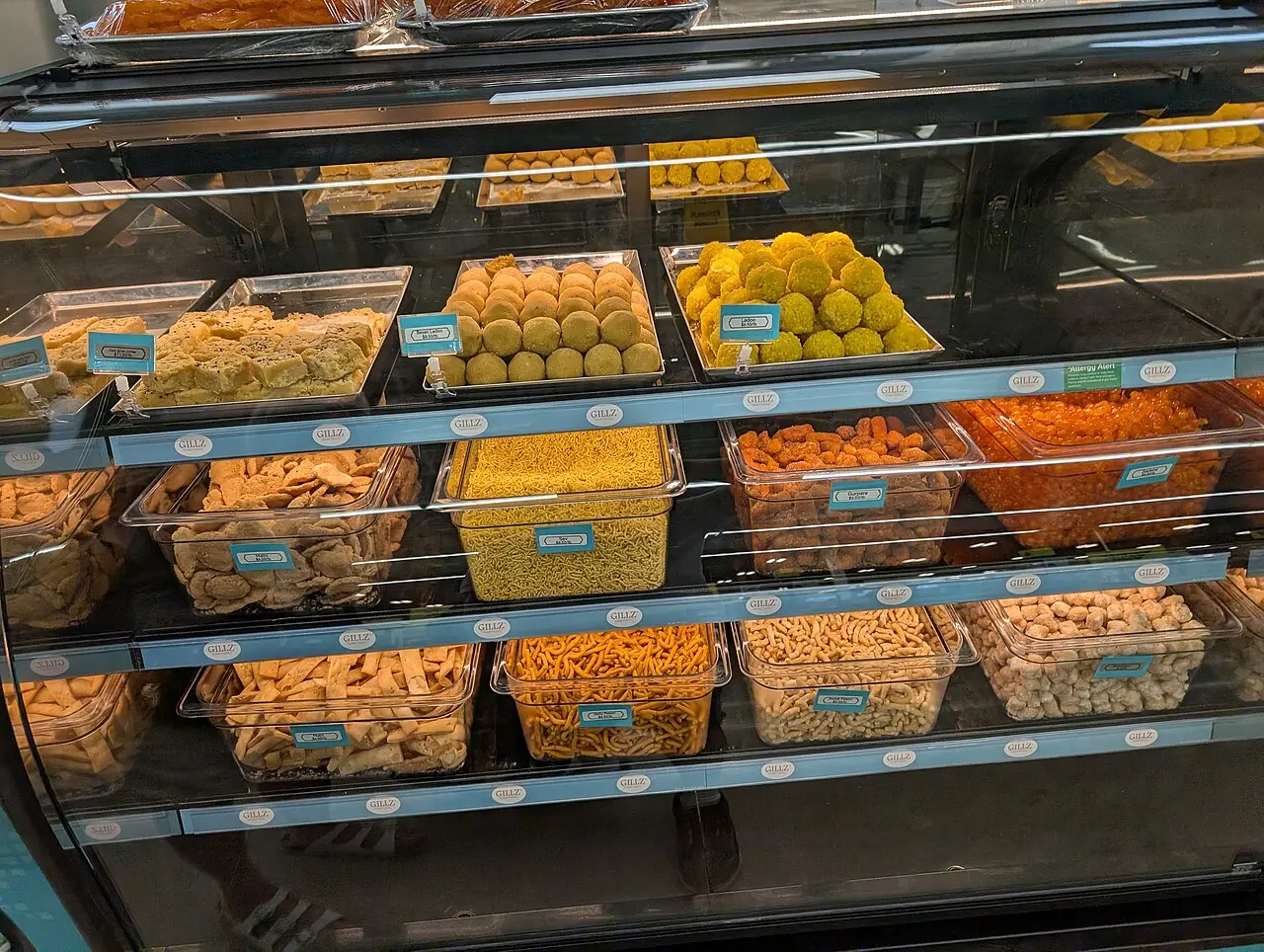
Annakut, the food-mountain laid before Krishna the day after Diwali: how a home lays it out, how temples do hundreds of dishes, and what chappan bhog means.
On Kartik Shukla Pratipada, together with Govardhan puja. In most homes and temples the food is arranged in the morning and offered before noon, and then shared as prasad. In some years Pratipada touches two days, so check a panchang (drikpanchang.com) for your city.
Any household. Temples, gaushalas and community kitchens do it on a large scale, and a family can do a small annakut at home with whatever it can cook with love.
about 1 hour to offer, with cooking time before
सामग्री Samagri checklist
The food
For the offering
Puja
तैयारी Before you begin
- Plan the menu a day ahead. Annakut means a heap of grain, so rice and wheat dishes come first.
- Cook everything without tasting it, keeping it clean for the offering.
- Bathe and put on clean clothes before you start.
- Clear a low table or a clean patch of floor in front of the home shrine.
- Keep tulsi leaves washed and ready.
पूजा विधि Step by step
आचमन Achaman, sipping water to purify
about 2 minutes
Sit on your asan facing east or north with a small cup (a copper or steel panchpatra if you have one) of clean water and a spoon. Pour a little water into your right palm and sip it three times, each time with one name of Vishnu, without a sound of slurping. Then wash the right palm, touch your lips, and touch water to the eyes, nose, ears and heart with the fingers, as your family does. Take only a small sip each time, not a mouthful. Do it before sankalp, and again whenever you leave the seat and return.
ॐ केशवाय नमः। ॐ नारायणाय नमः। ॐ माधवाय नमः।
Om Keshavaya namah. Om Narayanaya namah. Om Madhavaya namah.
Meaning: Salutations to Keshava, Narayana and Madhava, three names of Vishnu, one for each sip. Many Vedic households say 'svaha' in place of 'namah' for these three sips, and the Sandhya text does the same.
ॐ गोविन्दाय नमः
Om Govindaya namah
Meaning: A fourth name of Vishnu, said as the hand is washed after the three sips.
अन्न का पर्वत बनाना Shaping the mountain
about 20 minutes
Put the rice at the centre of a large thali or a clean cloth and pile it high so that it looks like a hill. Arrange the other dishes around it in layers, as a village around Govardhan. A symbolic Govardhan made of dung, mud or grain may stand beside it.
व्यंजन सजाना Laying out the dishes
about 15 minutes
Put one katori for each preparation and add a tulsi leaf to each. Place the sweets nearest the deity, then the cooked grains and vegetables, then the fruit. The count is up to you. A home can offer five or ten, the full 56, or more if the family wishes.
दीप और धूप Lamp and incense
about 5 minutes
Light the ghee lamp and incense. Mark Krishna with roli and akshat and offer a flower.
भोग अर्पण Offering the bhog
about 5 minutes
Fold your hands and say that this food is made for him, and that you are returning to him what he gave. Sprinkle a little water around the plate. Ring the bell once. Keep a short silence while he receives it.
भजन और कीर्तन Hymns
about 10 minutes
Sing Krishna hymns for ten minutes while the offering rests. In temples this is when kirtan is sung.
आरती विधि How to do aarti
about 5 minutes
Aarti comes near the end of the puja, after the offerings. Stand in front of the deity with a thali holding a ghee lamp (or camphor), a small bell, a flower and a little water. Ring the bell with the left hand and wave the thali with the right, always clockwise: in front of the deity, the thali goes from your left to your right in a full circle. Many households do about four circles at the feet, two at the navel or belly, one at the face and then seven or so around the whole form, going from feet upward. Sources do not agree on these counts, so follow your family; the clockwise circle is the part all agree on. Camphor is lit last and waved the same way, and one verse (karpur-gauram or the nirajan verse) is said while it burns. Sing the aarti of the deity with everyone, clapping softly in time. Then take the aarti: hold your hands over the flame and touch them lightly to your eyes and forehead, and pass the thali to others. Walk once round the deity clockwise and bow. Afterwards set the lamp back in the shrine; whether it burns on or is put out gently depends on your family custom, and a lamp that goes out in the middle can simply be relit.
कदलीगर्भसम्भूतं कर्पूरं तु प्रदीपितम्। आरार्तिकमहं कुर्वे पश्य मे वरदो भव॥
Kadali-garbha-sambhutam karpuram tu pradipitam. Aratikam aham kurve pashya me varado bhava.
Meaning: Camphor born from the heart of the plantain, now lit, I wave in aarti: look on me and be a giver of boons. Two drikpanchang pages give the first line as 'kadali-garbha-sambhutam karpuram tu pradipitam'; the second line is as it is commonly printed.
प्रसाद वितरण Sharing prasad
about 15 minutes
Cover the thali for a moment, then take a little of each dish and give it first to the elders and the children. Invite neighbours and anyone who cooks or cleans for your house. A part can be given to cows or a gaushala nearby.
सहभोज Eating together
about 30 minutes
The family sits down together and eats from the same offered food. In the old custom of the north, the whole meal was cooked in one kitchen and eaten as one family.
आरती और विसर्जन Aarti and closing
A Krishna aarti is sung with the ghee lamp in circles before the murti and the mountain of food. Some homes do the Giriraj aarti. The bell is rung at the end.
The food is shared as prasad on the same day. Leaves and clay plates are put in the compost or given to the cows. Nothing is thrown carelessly.
क्या करें · Do
- Cook fresh and offer before you eat.
- Give prasad to many, not only to your family.
- Keep the dishes covered and clean.
- Offer with love, in whatever number you can.
क्या न करें · Avoid
- Do not eat from the offered dishes before the offering.
- Do not taste while cooking for the bhog.
- Do not treat the number of dishes as a competition.
परंपराएँ Variations and Braj
- Braj and Vaishnav temples: the deity is offered a large annakut and the doors are open to everyone for darshan.
- Swaminarayan and ISKCON temples: hundreds to thousands of dishes are arranged, and kirtan and prasad follow.
- Swaminarayan temples arrange the annakut in the morning and finish before noon.
- Nathdwara is known for its own large annakut with milk baths for the deity. Ask the temple about its own seva.
- Homes in the north: a small Govardhan of dung or grain stands beside the food.
Annakut in Braj is tied to Govardhan, the hill whose lifting the festival remembers. The tradition of chappan bhog is said to come from the feast the gopis laid for Krishna after the seven days under the hill. One account links the idea of 56 bhog to eight prahars for seven days, and to the village of Aanyaur on the parikrama, but other accounts do not mention this, so take it as a local tradition. Temples in Mathura and Vrindavan open for annakut darshan through the day, and the schedule is fixed by each temple. On the hill itself, Govardhan puja is done every morning and evening near Daan Ghati, and at Mukharvind a large rock is offered milk.
Laladham can bring you from Delhi to Mathura, Vrindavan and Govardhan in one trip, so you can see annakut darshan in the temples of Braj without worrying about timings or the crowds. Plan this trip
Govardhan Hill and the Parikrama of about 21 kmDaan Ghati TempleMansi GangaJatipura (Mukharvind)
प्रश्न Questions, answered
What does annakut mean?
Anna is grain or food and kut is a heap or mountain. It is the heaped meal set before Krishna in memory of Govardhan.
What is chappan bhog?
Chappan means 56. It is the offering of 56 different dishes, drawn from the six tastes of bitter, pungent, astringent, sour, salty and sweet. Many places have no fixed limit now and offer 56 or even 108 items.
Do I need all 56 dishes at home?
No. A family can offer what it cooks. What matters is that it is offered clean and shared with others.
Why is food offered on the day after Diwali?
The day recalls the people of Braj offering food to Govardhan on Krishna's advice, instead of to Indra. When Indra sent a storm, Krishna lifted the hill.
Can I visit an annakut darshan in Mathura or Vrindavan?
Yes. Temples there hold annakut darshan, often through much of the day. Check the temple's own timings, as they change on festival days.
कुल की परंपरा सर्वोपरि है। Where your family custom differs, follow it, and ask your priest when in doubt.
Check locally
- The Pratipada tithi timing for your city on drikpanchang.com.
- Whether your family offers a fixed number of dishes, and which dishes are traditional in your community.
- The temple's own darshan timings, if you visit Braj. These change on festival days.
- The Aanyaur and eight-prahar tradition of 56 bhog came from one source and was not confirmed elsewhere.
Doing this in Braj? Seekers often bring a puja to Vrindavan, Govardhan or Mathura. A Laladham driver who knows the ghats and the timings is one message away.
Plan my trip