Bhajan · Krishna
Manush Hau To Wahi Raskhan मानुष हौं तो वही रसखान
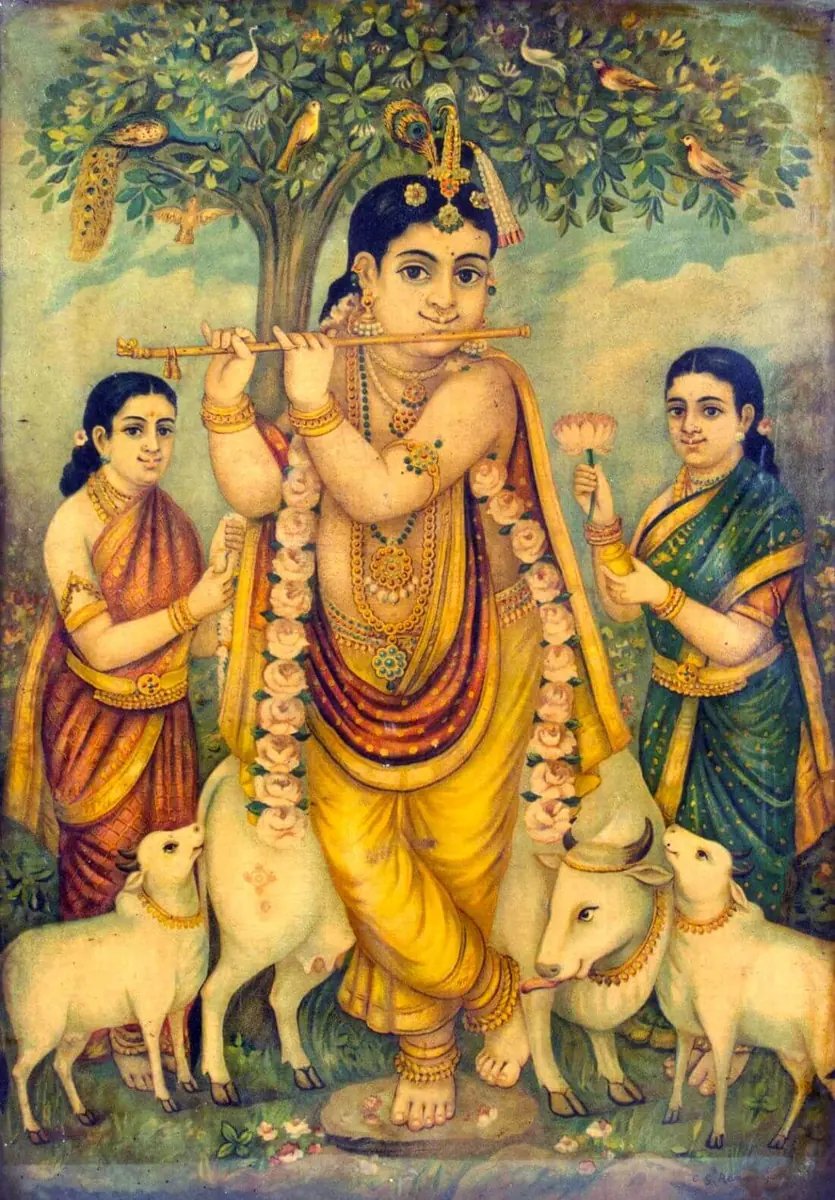
Raskhan lists what he would like to be in his next birth, and in every case it is somewhere near Krishna.
मानुस हौं तो वही रसखान, बसौं मिलि गोकुल गाँव के ग्वारन।
जो पसु हौं तो कहा बस मेरो, चरौं नित नंद की धेनु मँझारन॥
पाहन हौं तो वही गिरि को, जो धर्यो कर छत्र पुरंदर धारन।
जो खग हौं तो बसेरो करौं मिलि कालिंदीकूल कदम्ब की डारन॥
या लकुटी अरु कामरिया पर, राज तिहूँ पुर को तजि डारौं।
आठहुँ सिद्धि, नवों निधि को सुख, नंद की धेनु चराय बिसारौं॥
रसखान कबौं इन आँखिन सों, ब्रज के बन बाग तड़ाग निहारौं।
कोटिक हू कलधौत के धाम, करील के कुंजन ऊपर वारौं॥
What it means
Raskhan lists what he would like to be in his next birth, and in every case it is somewhere near Krishna. If human, a cowherd boy of Gokul. If an animal, one of Nand's cows. If a stone, the very hill that Krishna lifted as an umbrella over Braj. If a bird, one that nests in the kadamb trees on the Yamuna bank. The second savaiya goes further. For the stick and blanket of a cowherd he would give up the throne of the three worlds, and the eight powers and nine treasures would all be forgotten while tending Nand's cows. He would trade a million golden palaces for one karil thicket in the Braj forest.
How it is sung
These two savaiyas are usually recited or sung in a free rhythm, without a fixed beat, and often during Govardhan parikrama or Janmashtami programmes. Take a breath at the line end and let the last word of each line hang. Many Braj singers begin with it before moving on to a faster kirtan.
Questions, answered
Who was Raskhan?
Raskhan was a Muslim-born poet, known as Saiyad Ibrahim, who left his old life for Krishna devotion in Braj. His savaiyas on Krishna are still recited across north India.
What is a savaiya?
A savaiya is a Hindi poetic form of four long lines with a flowing rhythm, quite suited to recitation.
Where is this poem studied?
The first four lines and the next four are in the Class 9 Hindi book in India, so many children know them by heart.