Bhajan · Krishna
Dhuri Bhare Ati Shobhit Shyam Ji धूरि भरे अति सोहत स्याम जू
Raskhan watches the baby Krishna in the courtyard, covered in dust, and says the dust makes him look even more beautiful.
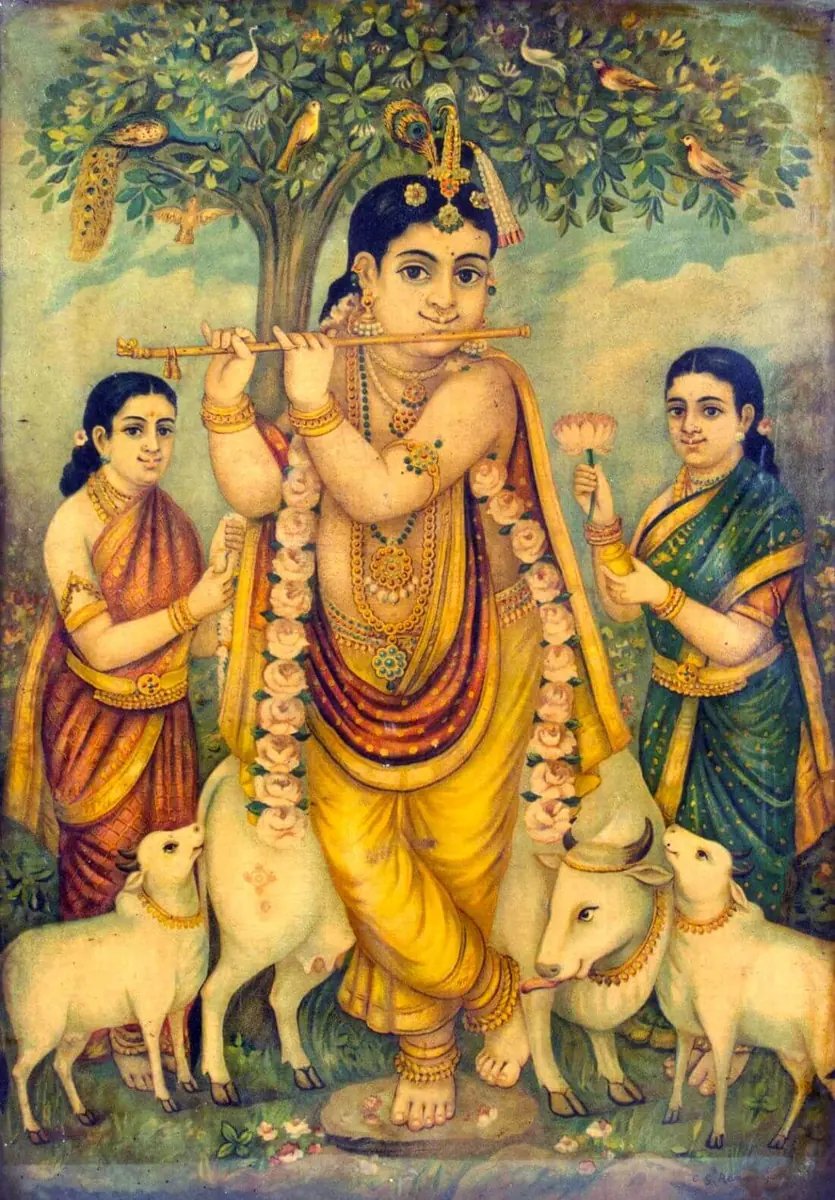
धुरि भरे अति सोहत स्याम जू, तैसी बनी सिर सुंदर चोटी।
खेलत खात फिरैं अँगना, पग पैंजनी बाजति, पीरी कछोटी॥
वा छबि को रसखान बिलोकत, वारत काम कला निधि कोटी।
काग के भाग बड़े सजनी, हरि हाथ सों लै गयो माखन रोटी॥
What it means
Raskhan watches the baby Krishna in the courtyard, covered in dust, and says the dust makes him look even more beautiful. A neat braid stands on his head. He plays and eats at the same time, running about the yard with anklets ringing and a small yellow waist-cloth tied on. Raskhan says that the god of love would give up crores of his skills for a look at this picture. The last line turns it into a joke, a friend telling another woman that the crow must have great luck, because it flew off with the bread and butter straight from Hari's hand.
How it is sung
These two lines are a pair of savaiya verses, recited with a flowing breath rather than a fixed beat. They are common in Bal Gopal programmes, at Janmashtami and on any morning of cradle-songs. The final line is spoken with a smile, as in a story told between friends.
Questions, answered
Why is the crow lucky in the last line?
In Braj stories the crow snatched butter and bread from Krishna's hand while he was a child. A gopi says it must have had very good fortune to be so close to him.
Who is Raskhan?
Raskhan was a sixteenth-century poet born as Saiyad Ibrahim, who became a devotee of Krishna in Braj and wrote savaiyas in Braj bhasha.
Is 'pauri kachhoti' the same as 'peeri kachhoti'?
Different books print it both ways. 'Peeri kachhoti' is a yellow waist-cloth, which is the common reading and the one used here.