रामायण प्रसंग · Ramayana episodes
शंबूक प्रसंग
Shambuka, a passage the tradition argues with
A late chapter of Valmiki that has been used to defend caste exclusion, what it actually says, and why many readers do not accept it as part of the epic's message.
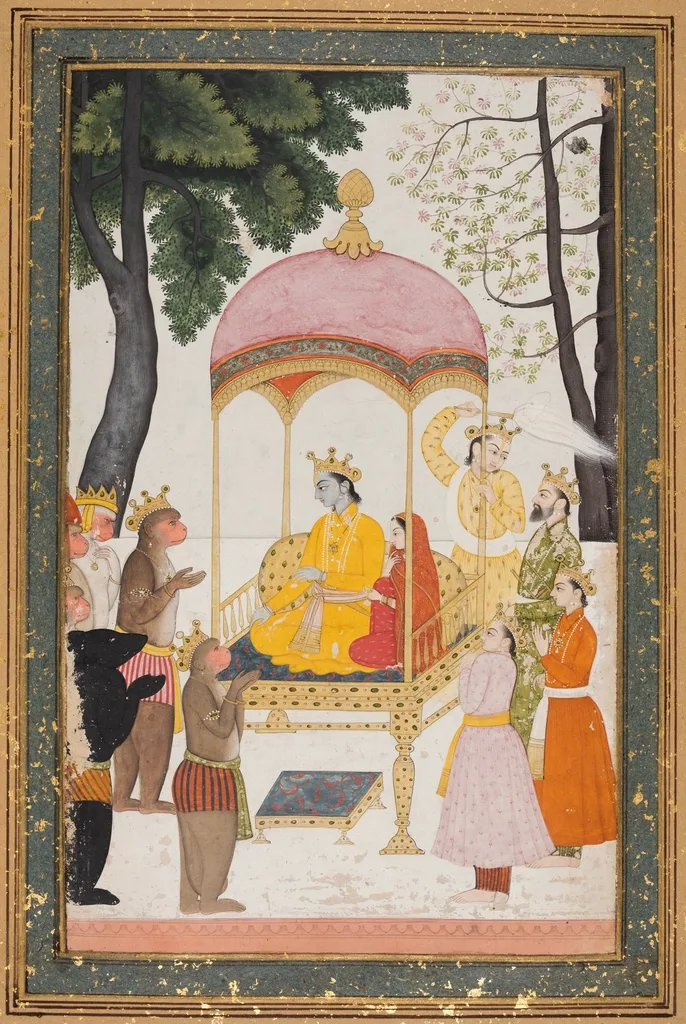
Source followed. Follows the Valmiki Ramayana, Uttara Kanda, sargas 73 to 76, as it is printed in the common editions.
वाल्मीकि रामायण, उत्तर कांड, सर्ग 73 से 76 के अनुसार, जैसा प्रचलित संस्करणों में छपा है।
In the Uttara Kanda, Rama is king in Ayodhya and the land is prosperous. One day a Brahmin comes to the palace gate carrying the body of his young son, who has died. He accuses the king: a child does not die in a good reign unless something has gone wrong, and the fault must be Rama's. Rama gathers his council of sages and asks what could have happened.
Narada tells the assembly that in the age of Treta, only Brahmins are permitted to perform austerities, and that if a man of another caste is practising them, it makes the child of a Brahmin die. Rama mounts the Pushpaka chariot and searches the kingdom in all directions. In the south, by a lake on Mount Shaivala, he sees a man hanging head downward from a tree, doing penance.
The man gives his name. He is Shambuka, he says, a Shudra, and he is doing tapas to reach heaven in his own body. Rama draws his sword and cuts off his head. The gods rain flowers and praise the act. Agastya's ashram is visited, the Brahmin's son comes back to life, and the story ends.
This is what the passage says. It is the most uncomfortable in the epic because the injustice is plain. A man who is harming no one is killed for what he was doing, and the king is praised for it. Many readers across the centuries have said that this does not sound like the Rama of the rest of the poem, who embraced the boatman Guha, ate with Shabari and made friends with monkeys and bears.
Teachers in the tradition have answered in different ways: the book is late and not Valmiki's, the passage was inserted when caste rules were hardened, and in some readings it is a story about the duty of a king to answer for his people's suffering and not about Shambuka at all. The bhakti saints, from Ravidas to Kabir, argued that devotion belongs to every person. Tulsidas left the story out. You are free to do the same, and to read it knowing why it troubles.
प्रश्न Questions, answered
Is the Shambuka story in Tulsidas?
No. Tulsidas's Ramcharitmanas does not include it or the later banishment of Sita.
Is the Uttara Kanda by Valmiki?
Many scholars hold that it is a later addition to the original six books. Traditions vary, and the common printed editions include it.
Why do we retell it?
So seekers who meet the passage in print can read what it says and why teachers in the tradition have refused to treat it as a model.