रामायण प्रसंग · Ramayana episodes
शबरी की प्रतीक्षा
Shabari waits at Pampa
An old woman who spent her life waiting for one guest, and what Rama said about devotion when he finally came.
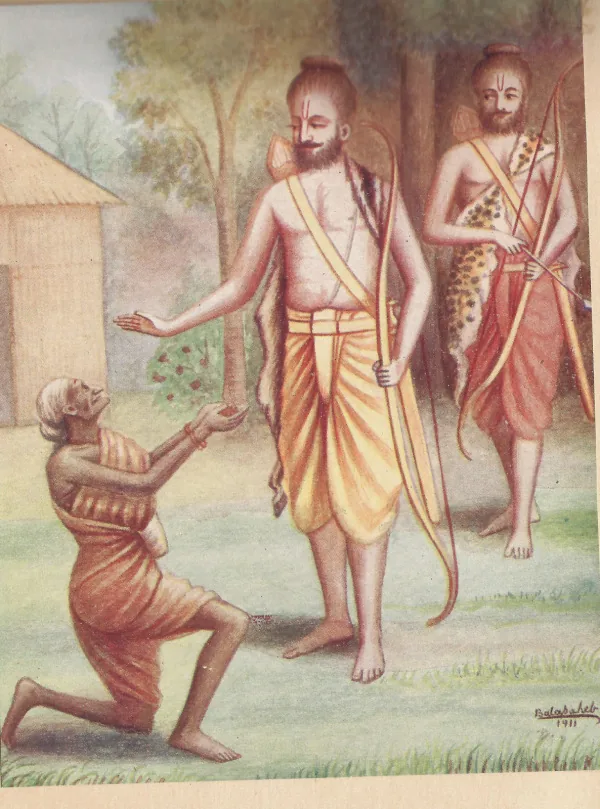
Source followed. Follows the Valmiki Ramayana, Aranya Kanda, sarga 74, with the nine kinds of bhakti from Tulsidas's Ramcharitmanas, Aranya Kanda.
वाल्मीकि रामायण, अरण्य कांड, सर्ग 74, और तुलसीदास के रामचरितमानस, अरण्य कांड की नवधा भक्ति के अनुसार।
Shabari lived at the hermitage of the sage Matanga on the bank of Lake Pampa, in the forest of the south. She was old, and she had once been a young woman who came to the sages to serve them. Before he left the world, Matanga had told her that Rama would one day pass that way and she should wait for him. She swept the path every morning, picked flowers, and waited.
Years went. The sages died or moved on. She kept the hut, kept the flowers fresh, and every day kept something ready in case this was the day. When Rama and Lakshmana, searching for Sita, finally came up the path, she recognised him without being told. She bowed to the ground and washed their feet. The Valmiki account says she had gathered fruits and roots that she had picked herself and set them before the princes.
In the folk version she bit into each berry to test it, so that the first one that touched his lips would be the sweetest. Lakshmana, who was brought up in a palace, was shocked. Rama ate them gladly and said it was the best food he had ever had. The poet knows exactly what he is doing with this scene. It is a way of saying that love that holds nothing back is worth more than a clean offering.
In the Ramcharitmanas, Rama then tells her the nine kinds of bhakti: keeping the company of holy people, listening to stories of God, serving the teacher without pride, singing His praise, repeating His name, restraint, contentment, honesty and simplicity, and a trust that does not waver. He tells her that anyone who has even one of these is dear to him, and that she has all nine.
Valmiki ends her story calmly. She asked leave to give up her body, lit a fire, entered it, and rose, the text says, to the regions of the sages she had served. Rama and Lakshmana went on to find Sugriva. The place is remembered in Karnataka near Hampi and also on the Kerala and Tamil sides. Tradition does not fix one site.
प्रश्न Questions, answered
Did Shabari really taste the berries?
Not in Valmiki. That scene comes from later devotional poetry and folk tradition, notably Tulsidas. Valmiki only says she offered fruits and roots.
What is Navadha Bhakti?
The nine forms of devotion Rama teaches Shabari in the Ramcharitmanas, including company of the holy, hearing stories, service, praise, name repetition, restraint, contentment and simplicity.
Where is Shabari's ashram?
Traditions point to the shore of Pampa near Hampi in Karnataka. Other places in India also claim the memory.