Lakshmi · पर्व और त्योहार
लक्ष्मी पूजन
Lakshmi Pujan
The Diwali evening puja of Lakshmi, Ganesh and Kuber at home, done in pradosh kaal, ending with the new bahi-khata and a row of lit diyas.
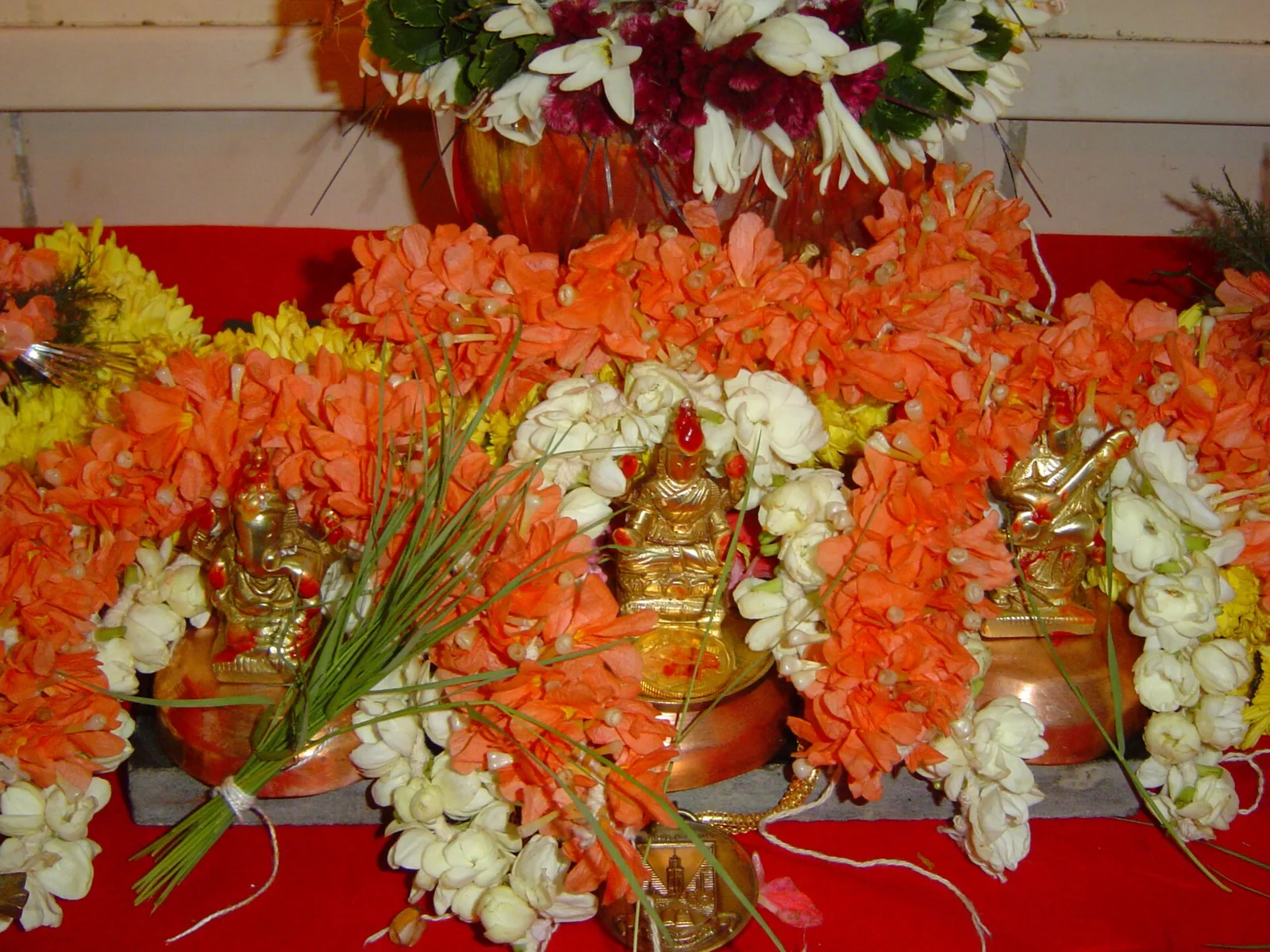
On the Amavasya of Kartik (the new-moon night of Diwali), in the pradosh kaal that begins at local sunset and runs for about two hours. Many families also pick the steady (sthir) lagna inside that window. Some Bengal and Odisha traditions worship Kali at the deepest hour of the night instead. Check a panchang (drikpanchang.com) for your own city, because sunset differs from Delhi to Mumbai to Mathura.
The whole family together. The eldest member or the head of the household usually sits for the sankalp, while children, daughters-in-law and guests join for the aarti. Shopkeepers also do the same worship in the shop in the evening.
about 1.5 to 2 hours
सामग्री Samagri checklist
Puja thali and seat
Offerings
Kuber and bahi-khata
तैयारी Before you begin
- Clean and declutter the house in the days before. Many families whitewash and repair the doors.
- Make a rangoli at the main entrance and keep the door open in the evening.
- Bathe, and wear clean new or freshly washed clothes. Women often wear a red or yellow sari.
- Set the chowki in the north-east or north of the house so you face east or north while sitting.
- Place Ganesh on the left and Lakshmi at the centre or right as your family does. Sources and families differ, so follow your elders.
- Fill diyas with ghee or mustard oil and keep them ready for lighting after the puja.
पूजा विधि Step by step
आचमन Achaman, sipping water to purify
about 2 minutes
Sit on your asan facing east or north with a small cup (a copper or steel panchpatra if you have one) of clean water and a spoon. Pour a little water into your right palm and sip it three times, each time with one name of Vishnu, without a sound of slurping. Then wash the right palm, touch your lips, and touch water to the eyes, nose, ears and heart with the fingers, as your family does. Take only a small sip each time, not a mouthful. Do it before sankalp, and again whenever you leave the seat and return.
ॐ केशवाय नमः। ॐ नारायणाय नमः। ॐ माधवाय नमः।
Om Keshavaya namah. Om Narayanaya namah. Om Madhavaya namah.
Meaning: Salutations to Keshava, Narayana and Madhava, three names of Vishnu, one for each sip. Many Vedic households say 'svaha' in place of 'namah' for these three sips, and the Sandhya text does the same.
ॐ गोविन्दाय नमः
Om Govindaya namah
Meaning: A fourth name of Vishnu, said as the hand is washed after the three sips.
संकल्प Sankalp for the evening
about 5 minutes
Hold water, akshat and a flower in your right hand. Say your name, your gotra, the place and the day, and that you are performing Lakshmi-Ganesh pujan for the wellbeing of your household. Release the water in a small plate. If you do not know the full Sanskrit, say it in plain words in your own language.
गणेश-गौरी स्मरण / आवाहन Ganesh and Gauri invocation at the start
about 5 minutes
Every puja begins by remembering Ganesh so that no obstacle comes in the way, with Gauri (Parvati) beside him. Place a small mound of rice or a betel nut wrapped with red thread (moli) on a leaf or a small plate as Ganesh, and a second smaller one as Gauri. If you have a Ganesh murti, use that. Bow, offer a little water, a dot of roli or sandal, rice and a flower to each, and pray that they stay till the puja is finished. When the main puja is over, offer them water again and say they may go where they please.
वक्रतुण्ड महाकाय सूर्यकोटि समप्रभ। निर्विघ्नं कुरु मे देव सर्वकार्येषु सर्वदा॥
Vakratunda mahakaya suryakoti samaprabha. Nirvighnam kuru me deva sarvakaryeshu sarvada.
Meaning: O curved-trunked, large-bodied one with the brilliance of a crore suns, make all my works free from obstacles, always. This is the Ganesh smaran verse already on our bhajan pages. For the avahan (invitation) proper, families use different verses, so recite the Ganesh verse of your own household.
On Diwali Ganesh is worshipped before Lakshmi so that the evening goes without obstacles. Offer durva and his favourite sweet.
गणेश मंत्र जप Ganesh mantra japa
about 5 minutes
After the offering, chant the short Ganesh mantra with a mala. Sources give 11 or 21 rounds, and both are accepted, so choose the count your family keeps.
ॐ गं गणपतये नमः ॥
Om Gam Ganapataye Namah
Meaning: I bow to Ganapati, remover of obstacles.
कलश स्थापना Kalash sthapana, installing the water pot
about 8 minutes
Make a small seat of rice (or sand mixed with a little soil) on a clean, raised spot to the right of the main deity, as you face the deity. Put a copper, brass or clay pot on it and fill it about three quarters with clean water; a few drops of Ganga jal, a little sandal, a betel nut, a coin, some rice and a blade of durva go in. Tie moli round its neck. Put five or seven mango leaves around the mouth with the tips up, then place a plate or the coconut on top. The coconut is wrapped in red cloth or sandalwood with its tuft facing up. The kalash stands for all sacred waters and the deities who are called into it, and the water is used for the rest of the puja and sprinkled on family and home at the end. Light a diya near it. Some families draw a swastika on the pot with roli.
कलशस्य मुखे विष्णुः कण्ठे रुद्रः समाश्रितः। मूले तत्र स्थितो ब्रह्मा मध्ये मातृगणाः स्मृताः॥
Kalashasya mukhe Vishnuh kanthe Rudrah samashritah. Mule tatra sthito Brahma madhye matri-ganah smritah.
Meaning: At the mouth of the pot is Vishnu, at the neck Rudra, at the base Brahma, and in the middle are the groups of Divine Mothers. This verse is found in kalash puja texts; a different book gives Krishna and Sadashiva for the mouth and neck, so the wording is not fixed.
The kalash stands for Varuna and all the gods. On Diwali it is often placed to the right of the chowki, next to the lamp.
लक्ष्मी आवाहन Inviting Lakshmi
about 5 minutes
Take a flower and akshat, fold your hands and ask Mahalakshmi to sit on the chowki. Offer her an asan (a flower or a small cloth), wash her feet with a spoon of water, and sprinkle water on the murti. Then recite the Lakshmi beej mantra.
ॐ श्रीं महालक्ष्म्यै नमः ॥
Om Shreem Mahalakshmyai Namah
Meaning: A bow to the great Goddess Lakshmi, giver of prosperity.
षोडशोपचार पूजन Offering the upacharas
about 15 minutes
Offer in this order: haldi and kumkum, a tilak of roli, akshat at her feet, flowers or the lotus, the garland, incense, and the lamp. Add paan, supari and laung, then the coins and notes that you place near her feet. Say the beej mantra with each offering if you know the sequence, otherwise keep a gentle chant going in the background.
लक्ष्मी गायत्री Lakshmi Gayatri
about 5 minutes
Chant the Gayatri in a calm voice, ideally 11 times on a mala, while looking at the murti. Some pandits chant the Shri Sukta here, which is longer, so keep it for those who already know it.
ॐ महालक्ष्म्यै च विद्महे विष्णुपत्न्यै च धीमहि । तन्नो लक्ष्मीः प्रचोदयात् ॥
Om Mahalakshmyai cha vidmahe Vishnupatnyai cha dhimahi, tanno Lakshmih prachodayat
Meaning: We meditate on Mahalakshmi, the consort of Vishnu. May Lakshmi inspire and guide us.
कुबेर पूजन Kuber pujan
about 5 minutes
Place a little rice and a flower near the tijori or cash box, and mark it with a swastika in roli. Call Kuber as the keeper of the family treasury and offer him fragrance, akshat and a sweet. Then say his short mantra a few times.
ॐ श्री कुबेराय नमः ॥
Om Shri Kuberaya Namah
Meaning: A bow to Shri Kuber, guardian of wealth.
बही-खाता / चोपड़ा पूजन Bahi-khata or chopda pujan
about 10 minutes
Spread the ledger on a red cloth. Sprinkle a little pure water on it, then draw a swastika with roli or sandalwood paste on the first page. Add a flower and a few rice grains. On the page write the line given below, then the date. Traders do this in the labh or amrit choghadiya or in pradosh kaal. Salaried families can do the same with a new diary or pen.
श्री गणेशाय नमः
Shri Ganeshaya Namah
Meaning: Written first in the new book.
श्री लक्ष्मी नमः
Shri Lakshmi Namah
Meaning: Written beneath it as a request for blessing on the year ahead.
नैवेद्य Naivedya and fruit
about 5 minutes
Place the sweets, khil, batasha and fruits in front of Lakshmi and Ganesh. Sprinkle a little water around the plate and say that it is offered with love. Leave it a minute or two before the aarti.
आरती विधि How to do aarti
about 5 minutes
Aarti comes near the end of the puja, after the offerings. Stand in front of the deity with a thali holding a ghee lamp (or camphor), a small bell, a flower and a little water. Ring the bell with the left hand and wave the thali with the right, always clockwise: in front of the deity, the thali goes from your left to your right in a full circle. Many households do about four circles at the feet, two at the navel or belly, one at the face and then seven or so around the whole form, going from feet upward. Sources do not agree on these counts, so follow your family; the clockwise circle is the part all agree on. Camphor is lit last and waved the same way, and one verse (karpur-gauram or the nirajan verse) is said while it burns. Sing the aarti of the deity with everyone, clapping softly in time. Then take the aarti: hold your hands over the flame and touch them lightly to your eyes and forehead, and pass the thali to others. Walk once round the deity clockwise and bow. Afterwards set the lamp back in the shrine; whether it burns on or is put out gently depends on your family custom, and a lamp that goes out in the middle can simply be relit.
कदलीगर्भसम्भूतं कर्पूरं तु प्रदीपितम्। आरार्तिकमहं कुर्वे पश्य मे वरदो भव॥
Kadali-garbha-sambhutam karpuram tu pradipitam. Aratikam aham kurve pashya me varado bhava.
Meaning: Camphor born from the heart of the plantain, now lit, I wave in aarti: look on me and be a giver of boons. Two drikpanchang pages give the first line as 'kadali-garbha-sambhutam karpuram tu pradipitam'; the second line is as it is commonly printed.
Sing the Lakshmi aarti first and Ganesh ji ki aarti after it, with the whole family standing.
दीपमालिका Lighting the rows of diyas
about 10 minutes
Take a lit diya from the puja lamp and place the first one at the main door, then in the kitchen, near the tulsi, on the terrace and on the stairs. Keep one small diya burning near Lakshmi all night if you can do so safely.
क्षमा प्रार्थना / पूजा समापन Kshama prarthana, asking forgiveness and closing
about 3 minutes
At the very end, after aarti and pradakshina, stand or sit with folded hands and ask pardon for every lack in the puja: wrong words, missed steps, thin devotion. This is not a formality; it is said that even a puja done with errors becomes complete by this prayer. Then offer a little water and flowers, say 'sarvam shri bhagavat arpanam' (all this is offered to the Lord), and take the water on the kalash as prasad. Do not rush away; sit a minute in silence. Close by saying the deity may go where he or she pleases (utthapan or visarjan) only if you called the deity into a fresh murti. A home murti or picture that lives on your altar is not sent away: you only bow and cover the offerings.
आवाहनं न जानामि न जानामि विसर्जनम्। पूजां चैव न जानामि क्षमस्व परमेश्वर॥ मन्त्रहीनं क्रियाहीनं भक्तिहीनं सुरेश्वर। यत्पूजितं मया देव परिपूर्णं तदस्तु मे॥
Avahanam na janami na janami visarjanam. Pujam chaiva na janami kshamasva Parameshvara. Mantra-hinam kriya-hinam bhakti-hinam Sureshvara. Yat pujitam maya deva paripurnam tad astu me.
Meaning: I do not know how to invite you, how to send you off, or how to worship; forgive me, O Supreme Lord. Whatever I have worshipped with lack of mantra, lack of action and lack of devotion, O Lord of the gods, let it be made complete. Two sources agree on this pair of verses; one prints 'tava archanam' (your worship) in the first line in place of 'pujam'.
प्रसाद Sharing prasad
about 10 minutes
Give the prasad to the youngest and eldest first, then to neighbours and anyone who comes to see the lights. Eat only after the puja ends.
आरती और विसर्जन Aarti and closing
Om Jai Lakshmi Mata is sung with the diya moved in clockwise circles before the murti, with the bell and sometimes a shankh. Ganesh ji ki aarti follows. At the end each person takes the flame with the palm and touches the eyes.
There is no immersion on the night. The murti stays on the chowki till the next morning, when the kalash water is sprinkled around the house and on plants. Coins and notes go back into the tijori. Clay Lakshmi-Ganesh murtis are usually immersed in a river or placed under a tree after a few days.
Om Jai Lakshmi Mata aartiGanesh ji ki aartiVakratunda Mahakaya
क्या करें · Do
- Begin with Ganesh and end with a short kshama prayer.
- Keep a ghee lamp lit through the evening.
- Use a fresh cloth for the chowki and wear clean clothes.
- Distribute sweets to neighbours and workers.
क्या न करें · Avoid
- Do not skip the sankalp, even a plain-words one.
- Do not keep any plate with stale food near the chowki.
- Do not leave burning diyas unattended near curtains.
- Do not rush the bell and aarti when guests arrive.
परंपराएँ Variations and Braj
- North India: Lakshmi and Ganesh with Saraswati sometimes added; the family sits on the floor and the puja happens in pradosh.
- Gujarat and Rajasthan trading families: chopda pujan on the same evening, with new books started on Labh Pancham, the fifth day of Kartik Shukla in many traditions.
- Maharashtra: Lakshmi pujan with Kuber and coins on the Amavasya evening, and a separate balipratipada the next day.
- Bengal and Odisha: Kali puja at night on the same Amavasya, with Lakshmi puja kept for Kojagari purnima in the previous weeks.
- South India: Deepavali begins at dawn with the oil bath, and Lakshmi puja is done in the evening or on Friday in many homes.
- Which murti sits on the left or right is not fixed. Elders and the family priest decide.
In Mathura and Vrindavan the evening begins with lamps on the ghats of the Yamuna and every temple is lit up. Home puja stays simple: clay murtis, a few batashe, and Yamuna water in the kalash if the family has it. Traders also begin their new books the same night.
प्रश्न Questions, answered
Which time is best for Lakshmi puja on Diwali?
Pradosh kaal on Amavasya, starting around sunset, is the common choice. Inside it, many pandits choose the steady lagna. Look up your city on drikpanchang.com.
Do we worship Ganesh before Lakshmi?
Yes. Ganesh is invoked first in almost every puja. Sources differ on which side the two idols sit, so ask your family priest.
How many times should the Lakshmi mantra be chanted?
108 on a mala is the figure most often given for the beej mantra. Sources also say the count can be adapted to the family custom, and attention is worth more than the number.
What is chopda pujan?
It is the worship of the new account book, mainly by traders. The book is purified with water, a swastika is drawn on its first page, and the first line is Shri Ganeshaya Namah.
Can we do the puja without a murti?
Yes. A clear picture or a silver coin with Lakshmi on it can be used, and many families do exactly that.
When do I take the diya out to the door?
After the aarti, once the puja is complete. Light it from the puja flame and place it at the main entrance first.
कुल की परंपरा सर्वोपरि है। Where your family custom differs, follow it, and ask your priest when in doubt.
Check locally
- The pradosh and sthir lagna window for your city on drikpanchang.com.
- Whether your family keeps Ganesh on the left or right of Lakshmi.
- Count of mantra rounds and any extra stotra your family chants, such as Shri Sukta.
- For the bahi-khata, ask your family pandit or accountant which choghadiya they follow. The wording of Kuber mantras is not uniform across sources, so only the short form is given here.
Doing this in Braj? Seekers often bring a puja to Vrindavan, Govardhan or Mathura. A Laladham driver who knows the ghats and the timings is one message away.
Plan my trip