Getting here from Delhi
This is a flight to Chennai, then a road leg south along the coast. Incredible India names Chennai International Airport as the nearest, and Tamil Nadu Tourism puts it about 55 km away, with Chennai's railway station 57 km off and Chengalpet station about 23 km. Buses run daily from Chennai, Pondicherry, Madurai and Coimbatore. No drive time is given on the pages we read, but it is a short hop compared with the flight, which is why the town works as a weekend getaway from Chennai and as a first or last night on a longer Tamil Nadu trip.
A little history so the stone makes sense
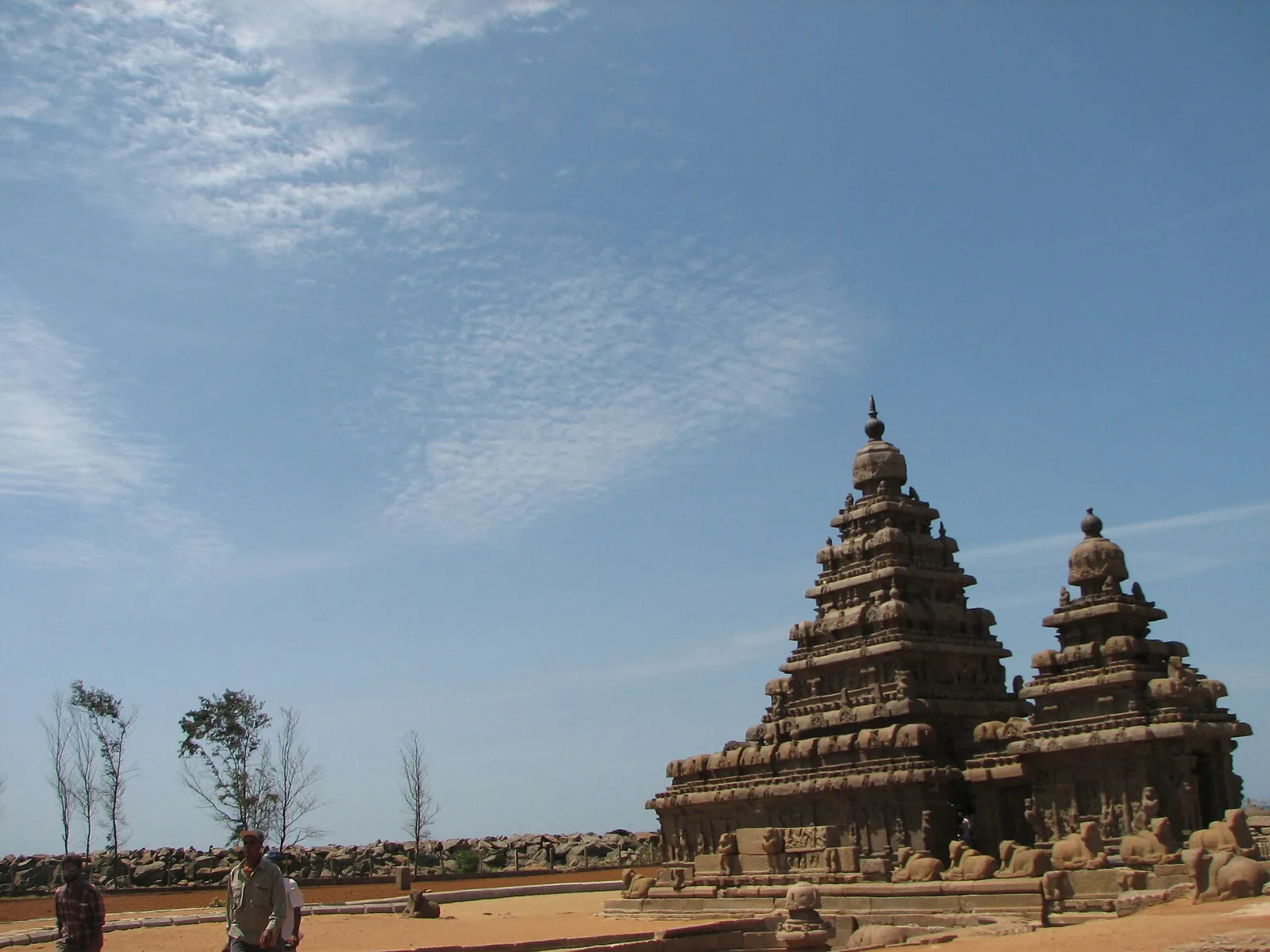
Tamil Nadu Tourism describes Mahabalipuram as a busy port that rose in importance between the 4th and 9th centuries under the Pallava dynasty, whose building programme left the temples that now make up a UNESCO World Heritage Group of Monuments. The signature of the style is ornate carving from uncut rock, and the officials call the Shore Temple one of the oldest temples in India built of granite blocks. Keep that in mind when you stand in front of it: it is stacked stone, not a cave.
The Shore Temple and the sea
The Shore Temple stands free beside the Bay of Bengal. Tamil Nadu Tourism says it is believed to date from the reign of the Pallava king Rajasimha, also called Narasimhavarman II, and that it has two sanctums, one for Shiva and one for Vishnu, under a stepped pyramidal tower of cut granite blocks. Until recently it was buried under sand. Marco Polo's Seven Pagodas are tied to this coast, and the board says the 2004 tsunami exposed another collapsed granite temple, with six more believed to lie under the sea.
Go early or late. The sea light on the grey stone is gentle at the start and end of the day and flat at noon, and the sand around the temple gets hot underfoot. Beyond it, the beach has water sports, surfing and quad biking if you want something less reverent, and the Mahabalipuram Lighthouse gives a view of the coast.
Arjuna's Penance, the big wall
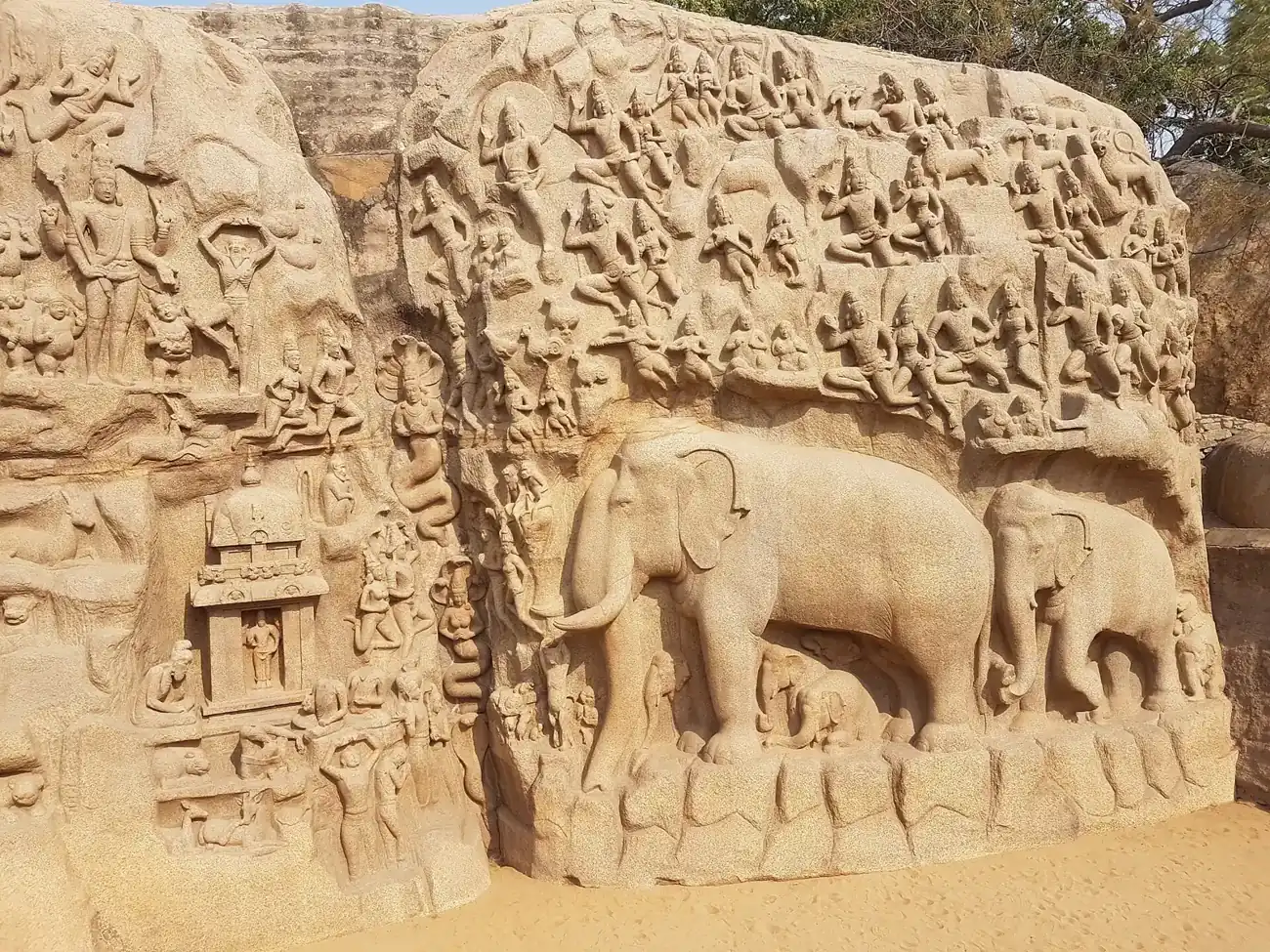
Arjuna's Penance, locally the Descent of the Ganges, is the largest set piece. Tamil Nadu Tourism measures the open-air relief at 29 by 13 metres, carved across two monolithic boulders and a natural cleft, with about 146 figures: gods, Nagas, apsaras, and animals watching the Ganges come down to earth under the king Bhagiratha. Spend more time here than seems reasonable. Stand back first for the whole composition, then step close to the life-size elephants and their calves, and look for the monkeys copying the sages at yoga.
The same page notes that descendants of the Pallava sculptors still live in the town, so the stone-cutting yards you pass on the way in are not a stage set. The December dance festival uses this wall as its backdrop.
Butter Ball and the caves
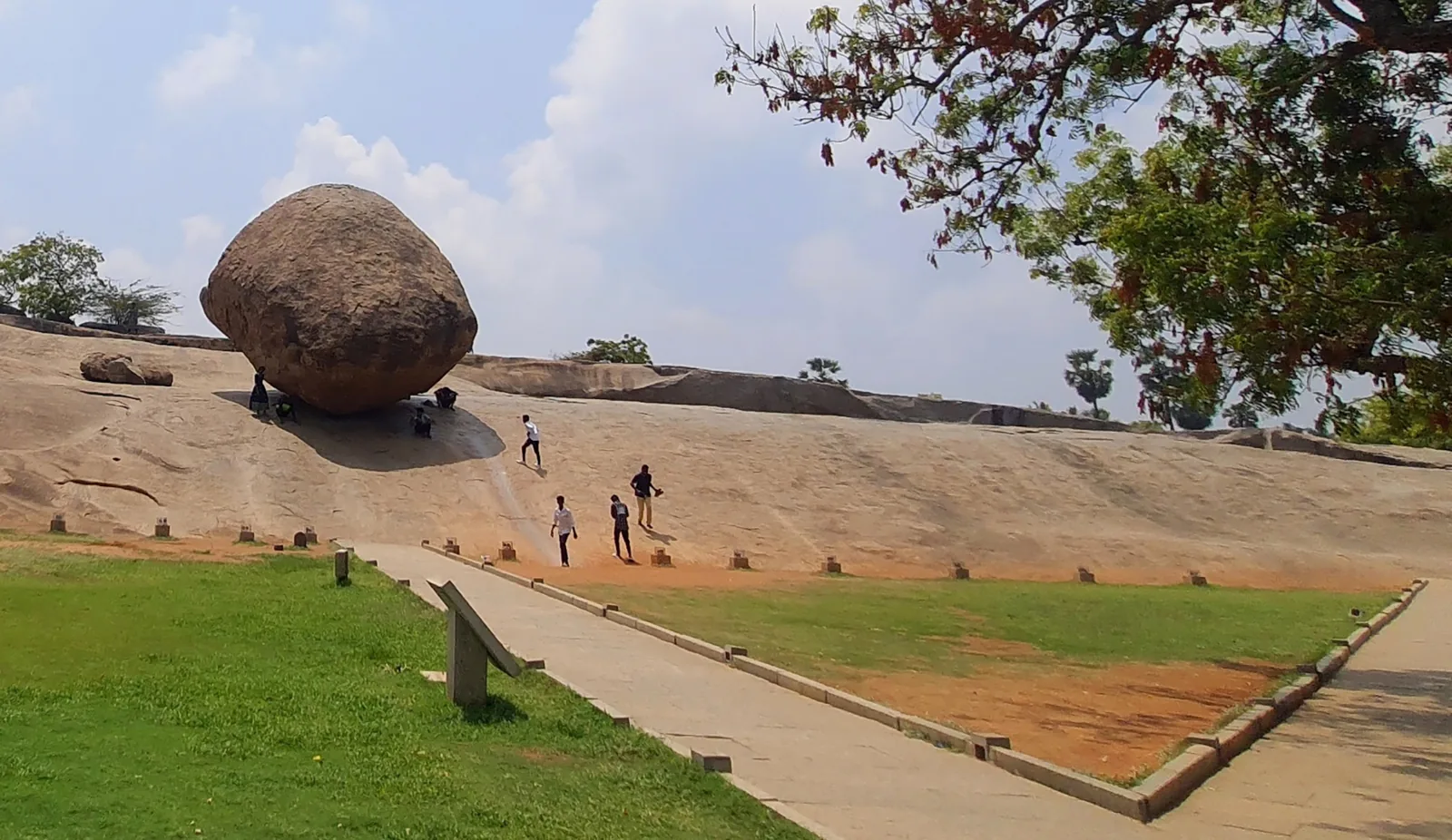
A short walk away, Krishna's Butter Ball is a boulder about 16 feet tall that sits on a small base on a sloping granite slab and seems to defy gravity. Visitors tend to climb the slope, photograph it and move on, but it is worth a minute to see how small the contact point looks.
Around it are the cave sanctuaries. The Mahishasuramardini Cave Temple carries reliefs of the goddess Durga's battle with the demon Mahishasura, the Varaha Cave Temple shows Vishnu in his forms, and the Trimurti Cave Temple is dedicated to the Hindu Trinity. The Krishna Mandapam has bas-relief scenes of Krishna's life, the Pancha Pandava Mandapam has carved pillars, and the Tiger Caves have rock-cut sculptures.
The Pancha Rathas
The Panch Rathas, five rock temples in the Dravidian style, are the monuments most people have seen in school books. Walk the full circuit rather than stopping at the first; each one has a different roof and proportion. Leave this for the cooler part of the day because there is almost no shade between them.
Museums and the artist village
If the sun gets too high, go indoors. The Sculpture Museum holds over 3000 exhibits, Dakshinachitra shows traditional houses and crafts of South India, and the Seashell Museum is a small collection of conches and cowries. Cholamandal Artists Village and the Government College of Architecture and Sculpture show how the stone-cutting tradition continues.
Food, festivals and the calendar
This is a coastal town, and seafood is the point: grilled fish, prawns, lobster and crab, in cafes that range from simple to polished. The December Mahabalipuram Dance Festival stages classical and folk dance against Arjuna's Penance, Pongal in January is a four-day harvest festival, and Masi Magam in February brings the float festival. Hotels fill for the dance festival, so book early. The tourism board recommends November to February, when the air is pleasant; humidity stays high in other months.
How long to stay
One full day covers the monuments, and a night extends it to a slower, sea-facing trip. Wear shoes you can take off quickly, a hat, and sunscreen, and carry water into the rock sites. Check opening hours and ticket rules with the Archaeological Survey of India or at the gate, because the official pages did not list them.
Let Laladham run it from Delhi
Laladham can pick you up in Delhi, at the airport, station, home or hotel, and run the complete trip: the flight to Chennai, a driver for the coast road, a stay by the sea and a plan that fits your dates. No price is published for this route, so ask for a quote on the book page with your dates and group size.
Questions, answered
Is Mahabalipuram the same as Mamallapuram?
Yes. Both names are used for the same town and the same UNESCO group of monuments.
Which airport is nearest?
Chennai International Airport, about 55 km away according to Tamil Nadu Tourism.
When is the best time to visit?
Between November and February, per the state tourism board.
How long do I need?
One full day for the monuments, or an overnight stay to add the beach at sunset.
What is the December festival?
A dance festival staged against the Arjuna's Penance relief.