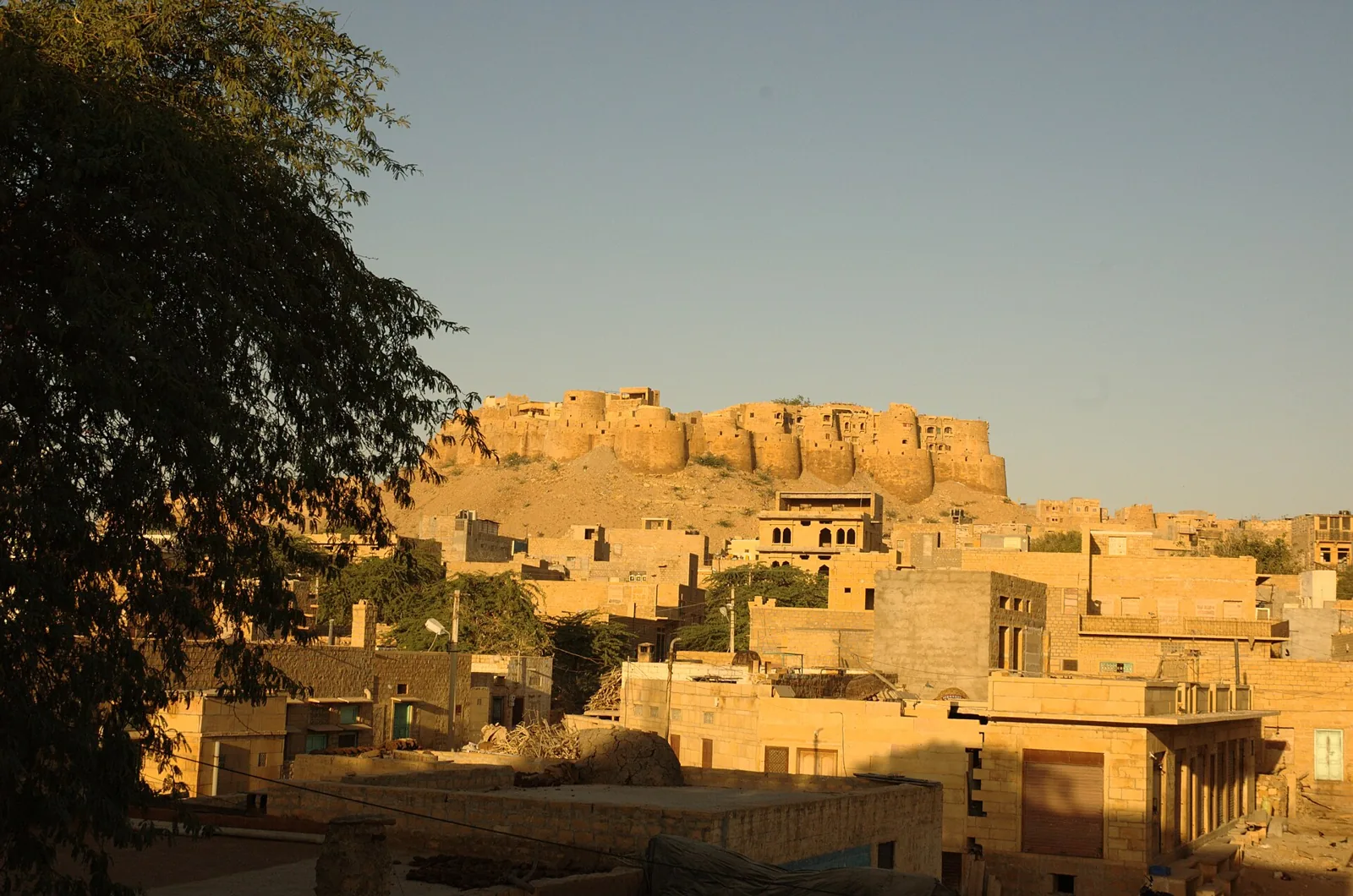
The west of Rajasthan is a different country from the Jaipur side. The land flattens, the walls turn from pink to honey, and the gaps between towns become long straight lines of road with nothing but scrub and the odd wind turbine. This trip follows that line west in five days and gives each end its due.
What makes the route work is the contrast. Jodhpur's Mehrangarh is a fortress built to be looked at from far below. Jaisalmer's fort is almost the opposite: a place where around three thousand people still live inside the walls, with washing on the rooftops and children playing in the lanes. In between sit a ruined temple town, a stretch of open highway and a night in the dunes, which is the part people argue about most.
It fits couples, friends and families with children old enough to sit through half a day in a car. It is a weaker choice in summer, when Jodhpur's highs reach 45 degrees on the state's official climate table, and a poor choice for anyone who needs everything softened; the desert night in particular is simple and cold.
From your pickup
Same trip, four starting points. Road times are real driving times; a long drive becomes its own travel day so nobody arrives wrecked.
Day by day
Day 1 · night in Jodhpur
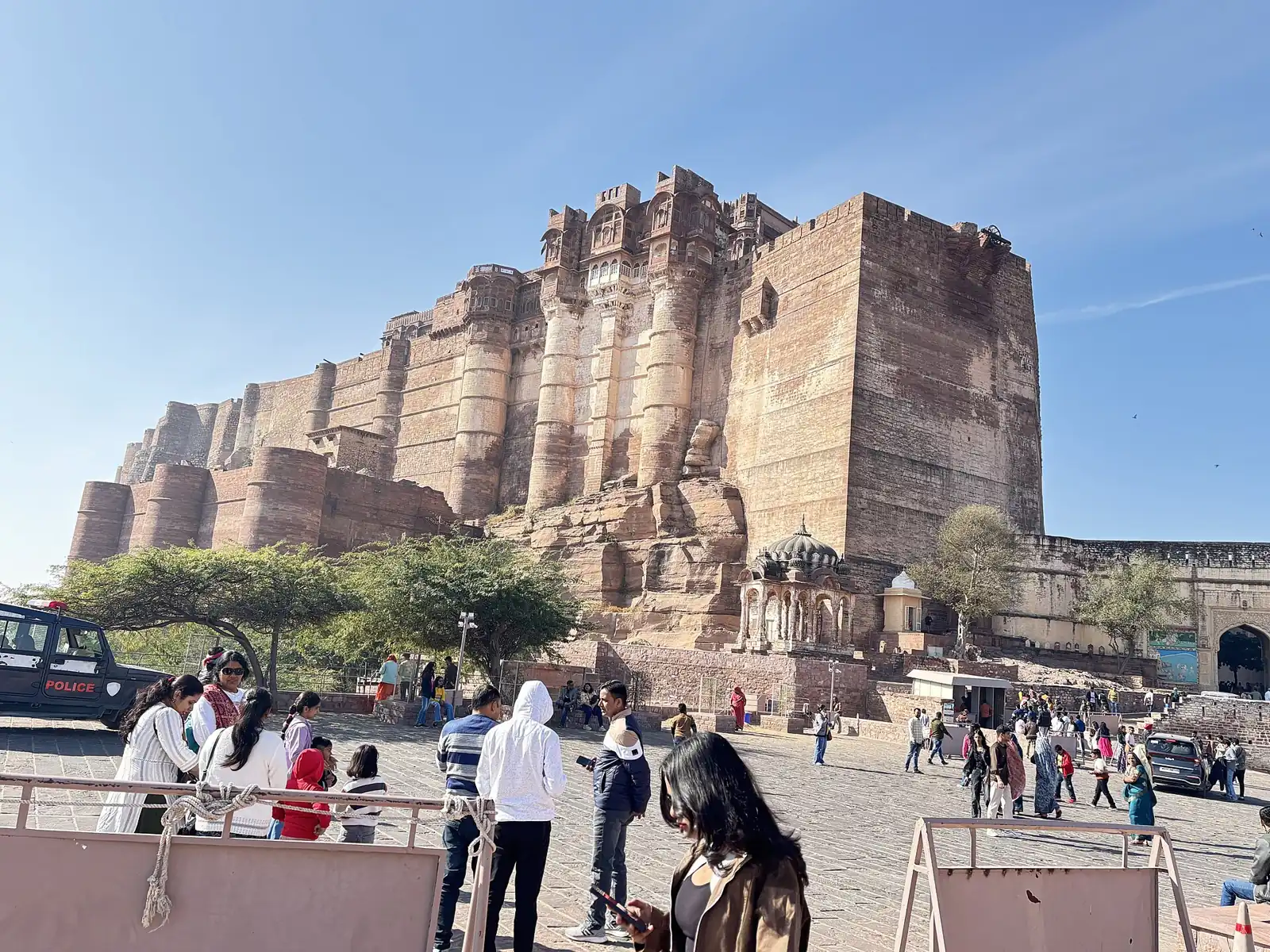
Mehrangarh at opening time and the quiet blue lanes
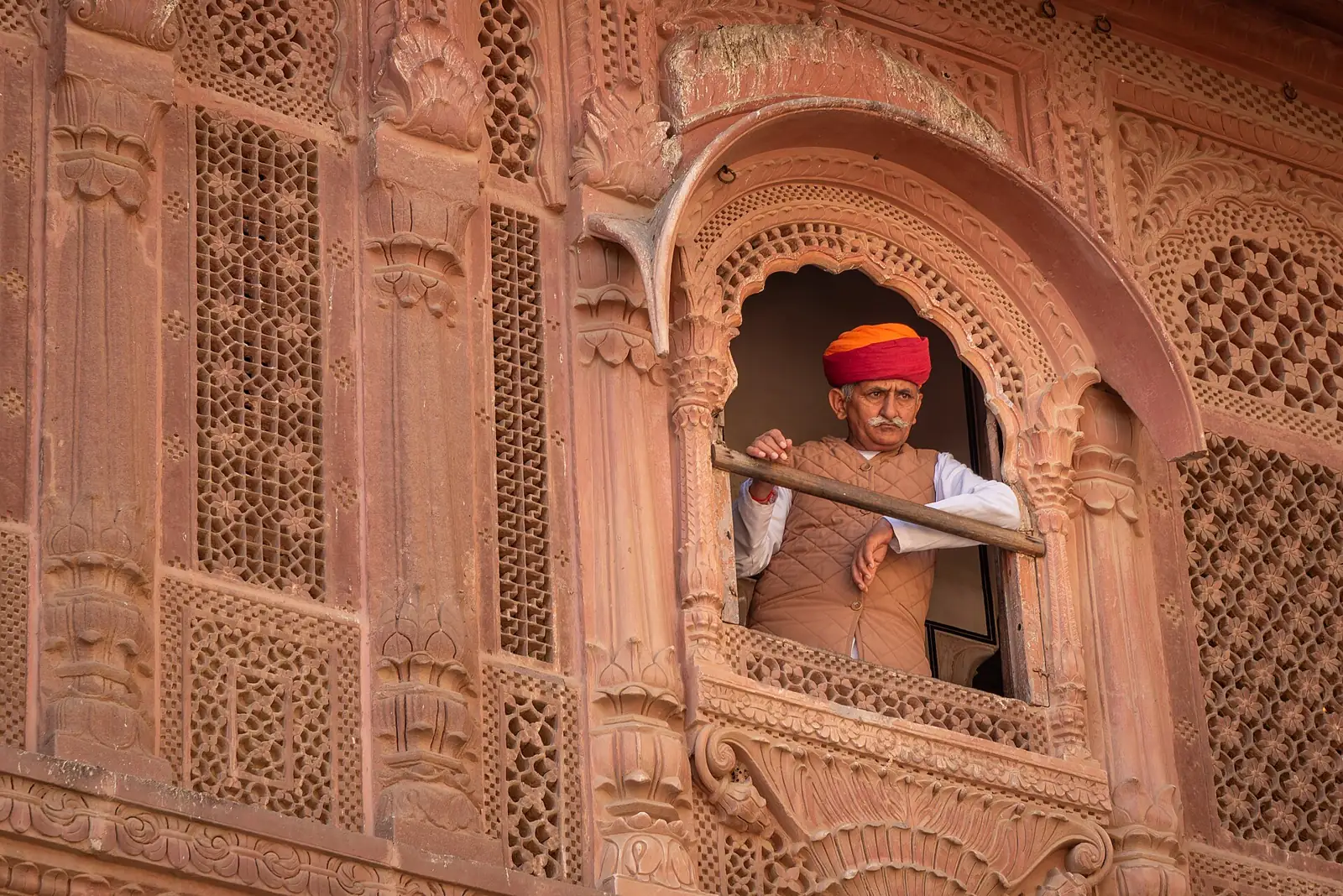
Be at the fort when it opens. It runs every day from nine, ticket sales stop at five, and the first hour belongs to whoever beat the tour groups up the ramp. Inside, rooms such as the mirrored chamber shown in the photographs show how much gold leaf and glass a Marwar ruler could afford. A guide from the ticket desk will point out the details that signs skip, but not everyone wants an audio headset: one solo traveller found the wall labels clear enough and went without.
Lunch is a thali. A woman who wrote about her stay reported that of seven meals in the city, an upstairs thali hall was the only one that really impressed, so ask your driver for it rather than settling for the nearest rooftop. In the afternoon go to Jaswant Thada, the white marble memorial of the nineteenth century, for its lattice screens and the garden beside it.
Save the blue lanes for late light. They are in the quarter near the fort, and the same writer found them almost empty while the Clock Tower and its market a few minutes away were jammed. Finish there, then have a slow dinner.
- Mehrangarh Fort
- Jaswant Thada
- Blue lanes
- Clock Tower

Day 2 · night in Jaisalmer
Osian's temples, then the long run west
Jodhpur to Osian, about 65 km, then on to Jaisalmer, roughly 300 km by the shortest road
Osian lies about 65 km north of Jodhpur, a drive of 60 to 90 minutes. Its temples date from the eighth to the twelfth centuries; of more than a hundred, only fifteen to eighteen are still standing. Climb the easy path to Sachiya Mata on the hill, a working shrine with a wide view of the desert, then walk down to the Mahavira Jain temple for its carved gateways. Dress modestly, and wear shoes you can slip off.
From here the road west is the real desert. Writers describe that stretch as a four-hour trance of straight tarmac, with the town of Pokhran about halfway and a few comic milestone names along the way. Detouring via Osian lengthens the day, so leave on time, carry water and snacks, and do not expect much by way of roadside choice.
You arrive in Jaisalmer in the late afternoon or at dusk, as the walls of the fort catch the last light. Check in, wash off the dust, and eat early. Tomorrow is a walking day.
- Osian
- Sachiya Mata Temple
- Mahavira Jain Temple
- Pokhran
Day 3 · night in Jaisalmer
Inside the living fort, havelis and a lake at sunset
The fort is free to enter and always open, because it is a neighbourhood. One couple who spent three days here said the way to do it is in small pieces: a lane, a viewpoint, a rooftop lunch, and then back out again. The back streets away from the main gate were the best part, and they found a roof cafe almost to themselves. Seven Jain temples sit inside, and they admit visitors only until midday, so go at eight or nine with your shoulders and knees covered and your shoes in a bag.
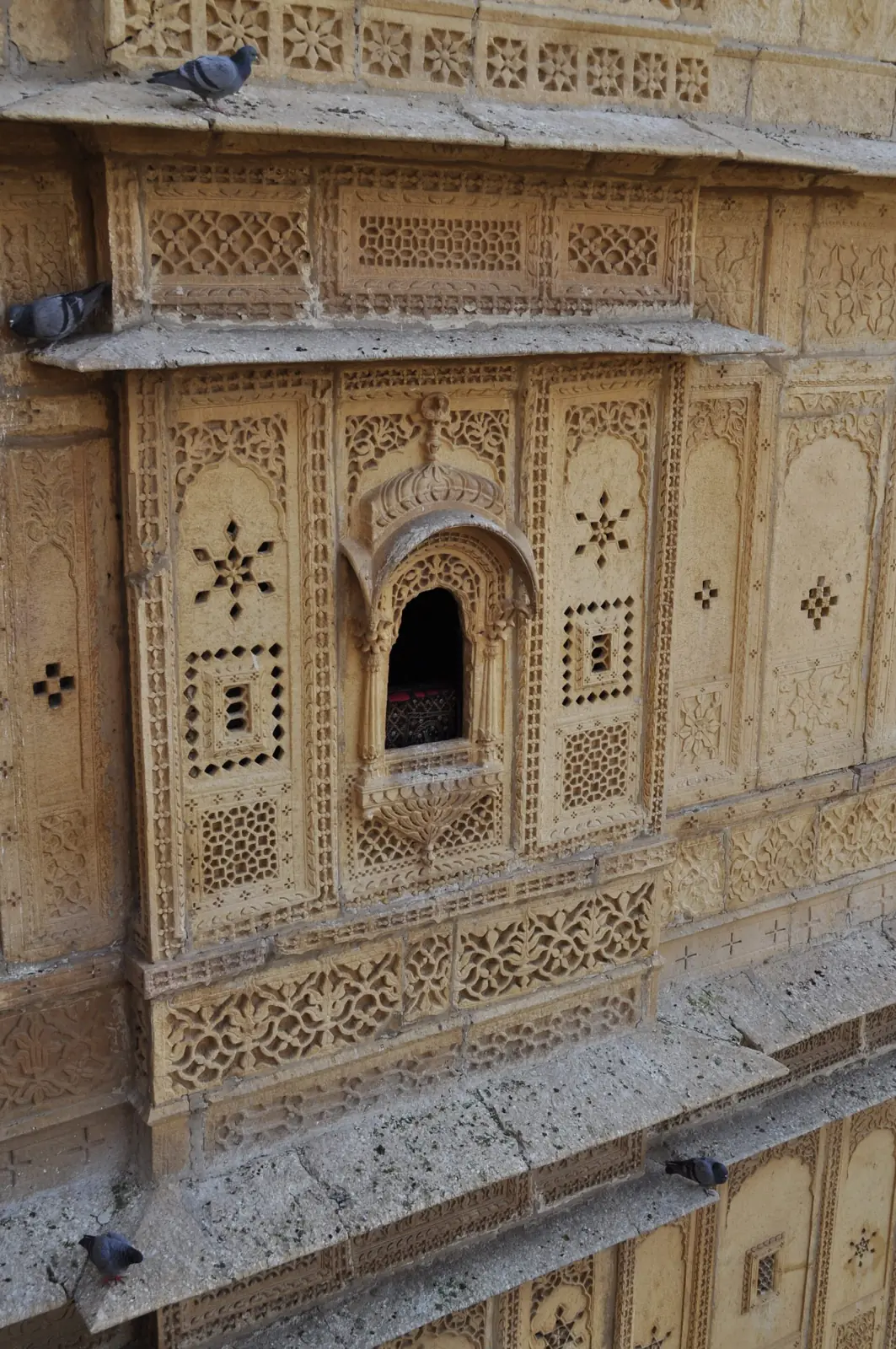
After lunch the car takes you to the havelis. Nathmal ki Haveli is still lived in, so most visitors admire it from the outside, and the official Jaisalmer page explains how two architect brothers built its two halves from opposite ends. Patwon ki Haveli, a group of five mansions, is easier to enter, and one writer recommends a private museum with a terrace for the fort views.
Finish at Gadisar Lake for sunset. Paddle boats and rowing boats are cheap, and the ghats are quiet in the last hour of light.
- Jaisalmer Fort
- Jain temples
- Nathmal ki Haveli
- Patwon ki Haveli
- Gadisar Lake

Day 4 · night in Sam or Khuri desert camp
Kuldhara, then the dunes and a camp for the night
The morning is an easy loop. Kuldhara, the abandoned village on the outskirts, is open from eight to six; reports differ on the mood, with one writer calling it eerily quiet and another saying she could smell sadness in the air rather than anything spooky. Take water, because there is no shade worth the name.
Then comes the choice that decides the night. Sam is the famous dune field and the busiest; one traveller picked Khuri instead because Sam felt commercial and crowded, and found Khuri looked much the same and was quieter. Whichever it is, reach the camp by about half past four to ride a camel in good light, and ask what the booking includes, since jeep dune-bashing and stargazing are often extras. Several writers also say the camel ride becomes uncomfortable after ninety minutes or so, and one who had done it earlier now suggests a jeep safari instead, for the animals' sake.
The evening is a fire, tea, folk songs and a plain dinner of rice, dal and vegetables. Nights are cold and the duvets are thick, so take a warm layer. Dune beetles are real, and so is the stomach upset one traveller suffered; drink from sealed bottles you have chosen yourself.
- Kuldhara
- Sam dunes
- Khuri
- Desert camp
Day 5 · night in Jaisalmer
Sunrise on the sand, then Bada Bagh and a last wander
Get up for the dawn. Light comes over the dunes quickly and the sand takes on colour a few minutes before the sun is up, and the air is at its coldest. After tea, drive back towards Jaisalmer.
Bada Bagh, a few kilometres north of the city, holds the cenotaphs of the ruling family. One writer calls it the place for golden evening light and says sunrise there is quiet, which suits a morning stop. If you want one more haveli, this is the time to see it before the heat builds. Otherwise return to the old city for a last lunch on a rooftop looking at the fort wall.
One practical note from people who did this: book your onward transport out of Jaisalmer early. It is a long way from anywhere, and one couple regretted leaving it to the last day.
- Bada Bagh
- Jaisalmer old city
- Desert sunrise
Sam, Khuri, or a different night altogether
The tourism page for Jaisalmer lists the dunes and the three-day Desert Festival but little else, so most of what is known about camps comes from people who slept in one. The common thread is that the camp is basic. You get a tent or cot, a campfire and a set meal. You do not get silence on a busy weekend at Sam.
Quieter dunes also exist closer to Osian, per Outlook Traveller, where camps offer folk performances by Kalbeliya dancers and clear skies for stargazing. They are an option if the Jaisalmer side feels too busy.

Cold, heat and what to pack
Daytime in October and March is warm and the sun is harsh, but desert nights drop quickly. Jodhpur's January lows are about 5 degrees, and a thin sweater is not enough in a tent. Carry a real jacket, a scarf, closed shoes for the fort lanes and sandals for temples. Sealed water, snacks and a torch are the other items people mention.
Between May and August the desert is hard work. Daytime peaks sit near 45 degrees, and the camps are not at their best.
What travellers would leave out
The most common cut is a second desert night. One couple who booked two nights lost their deposit when one person fell ill, and several accounts say one night is enough. Roadside dhabas on the Ramgarh side drew hygiene remarks from one writer. Border visits to Tanot Mata require a pass and a long queue in afternoon sun, and the advice is to send the driver ahead for it if you add that detour.
What the price covers
- One car and driver from your pickup to the final drop
- 7 nights in hand-picked stays
- Breakfast and dinner every day
- Local guide at the main sights
- Tolls, parking and fuel
- Lunches
- Monument tickets, permits and activity fees
- Personal shopping
Questions people ask
Is five days enough for Jodhpur and Jaisalmer?
Yes, if you accept one night in the desert rather than two. The days are paced so that one is for each fort, one is for the road, and one is for Kuldhara and the dunes.
How long is the drive from Jodhpur to Jaisalmer?
Around 300 km. Writers describe straight road of about four hours without stops, but adding Osian turns it into a full day.
Is a camel safari worth it?
It depends who you ask. People who rode for a couple of hours found it sore, and at least one traveller now recommends a jeep safari for animal welfare reasons. A short ride at sunset is the version most people are happy with.
Can we visit from Delhi, Agra, Mathura or Jaipur?
Yes. Laladham picks you up from any of those four places. The drive to Jodhpur becomes a separate travel day, so the five days here begin fresh with the fort.
Is the Jaisalmer fort open to visitors at night?
It is a lived-in neighbourhood, so the lanes are open at all hours. Inside, the Jain temples close at midday, and the palace museum keeps its own hours.
Are the desert camps safe for women and families?
Most travellers report simple but orderly camps. Choose one with proper tents and sealed water, arrive before dark, and ask beforehand about shared or private tents.
- Mehrangarh hours and ticket cut-off: museum site said 9 am to 5 pm daily when read on 15 Nov 2026.
- Jain temples in Jaisalmer Fort reportedly shut at midday; hours and photography rules vary by source.
- Kuldhara gate hours (reports say 8 am to 6 pm) and Sachiya Mata temple dress and shoe rules.
- Camp inclusions at Sam or Khuri: jeep dune ride, stargazing and cultural show are often extras.
 3 days
 5 days
 5 days