महाभारत प्रसंग · Mahabharata episodes
भीष्म की प्रतिज्ञा
Devavrata becomes Bhishma
A prince gives up a throne and a family of his own so that his father can marry, and is given a name for it.
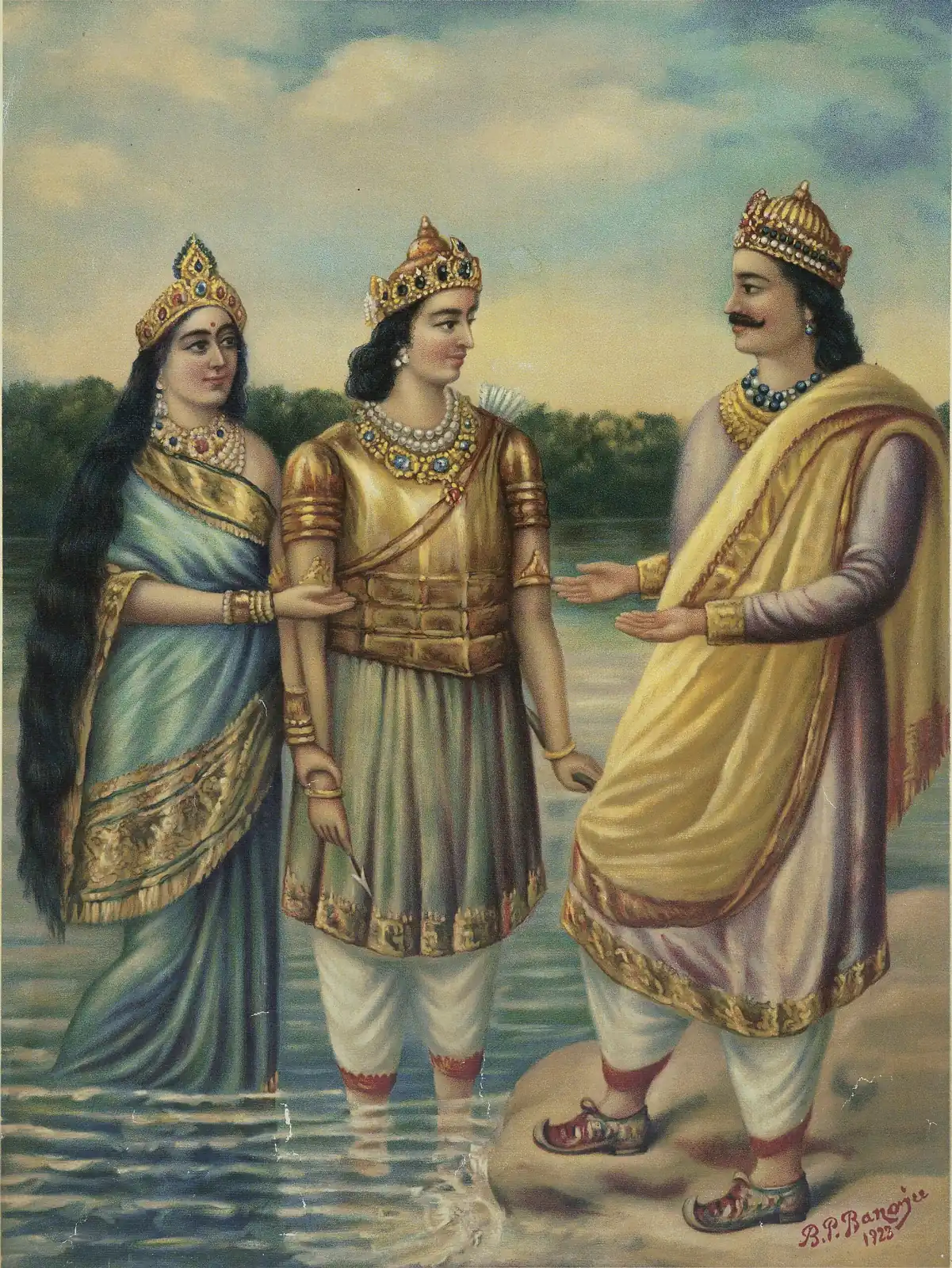
Source followed. Follows the Mahabharata, Adi Parva, the Sambhava Parva section.
महाभारत, आदि पर्व, संभव पर्व के प्रसंग के अनुसार।
King Shantanu of Hastinapur had a son, Devavrata, the child of his marriage with the river goddess Ganga. Ganga had left him after the child was born, but the boy grew up as a wise, kind and skilful prince, and was named heir. Shantanu was happy with him. Then, one day, walking by the Yamuna, the king caught a scent that he had never smelled.
It came from a fisherman's daughter, Satyavati, who was working the ferry. Shantanu fell in love and went to her father. The chief of the fishermen would only give his daughter in marriage if her sons, and no one else's, would become king. Shantanu would not agree. He went home and fell silent and unhappy. He told nobody why.
Devavrata saw his father's grief and asked his ministers until one told him. At once he went himself to the fisherman. The chief repeated his condition and added a doubt: you might give up the throne yourself, he said, but what about your sons? Devavrata then took an oath in front of him. He gave up his claim to the throne for ever.
The fisherman still hesitated, and Devavrata added a second oath, harder than the first. He vowed that he would never marry and never have children, so that no son of his would one day claim the throne. The sky is said to have thundered and flowers fell. The gods called out his new name: Bhishma, the one who has taken a terrible vow.
Shantanu, hearing what his son had done, gave him a boon: he would die only when he himself chose. Bhishma lived for the rest of his long life as the guardian of the throne he had renounced. He would be the grandfather of the Kauravas and the Pandavas, and the commander of the army in the first ten days of the war. The question the epic leaves hanging is whether his oath saved the kingdom or, by tying his hands, helped destroy it.
प्रश्न Questions, answered
Why is he called Bhishma?
From bhishana, terrible, because of his terrible vow of celibacy and of giving up the throne.
What was Bhishma's boon?
Icchamrityu, the power to choose the hour of his death, given by his father Shantanu.
Who was Satyavati?
A fisherman's daughter who married Shantanu and became the grandmother of the Kauravas and Pandavas through her son Vyasa and her sons by Shantanu.