Many devs · नित्य पूजा
घर पर हवन
Havan at Home
A home havan is a small fire in a kund fed with samidha, ghee and samagri, each offering ending in Svaha. Here is how to set it up, offer, close and keep it safe indoors.
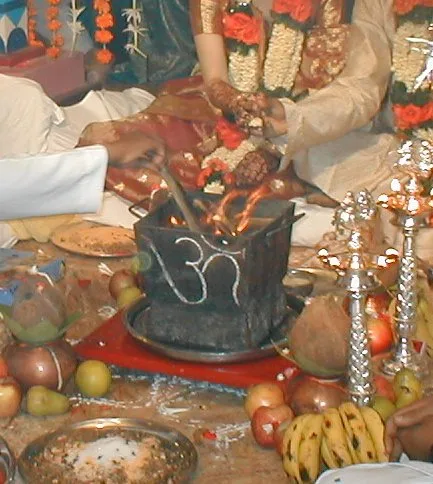
Morning after bath, or at dusk, on any day a family wishes, and as part of Griha Pravesh, birthdays, Navratri or Navagraha shanti. Check the panchang for a muhurat if it is a named occasion. Avoid doing it while the house is in sutak.
Anyone in the family, led by whoever knows the mantras. Children may offer the samagri when an adult handles the ghee and the flame. A pandit is invited for large havans of 108 or 1008 ahutis.
30 minutes for a short havan, 1 hour or more for a full one
सामग्री Samagri checklist
Fire
Offerings
Around the kund
तैयारी Before you begin
- Choose a room with a high ceiling or a balcony and an open window; havan smoke is thick.
- Place the kund on a non-flammable base, east side facing, clear of curtains and low furniture.
- Keep the water bowl and the sand bucket within reach, and a fire extinguisher if one is in the house.
- Switch off or cover the smoke alarm only if the rules of the building allow, and uncover it right after.
- Bathe, wear clean clothes, and abstain from meat and intoxicants the day before.
पूजा विधि Step by step
आचमन Achaman, sipping water to purify
about 2 minutes
Sit on your asan facing east or north with a small cup (a copper or steel panchpatra if you have one) of clean water and a spoon. Pour a little water into your right palm and sip it three times, each time with one name of Vishnu, without a sound of slurping. Then wash the right palm, touch your lips, and touch water to the eyes, nose, ears and heart with the fingers, as your family does. Take only a small sip each time, not a mouthful. Do it before sankalp, and again whenever you leave the seat and return.
ॐ केशवाय नमः। ॐ नारायणाय नमः। ॐ माधवाय नमः।
Om Keshavaya namah. Om Narayanaya namah. Om Madhavaya namah.
Meaning: Salutations to Keshava, Narayana and Madhava, three names of Vishnu, one for each sip. Many Vedic households say 'svaha' in place of 'namah' for these three sips, and the Sandhya text does the same.
ॐ गोविन्दाय नमः
Om Govindaya namah
Meaning: A fourth name of Vishnu, said as the hand is washed after the three sips.
संकल्प Sankalp, the vow of intent
about 3 minutes
Sit facing east or north. In your right palm take water, a few whole rice grains (akshat), a flower and, if you like, a coin. Hold your right wrist with your left hand. Say the sankalp slowly: it names the cosmic time, the place, the Hindu year, month, fortnight, tithi, weekday and nakshatra, then your gotra, your name and the puja you are about to do. Where the blanks below say 'अमुक', fill your own details; for the panchang parts use a panchang for your city. At the end let the water fall on the ground or into a copper plate, then begin the puja. If you do not know your gotra, many priests say to use 'Kashyap' as the gotra of an unknown line; confirm this with your family priest.
ॐ विष्णुः विष्णुः विष्णुः। अद्य ब्रह्मणो द्वितीये परार्धे श्रीश्वेतवाराहकल्पे वैवस्वतमन्वन्तरे अष्टाविंशतितमे कलियुगे कलिप्रथमचरणे जम्बूद्वीपे भरतवर्षे भरतखण्डे अमुकदेशे अमुकनामसंवत्सरे अमुकमासे अमुकपक्षे अमुकतिथौ अमुकवासरे अमुकगोत्रोत्पन्नः अमुकनामाहं अमुकपूजनं करिष्ये।
Om Vishnur Vishnur Vishnuh. Adya Brahmano dvitiye parardhe Shri-Shvetavarahakalpe Vaivasvatamanvantare ashtavimshatitame Kaliyuge Kaliprathamacharane Jambudvipe Bharatavarshe Bharatakhande amuka-deshe amuka-nama-samvatsare amuka-mase amuka-pakshe amuka-tithau amuka-vasare amuka-gotrotpannah amuka-namaham amuka-pujanam karishye.
Meaning: Vishnu, Vishnu, Vishnu. Today, in the second half of Brahma's life, in the Shveta-Varaha kalpa, in the Vaivasvata manvantara, in the 28th Kali yuga, in its first quarter, in Jambudvipa, Bharata-varsha, Bharata-khanda, in this place, in this named year, month, fortnight, tithi and weekday, I of this gotra and this name will perform this puja. This is the commonly given template: the cosmic-time lines agree in the sources we read, but the wording differs a little between books (one source says 'second half of the second watch' in place of 'second half of Brahma's life'), and a puja often adds a line naming the wish, such as long life, health or prosperity. Use the line your priest gives.
Name the purpose of this havan: a festival, a house, a birthday, or only the daily peace of the home.
कुंड की तैयारी Setting the kund
about 5 minutes
Sit facing east with the kund in front. Lay a few dry coconut pieces and mango sticks in a neat square, small ones below and the thicker sticks across the top, leaving gaps for air. Place the ghee on your right and the samagri bowl on your left.
अग्नि स्थापना Lighting the fire
about 5 minutes
Light camphor and touch it to the fuel, saying the vyahriti Om Bhur Bhuvah Svah. Wait until the sticks catch, then offer ghee eight times to feed the flame. Do not blow hard into the fire; fan it with a plate.
ॐ भूर्भुवः स्वः
Om Bhur Bhuvah Svah
Meaning: The three worlds: earth, the space between, and heaven
प्रारंभिक आहुतियाँ Opening oblations
about 5 minutes
Take a little ghee on the spoon for each name and pour it into the flame at Svaha. Offer to Prajapati, Indra, Agni and Soma in turn. At Svaha, let the drop fall into the fire rather than on the rim.
ॐ प्रजापतये स्वाहा
Om Prajapataye Svaha
Meaning: Offered to Prajapati, the Lord of creatures
ॐ इन्द्राय स्वाहा
Om Indraya Svaha
Meaning: Offered to Indra
ॐ अग्नये स्वाहा
Om Agnaye Svaha
Meaning: Offered to Agni, the fire
ॐ सोमाय स्वाहा
Om Somaya Svaha
Meaning: Offered to Soma, the moon
इष्ट देव की आहुति Oblations to the deity of the day
about 10 minutes
Now offer to the deity of your puja, such as Ganesh for a new venture, Lakshmi at Diwali or the grahas in Navagraha shanti. Say the name with Namah Svaha and add samagri with the ghee each time. Eight or eleven rounds is common.
ॐ गं गणपतये नमः स्वाहा
Om Gam Ganapataye Namah Svaha
Meaning: Offered with salutation to Ganapati
गायत्री आहुति Gayatri ahutis
about 15 to 25 minutes
The most widespread home havan is chanting the Gayatri mantra with an ahuti at the end of each round. Counts of 24, 108, 1008 and more are quoted. In a home setting 11, 21 or 24 rounds are reasonable. Keep a rosary or count on fingers so the number is not lost.
ॐ भूर्भुवः स्वः। तत्सवितुर्वरेण्यं भर्गो देवस्य धीमहि। धियो यो नः प्रचोदयात्॥
Om Bhur Bhuvah Svah. Tat Savitur Varenyam, Bhargo Devasya Dhimahi, Dhiyo Yo Nah Prachodayat
Meaning: We meditate on the radiance of the divine Sun; may it awaken our understanding
अंतिम आहुतियाँ Closing oblations
about 5 minutes
Offer ghee for Agni, Vayu and Surya in turn, then to Vishnu and Rudra, each with Svaha, and one for Bhur Bhuvah Svah. This closes the main round.
पूर्णाहुति Purnahuti
about 5 minutes
Stand up if you can. Place a coconut piece, a betel nut, a spoon of samagri and a long stream of ghee in the fire together, and pray for the family, the home and all beings. Everyone puts a flower or grain at the end.
शांति पाठ Shanti path
about 3 minutes
Sit quietly for a minute, watching the flame fall. Close with the shanti call, three times, and pour a spoon of water around the kund.
ॐ शान्तिः शान्तिः शान्तिः
Om Shantih Shantih Shantih
Meaning: Peace in body, mind and surroundings
आरती विधि How to do aarti
about 5 minutes
Aarti comes near the end of the puja, after the offerings. Stand in front of the deity with a thali holding a ghee lamp (or camphor), a small bell, a flower and a little water. Ring the bell with the left hand and wave the thali with the right, always clockwise: in front of the deity, the thali goes from your left to your right in a full circle. Many households do about four circles at the feet, two at the navel or belly, one at the face and then seven or so around the whole form, going from feet upward. Sources do not agree on these counts, so follow your family; the clockwise circle is the part all agree on. Camphor is lit last and waved the same way, and one verse (karpur-gauram or the nirajan verse) is said while it burns. Sing the aarti of the deity with everyone, clapping softly in time. Then take the aarti: hold your hands over the flame and touch them lightly to your eyes and forehead, and pass the thali to others. Walk once round the deity clockwise and bow. Afterwards set the lamp back in the shrine; whether it burns on or is put out gently depends on your family custom, and a lamp that goes out in the middle can simply be relit.
कदलीगर्भसम्भूतं कर्पूरं तु प्रदीपितम्। आरार्तिकमहं कुर्वे पश्य मे वरदो भव॥
Kadali-garbha-sambhutam karpuram tu pradipitam. Aratikam aham kurve pashya me varado bhava.
Meaning: Camphor born from the heart of the plantain, now lit, I wave in aarti: look on me and be a giver of boons. Two drikpanchang pages give the first line as 'kadali-garbha-sambhutam karpuram tu pradipitam'; the second line is as it is commonly printed.
आरती और विसर्जन Aarti and closing
After the purnahuti show camphor to the flame and to the deity picture, sing the aarti sitting or standing close, and take the warmth of the fire with both hands over the eyes and head.
Leave the flame to die out by itself. Do not use water to put it out. Once the kund is cool, collect the ash in a clean cloth; a little is kept for tilak and the rest is put at the roots of a plant. Wash the kund and spoons after they are fully cool.
क्या करें · Do
- Use dry mango wood and pure ghee, and keep the room ventilated.
- Keep children and pets at an arm's length from the kund.
- Supervise the fire until the last ember is cold.
- Count every ahuti in your head or on a rosary.
क्या न करें · Avoid
- Do not use plastic, garbage or wet wood as fuel.
- Do not put water on the fire to end it.
- Do not leave the kund near curtains, sofas or a gas stove.
- Do not run a havan in a closed room with the doors shut.
परंपराएँ Variations and Braj
- Arya Samaj havans keep to the Vedic mantras and say Idam na mama after every offering; Sanatani families often use the shorter Svaha form.
- South Indian homam follows its own order of offerings and kund shapes, so a family from that tradition should follow its own priest.
- Some use sesame oil in place of ghee in specific homas; this is by tradition and the pandit decides it.
In Braj, cow ghee is the offering most families insist on, and a havan at home is often followed by a kirtan or a Krishna aarti before the prasad.
प्रश्न Questions, answered
Can I do a havan inside a flat?
Yes, if ventilation and fire safety are looked after. Open a window, keep a small kund on a metal tray, and check the building rules and the smoke alarm before you start.
Which wood is used as samidha?
Dry mango wood is the usual choice, with sandalwood and devdaru added in some homes. For the nine grahas, a different wood is used for each; see the Navgraha shanti page.
How many ahutis are needed?
There is no single number. A small one may have 11, 21 or 24 Gayatri ahutis, a larger one 108, 1008 or more. Choose what the family can complete calmly.
What does Svaha mean?
Svaha is the word said as the offering goes into the fire. It is the call that hands the oblation to Agni to carry to the deity named before it.
Can I use water to put out the fire?
Guides advise leaving it to die down on its own and using the ash as vibhuti. In an emergency, do use sand or water for safety first.
कुल की परंपरा सर्वोपरि है। Where your family custom differs, follow it, and ask your priest when in doubt.
Check locally
- Whether your building allows an open flame indoors, and where the smoke alarm sits.
- The ahuti count and the mantra order your family tradition uses.
- Safety advice here is common-sense and not taken from a havan-specific fire code.
Doing this in Braj? Seekers often bring a puja to Vrindavan, Govardhan or Mathura. A Laladham driver who knows the ghats and the timings is one message away.
Plan my trip