श्रीकृष्ण · अष्टोत्तरशतनामावली
श्रीकृष्ण के १०८ नाम
108 names of Krishna with meaning
108 names of Krishna with meaning in English and Hindi: the full Ashtottara Shatanamavali in Sanskrit, with the Om Namah line for each name and how to chant it.
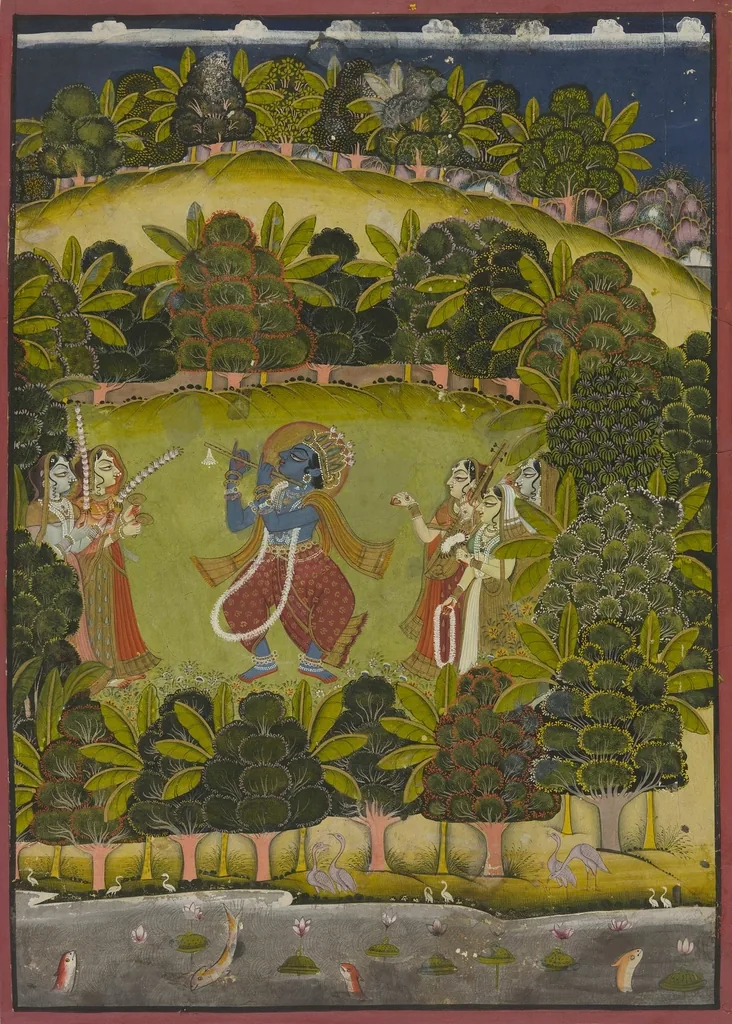
Krishna has more names than any other figure in the Hindu tradition, and each one is a small story. Some recall a child stealing butter in Gokul, some a charioteer holding the reins on the field of Kurukshetra, and some point past every story to the one reality behind all forms. Devotees say a name is a doorway: when you repeat it, you step into the scene it carries.
This page gives the traditional hundred and eight, one by one, in the order they are printed in puja books. Beside every name you will find the Sanskrit in Devanagari, a plain spelling you can read aloud, the Om Namah line used for offering, and a short meaning in English and in Hindi. The meanings were worked out from the Sanskrit roots, with a second sense noted where the tradition gives one.
Use it in whichever way suits you: read it slowly once to know whom you are calling, chant it on Janmashtami, or pick a single name for a child, a mantra or a quiet morning. If a name here lights up a memory of Braj, that is exactly how the list was meant to work.
१०८ नाम The full list, with meaning
108 of 108 names
- 1
कृष्ण
Krishna
The dark one, who draws every heart toward himself
जो श्याम वर्ण हैं और सबके मन को अपनी ओर खींच लेते हैं
- 2
कमलानाथ
Kamalanatha
Lord of Kamala, which is Lakshmi
कमला यानी लक्ष्मी जी के स्वामी
- 3
वासुदेव
Vasudeva
Son of Vasudeva; also the one who dwells in all beings
वसुदेव जी के पुत्र, और सब प्राणियों में बसने वाले
- 4
सनातन
Sanatana
The eternal one, without beginning or end
जो सदा से हैं और सदा रहेंगे
- 5
वसुदेवात्मज
Vasudevatmaja
Born as the son of Vasudeva
जिन्होंने वसुदेव जी के पुत्र के रूप में जन्म लिया
- 6
पुण्य
Punya
The holy one, whose remembrance brings merit
जो स्वयं पवित्र हैं और जिनका स्मरण पुण्य देता है
- 7
लीलामानुषविग्रह
Lilamanushavigraha
He who took a human form as a divine play
जिन्होंने लीला के लिए मनुष्य का रूप धारण किया
- 8
श्रीवत्सकौस्तुभधर
Shrivatsakaustubhadhara
Bearer of the Shrivatsa mark and the Kaustubha jewel on his chest
जो वक्ष पर श्रीवत्स चिह्न और कौस्तुभ मणि धारण करते हैं
- 9
यशोदावत्सल
Yashodavatsala
The beloved child of Yashoda
यशोदा मैया के लाडले पुत्र
- 10
हरि
Hari
The one who takes away sorrow and sin
जो दुख और पाप को हर लेते हैं
- 11
चतुर्भुजात्तचक्रासिगदाशङ्खाद्यायुध
Chaturbhujattachakrasigadashankhadyayudha
Four armed, holding discus, sword, mace, conch and other weapons
चार भुजाओं में चक्र, खड्ग, गदा, शंख आदि धारण करने वाले
- 12
देवकीनन्दन
Devakinandana
The joy of Devaki
देवकी माता को आनंद देने वाले पुत्र
- 13
श्रीश
Shrisha
Lord of Shri, the goddess Lakshmi
श्री यानी लक्ष्मी जी के स्वामी
- 14
नन्दगोपप्रियात्मज
Nandagopapriyatmaja
The dear son of Nanda the cowherd chief
नंद गोप के प्यारे पुत्र
- 15
यमुनावेगसंहारी
Yamunavegasamhari
He who stilled the flood of the Yamuna on the night of his birth
जिन्होंने यमुना के उफनते वेग को शांत किया
- 16
बलभद्रप्रियानुज
Balabhadrapriyanuja
The younger brother dear to Balarama
बलराम जी के प्यारे छोटे भाई
- 17
पूतनाजीवितहर
Putanajivitahara
He who drew out the life of the demoness Putana
जिन्होंने पूतना राक्षसी के प्राण खींच लिए
- 18
शकटासुरभञ्जन
Shakatasurabhanjana
Breaker of the cart demon Shakata
शकटासुर नामक दैत्य को तोड़ने वाले
- 19
नन्दव्रजजनानन्दी
Nandavrajajananandi
Delight of the people of Nanda's Vraja
नंद के व्रज के लोगों को आनंद देने वाले
- 20
सच्चिदानन्दविग्रह
Sachchidanandavigraha
Whose form is being, awareness and bliss
जिनका स्वरूप सत्, चित् और आनंद है
- 21
नवनीतविलिप्ताङ्ग
Navanitaviliptanga
With limbs smeared in fresh butter
जिनके अंग ताज़े माखन से सने हैं
- 22
नवनीतनट
Navanitanata
The little dancer who dances for butter
माखन के लिए नाचने वाले नटखट
- 23
अनघ
Anagha
The sinless one, free of any fault
जो निष्पाप हैं और जिनमें कोई दोष नहीं
- 24
नवनीतनवाहारी
Navanitanavahari
Eater of freshly churned butter
ताज़ा मथे हुए माखन को खाने वाले
- 25
मुचुकुन्दप्रसादक
Muchukundaprasadaka
He who showed grace to the old king Muchukunda
राजा मुचुकुंद पर कृपा करने वाले
- 26
षोडशस्त्रीसहस्रेश
Shodashastrisahasresha
Lord of the sixteen thousand queens of Dwarka
द्वारका की सोलह हज़ार रानियों के स्वामी
- 27
त्रिभङ्गी
Tribhangi
He who stands bent at three places, the flute pose
जो तीन जगह से झुकी हुई मुद्रा में खड़े होते हैं
- 28
मधुराकृति
Madhurakriti
Of a sweet and enchanting form
जिनका रूप अत्यंत मधुर और मोहक है
- 29
शुकवागमृताब्धीन्दु
Shukavagamritabdhindu
The moon that swells the ocean of Shuka's nectar-like words, the Bhagavata
शुकदेव जी की अमृत जैसी वाणी के सागर को बढ़ाने वाले चंद्रमा
- 30
गोविन्द
Govinda
Protector of cows and senses; also the finder of the earth
गायों और इंद्रियों के रक्षक
- 31
योगिनांपति
Yoginampati
Lord of the yogis
योगियों के स्वामी
- 32
वत्सवाटचर
Vatsavatachara
He who roams the calf-pens, tending the calves
बछड़ों के बाड़े में घूमने और बछड़े चराने वाले
- 33
अनन्त
Ananta
The endless one, without limit
जिनका कोई अंत नहीं
- 34
धेनुकासुरभञ्जन
Dhenukasurabhanjana
Breaker of the donkey demon Dhenuka
धेनुकासुर नामक दैत्य का संहार करने वाले
- 35
तृणीकृततृणावर्त
Trinikritatrinavarta
He who made the whirlwind demon Trinavarta like a blade of straw
जिन्होंने तृणावर्त को तिनके के समान कर दिया
- 36
यमलार्जुनभञ्जन
Yamalarjunabhanjana
Breaker of the twin arjuna trees
यमलार्जुन नाम के जुड़वाँ वृक्षों को गिराने वाले
- 37
उत्तालतालभेत्ता
Uttalatalabhetta
He who split the lofty palm trees of Talavana
ताल वन के ऊँचे ताड़ वृक्षों को भेदने वाले
- 38
गोपगोपीश्वर
Gopagopishvara
Lord of the cowherds and the gopis
गोपों और गोपियों के स्वामी
- 39
योगी
Yogi
The master of yoga
योग के परम ज्ञाता
- 40
कोटिसूर्यसमप्रभ
Kotisuryasamaprabha
Shining like ten million suns
करोड़ों सूर्यों के समान तेज वाले
- 41
इलापति
Ilapati
Lord of Ila, the earth
इला यानी पृथ्वी के स्वामी
- 42
परंज्योति
Paranjyoti
The supreme light
परम प्रकाश स्वरूप
- 43
यादवेन्द्र
Yadavendra
Chief of the Yadavas
यदुवंशियों के राजा
- 44
यदूद्वह
Yadudvaha
Upholder of the line of Yadu
यदु के वंश को संभालने वाले
- 45
वनमाली
Vanamali
Wearer of the garland of forest flowers
वन के फूलों की माला पहनने वाले
- 46
पीतवासी
Pitavasi
Clad in yellow silk
पीले वस्त्र धारण करने वाले
- 47
पारिजातापहारक
Parijatapaharaka
He who carried the Parijata tree away from heaven
स्वर्ग से पारिजात वृक्ष ले आने वाले
- 48
गोवर्धनाचलोद्धर्ता
Govardhanachaloddharta
Lifter of the mountain Govardhan
गोवर्धन पर्वत को उठाने वाले
- 49
गोपाल
Gopala
Herder and protector of cows
गायों के पालक और रक्षक
- 50
सर्वपालक
Sarvapalaka
Protector of all beings
सब प्राणियों का पालन और रक्षण करने वाले
- 51
अज
Aja
The unborn, beyond the cycle of birth
जो जन्म के चक्र से परे हैं
- 52
निरञ्जन
Niranjana
Spotless, untouched by any stain
निर्मल, जिन्हें कोई दाग नहीं छूता
- 53
कामजनक
Kamajanaka
Father of Kama; Pradyumna, his son, is Kama born again
कामदेव के पिता, क्योंकि प्रद्युम्न उन्हीं के पुत्र रूप में कामदेव थे
- 54
कञ्जलोचन
Kanjalochana
Lotus eyed
कमल के समान नेत्रों वाले
- 55
मधुघ्न
Madhughna
Slayer of the demon Madhu
मधु नामक दैत्य का वध करने वाले
- 56
मथुरानाथ
Mathuranatha
Lord of Mathura
मथुरा नगरी के स्वामी
- 57
द्वारकानायक
Dwarakanayaka
Leader and lord of Dwarka
द्वारका के नायक
- 58
बली
Bali
The mighty one
महान बलशाली
- 59
बृन्दावनान्तसञ्चारी
Brindavanantasanchari
Wanderer through the groves of Vrindavan
वृंदावन के वनों में विचरण करने वाले
- 60
तुलसीदामभूषण
Tulasidamabhushana
Adorned with a garland of tulsi
तुलसी की माला से सजे हुए
- 61
स्यमन्तकमणिहर्ता
Syamantakamanihartta
He who took back the Syamantaka jewel from Jambavan
जिन्होंने जाम्बवान से स्यमंतक मणि वापस ली
- 62
नरनारायणात्मक
Naranarayanatmaka
One in spirit with the twin sages Nara and Narayana
नर और नारायण ऋषियों से एक स्वरूप वाले
- 63
कुब्जाकृष्णाम्बरधर
Kubjakrishnambaradhara
Wearer of dark cloth; the name also recalls Kubja, whom he made straight
काले वस्त्र धारण करने वाले; यह नाम कुब्जा की कथा की भी याद दिलाता है
- 64
मायी
Mayi
Master of maya, the divine power of illusion
माया की दिव्य शक्ति के स्वामी
- 65
परमपुरुष
Paramapurusha
The supreme person
परम पुरुष, सबसे श्रेष्ठ
- 66
मुष्टिकासुरचाणूरमल्लयुद्धविशारद
Mushtikasurachanuramallayuddhavisharada
Master wrestler who overcame Mushtika and Chanura
मल्लयुद्ध में निपुण, जिन्होंने मुष्टिक और चाणूर को हराया
- 67
संसारवैरी
Samsaravairi
Enemy of worldly bondage
संसार के बंधनों के शत्रु
- 68
कंसारि
Kamsari
The foe and slayer of Kamsa
कंस के शत्रु और उसका अंत करने वाले
- 69
मुरारि
Murari
Foe of the demon Mura
मुर दैत्य के शत्रु
- 70
नरकान्तक
Narakantaka
Ender of the demon Narakasura
नरकासुर का अंत करने वाले
- 71
अनादिब्रह्मचारी
Anadibrahmachari
The beginningless one, ever steady in Brahman
आदि से रहित, सदा ब्रह्म में स्थित रहने वाले
- 72
कृष्णाव्यसनकर्षक
Krishnavyasanakarshaka
Remover of the distress of Draupadi, who is also called Krishna
द्रौपदी, जिनका एक नाम कृष्णा है, के संकट को दूर करने वाले
- 73
शिशुपालशिरच्छेत्ता
Shishupalashirachchhetta
He who cut off the head of Shishupala
शिशुपाल का सिर काटने वाले
- 74
दुर्योधनकुलान्तक
Duryodhanakulantaka
Ender of Duryodhana's line
दुर्योधन के कुल का अंत करने वाले
- 75
विदुराक्रूरवरद
Vidurakruravarada
Giver of boons to Vidura and Akrura
विदुर और अक्रूर को वरदान देने वाले
- 76
विश्वरूपप्रदर्शक
Vishvarupapradarshaka
He who showed his cosmic form
जिन्होंने अपना विराट विश्वरूप दिखाया
- 77
सत्यवाक्
Satyavak
Of true speech
जिनकी वाणी सदा सत्य है
- 78
सत्यसङ्कल्प
Satyasankalpa
Whose resolve always comes true
जिनका संकल्प सदा सच होता है
- 79
सत्यभामारत
Satyabhamarata
Devoted to Satyabhama
सत्यभामा जी के प्रिय
- 80
जयी
Jayi
The ever victorious
सदा विजयी रहने वाले
- 81
सुभद्रापूर्वज
Subhadrapurvaja
Elder brother of Subhadra
सुभद्रा जी के बड़े भाई
- 82
जिष्णु
Jishnu
The triumphant one
विजय पाने वाले
- 83
भीष्ममुक्तिप्रदायक
Bhishmamuktipradayaka
Giver of liberation to Bhishma
भीष्म पितामह को मुक्ति देने वाले
- 84
जगद्गुरु
Jagadguru
Teacher of the whole world
समस्त संसार के गुरु
- 85
जगन्नाथ
Jagannatha
Lord of the universe
जगत के स्वामी
- 86
वेणुनादविशारद
Venunadavisharada
Master of the call of the flute
बाँसुरी की तान में निपुण
- 87
वृषभासुरविध्वंसी
Vrishabhasuravidhvamsi
Destroyer of the bull demon Vrishabhasura
वृषभासुर नामक बैल रूपी दैत्य का नाश करने वाले
- 88
बाणासुरकरान्तक
Banasurakarantaka
He who cut down the arms of Banasura
बाणासुर की भुजाएँ काटने वाले
- 89
युधिष्ठिरप्रतिष्ठाता
Yudhishthirapratishthata
He who established Yudhishthira on the throne
युधिष्ठिर को राजसिंहासन पर प्रतिष्ठित करने वाले
- 90
बर्हिबर्हावतंसक
Barhibarhavatamsaka
Crowned with a peacock feather
मोरपंख को मुकुट की तरह धारण करने वाले
- 91
पार्थसारथि
Parthasarathi
Charioteer of Partha, which is Arjuna
पार्थ यानी अर्जुन के सारथी
- 92
अव्यक्त
Avyakta
The unmanifest, beyond the senses
जो इंद्रियों से परे और अप्रकट हैं
- 93
गीतामृतमहोदधि
Gitamritamahodadhi
The great ocean of the nectar of the Gita
गीता रूपी अमृत के विशाल सागर
- 94
कालीयफणिमाणिक्यरञ्जितश्रीपदाम्बुज
Kaliyaphanimanikyaranjitashripadambuja
Whose lotus feet are reddened by the gems on the hoods of Kaliya
जिनके चरणकमल कालिय नाग के फनों की मणियों से रंग गए
- 95
दामोदर
Damodara
The one bound at the waist with a rope by Yashoda
जिन्हें यशोदा मैया ने कमर में रस्सी से बाँधा
- 96
यज्ञभोक्ता
Yajnabhokta
Receiver of the offerings of every sacrifice
हर यज्ञ की आहुति ग्रहण करने वाले
- 97
दानवेन्द्रविनाशक
Danavendravinashaka
Destroyer of the chiefs of the danavas
दानवों के सरदारों का नाश करने वाले
- 98
नारायण
Narayana
The refuge of all beings
सब प्राणियों के परम आश्रय
- 99
परब्रह्म
Parabrahma
The supreme reality
परम ब्रह्म
- 100
पन्नगाशनवाहन
Pannagashanavahana
Whose mount is Garuda, the eater of serpents
नागों को खाने वाले गरुड़ जिनके वाहन हैं
- 101
जलक्रीडासमासक्तगोपीवस्त्रापहारक
Jalakridasamasaktagopivastrapaharaka
He who took away the clothes of the gopis absorbed in water play, a tale from the Bhagavata
जल में खेलने में मग्न गोपियों के वस्त्र ले जाने वाले, भागवत की एक कथा
- 102
पुण्यश्लोक
Punyashloka
Of holy fame, whose praise purifies
जिनका यश सुनने और गाने से पुण्य मिलता है
- 103
तीर्थपाद
Tirthapada
Whose feet are themselves a sacred ford
जिनके चरण स्वयं तीर्थ हैं
- 104
वेदवेद्य
Vedavedya
He who is known through the Vedas
जो वेदों के द्वारा जाने जाते हैं
- 105
दयानिधि
Dayanidhi
Treasure house of compassion
दया के भंडार
- 106
सर्वतीर्थात्मक
Sarvatirthatmaka
In whom all sacred waters and places dwell
जिनमें सभी तीर्थ समाए हुए हैं
- 107
सर्वग्रहरूपी
Sarvagraharupi
He who takes the form of all the grahas, the planets
सभी ग्रहों के रूप में विराजने वाले
- 108
परात्पर
Paratpara
Higher than the highest
श्रेष्ठ से भी श्रेष्ठ
स्रोत Where this list comes from
The hundred and eight names followed here are the Krishna Ashtottara Shatanama, which the printed editions give both as a Sanskrit stotra of twenty verses and as a namavali, a list of salutations that begins Om Krishnaya Namah. The Sanskrit text carries a colophon naming the Narada Pancharatra, a Vaishnava treatise of the Pancharatra school, as the book it is tied to. I have not been able to check that attribution against a critical edition, so treat it as the tradition's own claim.
Ashtottara means one hundred and eight, and shatanama means hundred names. The number is a sacred round figure in Indian worship: it is the length of a japa mala, and so a list of this size can be chanted bead by bead. The text begins with Krishna, Kamalanatha, Vasudeva and Sanatana, and closes with Paratpara, the one who is higher than the highest.
This list is a short companion to the long thousand-name hymns that devotees recite for Vishnu and for Krishna, and it carries the best known epithets from the childhood in Gokul, the years in Mathura and Dwarka, and the teaching of the Gita. Other lineages, including the Gaudiya tradition, keep their own hundred and eight, so you may meet lists that differ. The variants noted below show where the printed copies I compared disagree.
This page follows the 108 names as printed on Stotranidhi, which agree with the Drikpanchang stotra except at a few points. The stotra text omits Navanitaviliptanga, Navanitanata and Anagha but adds Tamalashyamalakriti, and reads Vatsapalanasanchari, Bakari, Tirthakara, Vishnu and Banabahukrit where this list has Vatsavatachara, Banasurakarantaka, Tirthapada and Jishnu. The Bhaktibharat printing keeps Tamalashyamalakriti and splits name 11 into two. The name Mathuranatha is sometimes misprinted as Madhuranatha.
जप और पूजा How the names are chanted
Each name is offered in the dative case with Om before it and Namah after it, so that Keshava becomes Om Keshavaya Namah. The line on this page is already set in that form, and you only have to read it. Pronounce each name clearly, and let the word Namah settle before you begin the next.
For a simple puja, sit facing the picture or murti after your bath, light a lamp and offer a tulsi leaf, a flower or a few grains of rice at each name, placing it at the feet of Krishna. If a full offering feels long, hold a mala and chant the list once for the sake of the count, or take only the names that speak to you. A cloth of yellow, a spoon of butter with sugar crystals, and tulsi are the offerings most Vaishnava homes keep ready.
Ekadashi is dear to Krishna's devotees, and families who keep a weekly habit often choose one fixed morning for it. The night of Janmashtami is the high point of the year, when the list is read out before the midnight aarti. Women and men, young and old, can chant it, as can anyone who has simply learned to say the words with love.
Krishna ChalisaGovinda Damodara StotramDamodarashtakamMadhurashtakamKrishnashtakamJanmashtami puja at homeJanmashtami vrat katha
नामकरण Baby names from Krishna
Many families pick a name for a newborn from this very list. These pages sort out the ones that work as everyday given names.
If these names make you want to stand where the stories happened, Laladham can pick you up in Delhi and take you through Vrindavan, Mathura, Govardhan and Barsana at an easy pace, with a driver who knows the lanes. Plan this trip
प्रश्न Questions, answered
What are the 108 names of Krishna?
They are the Krishna Ashtottara Shatanama, a hymn and list of one hundred and eight epithets that begins with Krishna, Kamalanatha, Vasudeva and Sanatana and ends with Paratpara. The full list is given on this page in order, with the Sanskrit, a plain spelling, and a meaning in English and Hindi for every name.
How many names does Krishna have?
The tradition counts far more than one hundred and eight. Longer Vishnu and Krishna hymns hold a thousand, and devotees add local names such as Banke Bihari, Dwarkadhish and Shrinathji. The number one hundred and eight is chosen for chanting, because it matches the beads on a mala.
What is the meaning of Govinda?
Govinda is name 30 here. It is read as the protector or master of cows and of the senses, and also as the one who found and raised the earth, from go meaning cow, earth or sense, and vinda meaning finder. It is among the most loved names in Braj and across India.
Which day is best to chant the 108 names of Krishna?
Janmashtami night is the most auspicious time, and Ekadashi is also dear to Krishna. Any morning after bath is acceptable, because the practice depends on devotion more than on the calendar.
Can women chant the Krishna Ashtottara?
Yes. Nothing in the list or in the way it is offered limits it to men. Mothers, daughters and grandmothers chant it in many homes, and in Braj the most devoted voices to Krishna are often women. It can be read from this page or learned by heart.
What does Damodara mean and why is Krishna called by it?
Damodara is name 95, from dama meaning rope and udara meaning belly. The name recalls the story in which mother Yashoda tied the child Krishna to a wooden mortar around his waist, after he broke a pot of butter and curd. It is also the month name Kartik in Vaishnava tradition.
Do I need a priest or a mala to chant the names?
No. You may sit before a picture, say each line aloud, and offer a tulsi leaf or a flower. A mala only helps with counting. If you want the formal mantra for a larger puja, see the Janmashtami puja guide linked below.
नामों के रूप और क्रम अलग-अलग परंपराओं में थोड़े भिन्न मिलते हैं; कुल की परंपरा और गुरु का क्रम सर्वोपरि है। Wording and order differ a little between traditions, so follow your family or guru's version if it differs.
Chant it where it was sung. Laladham picks you up in Delhi and runs the complete trip, so you can recite the names in the temples themselves.
Plan my trip