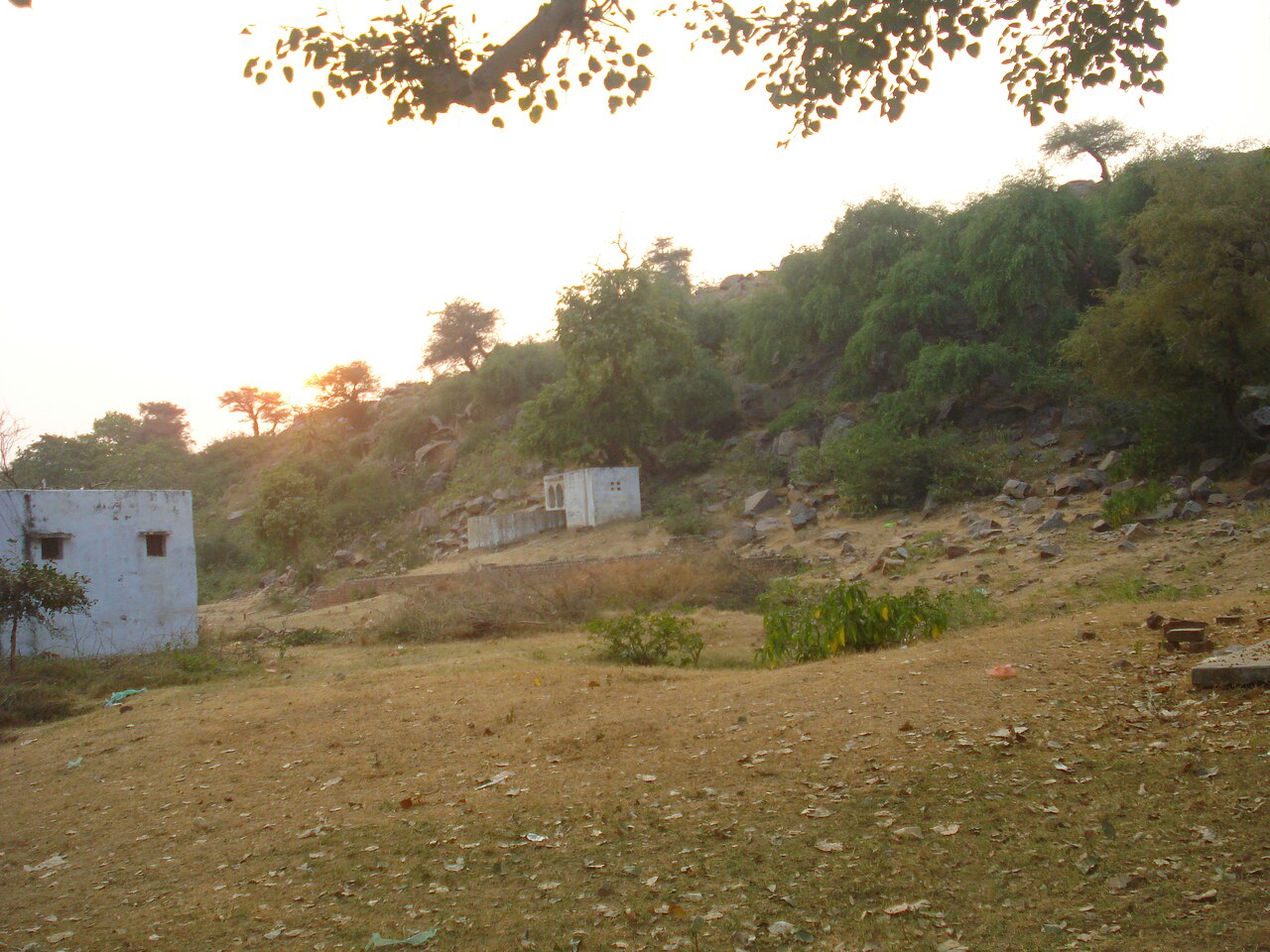
On the long walk around Govardhan, most people remember Mansi Ganga and Radha Kund. Fewer remember the two villages at the southern end, where the road runs quiet and the hill looks different. At Jatipura, they say, the hill shows its face. At Punchari, it ends in a tail.
It is said that the hill is a living being, lying like a peacock or a cow. Here are the two places that complete the picture.
The story in a few lines
In the Pushtimarg tradition, Krishna's raised left arm appeared from Giriraj in 1409 of the Vikram era, on Shravana Shukla Panchami, which is Nag Panchami, and the face appeared later, in 1479. Cowherds saw a cow pour milk daily on a spot on the hill, and a hand appeared. The deity was named Devadamana, later Shrinathji. Vallabhacharya, who lived from 1479 to 1531, installed Shrinathji in a small shrine on Govardhan in 1499, and the Pushtimarg path was founded here. These dates follow tradition and should be treated as such.
The same tradition sets Mansi Ganga at the neck of the hill, Radha Kund at the mouth and Punchari at the tail, puchh. A friend of Krishna named Lautha is said to have stayed at the tail when Krishna left for Dwarka.
Why it matters on the yatra
The Mukharvind at Jatipura is the face of the hill itself, worshipped with milk and flowers, and it recalls the Govardhan chapters of the Bhagavata Purana (10.24 and 10.25). Madhavendra Puri, a predecessor of Chaitanya, is linked to the area, and the Chaitanya Charitamrita (Madhya Lila 4) tells how the deity Gopal, whom he served, asked for sandalwood paste.
Punchari ka Lautha is entirely local faith. The Bhagavatam does not mention it. People bring offerings and ask Lautha to keep their prayers waiting for Krishna's return, which shows how Braj keeps Krishna close even when the stories end.
Getting there from Vrindavan, Mathura and Delhi airport
Jatipura is about 28 km from Mathura Junction and 31 km from Banke Bihari, by the guide. Mansi Ganga is 4 km away, Kusum Sarovar 5 km and Punchari 6 km. Punchari itself is some 32 km from the junction and 35 km from the Banke Bihari temple, near the Rajasthan border. Delhi airport is about 180 to 185 km.
Park near Jatipura village on the parikrama road, in narrow lanes, and walk about 5 minutes. At Punchari, parking is roadside and the walk is a few minutes. Charges and details at both are to be checked locally.
These stops lie at the quieter end of the circuit. If you are doing the parikrama by e-rickshaw, ask the driver to include them from the start, since many drivers skip them to save time. A short extra fare for the detour is reasonable, and agreed in advance.
Timings and what changes by season
Indicative hours at Jatipura are about 5:30 am to 12:00 pm and 4:00 pm to 8:30 pm in summer, and about 6:00 am to 12:00 pm and 3:30 pm to 8:00 pm in winter, with an afternoon closing. Punchari is informal and daylight only, with no verified hours. Morning is best at both.
Nag Panchami in July or August is the appearance day at Jatipura. Annakut after Diwali brings a crowd. Check dates with a panchang.
Dress, phones, crowds and kind manners
Dress modestly, leave shoes at the gate and avoid photography inside. Crowds are light on most days. Monkeys are common, toilets limited, and the ground uneven, so these are not easy places for wheelchairs. Donation-seeking touts appear at Jatipura, and you may decline kindly.
Peacocks and the quiet end of the hill are a reward at Punchari. Please do not feed the animals.
Pilgrims who walk barefoot should remember that village lanes hold broken glass and thorns. Slippers in a bag cost nothing to carry, and a first-aid strip for blisters is wiser than a brave face.
The Mukharvind temple
At Jatipura you will see the Mukharvind of Giriraj, Vallabhacharya's baithak and the milk abhishek of the stone. Shrinathji himself is not here. He was moved from Govardhan to Nathdwara in Rajasthan in 1672 for safety, and Nathdwara is now his home. Jatipura remains the place of his appearance.
A visit takes about 30 minutes. If you follow Pushtimarg, this is one of the sacred places of the sect, and if you do not, it is still a moving, quiet shrine.
Where to eat nearby
Jatipura has tea and sweets, and Punchari has tea stalls. Neither has a verified restaurant. Our Govardhan food notes are thin and come from weak sources, so carry fruit and water and eat a full meal at Mathura or Vrindavan.
Plan it with nearby stops
These two stops complete the parikrama for those who walk or ride the full circuit of about 21 km (routes vary). For a short car plan, go to Mansi Ganga, Jatipura and Kusum Sarovar. lala:Cab can arrange an e-rickshaw circuit with a driver, and a guide who tells the story of the hill's face and tail.
Questions, answered
Is Shrinathji's deity at Jatipura?
No. Shrinathji is in Nathdwara, Rajasthan; Jatipura is where he first appeared.
Why is Punchari called the tail?
By local tradition the hill lies like a living creature, and this village is where its tail is.
Who is Lautha?
By local tradition, a companion of the Lord who waited by the tail after he went to Dwarka.
How far is Jatipura from Mansi Ganga?
About 4 km by the guide.
Timings, entry rules and fees change. Please confirm on the day with the temple or your driver.
- Timings at Jatipura and Punchari
- Pushtimarg dates (tradition)
- Parking and road at Punchari
- Lautha tradition
- Chaitanya Charitamrita Madhya 4 (Vedabase)
- Inditales: Govardhan Parikrama
- Srimad Bhagavatam 10.24-10.25 (Vedabase)
- Pushtimarg tradition on the appearance of Shrinathji (dates are tradition)
Walking this path soon?
If you would like a driver who knows the lanes and the timings, the lala:Cab app is there when you are ready. No advance, no pressure.