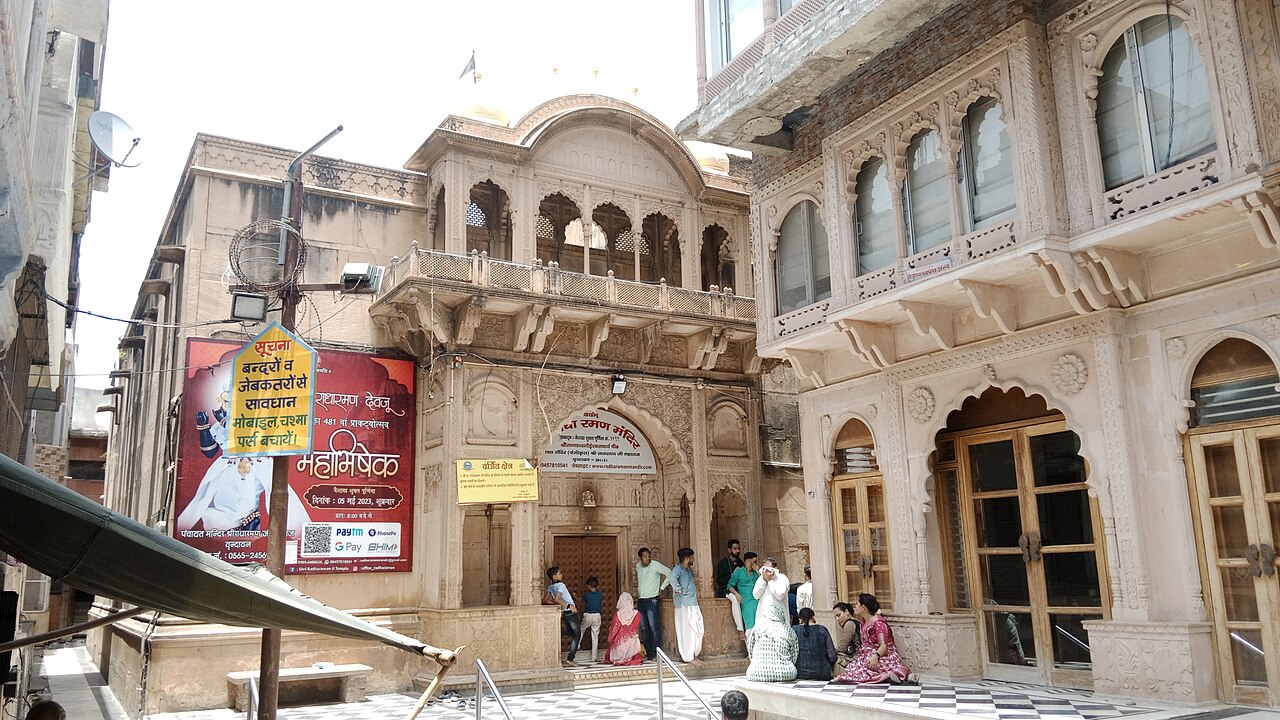
A few minutes from the loud lanes of Banke Bihari there is a temple where voices drop on their own. The deity here is only about thirty centimetres tall. Yet it is one of the oldest and most loved in Vrindavan, and the families who serve him say they have done so without a break for nearly five hundred years.
It is said that he rose from a stone. Here is the story, and how to visit him without hurry.
The story in a few lines
Gopal Bhatta Goswami, one of the six Goswamis of Vrindavan, wished to worship Krishna in a form with a face, hands and feet. He had carried twelve shaligram stones from his pilgrimage in the Himalaya. One day, the story goes, as he sat sorrowful before them, one stone opened into a full form of Krishna with the three-bent pose, the flute and a smile. This is placed on a Vaishakha full moon, traditionally in 1542. They called him Radha Raman, the one who delights Radha.
The deity's back is still the round shaligram. There is no separate image of Radha, and a crown set beside him stands for her. This is the tradition of the sampradaya, and the manifestation itself is not documented in history.
Gopal Bhatta Goswami is remembered as a scholar and a quiet soul, one of the six who made Vrindavan a place of learning as well as song. His samadhi in the courtyard is therefore a place of respect for all visitors, whatever their tradition.
Why it matters on the yatra
The Gaudiya tradition of Chaitanya Mahaprabhu sent the Goswamis to Vrindavan to bring its holy places to light. Radha Raman is one of the seven great Thakurs of the town by a common reckoning, though the exact list should be verified. In the 17th century, when Mughal-era disturbances led several deities to be moved to Rajasthan, this one stayed in Vrindavan, and so is counted among the few original deities still here.
The deeper background is the picture of Krishna in the Rasa chapters of the Bhagavata (10.29 to 10.33).
Getting there
The temple lies in the old town, about 0.7 km from Banke Bihari on foot, 13 km from Mathura Junction and about 175 km from Delhi airport. Nidhivan is 0.4 km away, Radha Vallabh 0.3 km, Shahji 0.7 km and Seva Kunj 0.6 km.
Cars stop at town lots, for about Rs 50 to 100, to be checked locally. Drop near the Banke Bihari approach and walk 10 to 15 minutes, since Radha Raman is on the lane toward Nidhivan. On festival days only e-rickshaws run for the last kilometre.
Timings and aarti
Indicative hours in summer are about 5:30 am to 12:30 pm and 4:00 pm to 9:00 pm, and in winter about 6:30 am to 12:30 pm and 3:30 pm to 8:00 pm, with a noon rest. There is a mangala aarti early in the morning, a sandhya aarti around dusk and a shayan aarti at night. Confirm the day's times at the gate.
Mornings are very calm on weekdays. The crowd is moderate, heavier on Thursdays and festival days. Queues are shorter than at Banke Bihari, but the culture is quiet and hereditary goswami families run the temple.
Dress, phones and manners
Dress modestly and remove footwear at the gate, where there are shoe stands near the entrance. Leather items are discouraged. Photography inside the sanctum is not allowed, and the courtyard rule should be checked locally.
Monkeys live in the lanes, so keep your glasses and phone in a bag. Toilets are limited, so use them before you leave the main road.
Come with time to sit. The courtyard invites you to rest on the stone floor and listen to the bells. Many visitors say this is the temple where Vrindavan first felt gentle to them, after the pressing crowds of the better-known lanes.
The kitchen fire and what to see
The temple kitchen is said to keep a fire that has burned since the first day. Do ask politely if you can see it, as access depends on the time. In the courtyard is the samadhi of Gopal Bhatta Goswami. A small museum area known as the Radha Raman Ghera is also mentioned, but check locally whether it is open.
The appearance day falls on Vaishakha Purnima in April or May. Janmashtami has a midnight abhishek, and Holi and Phulera Dooj bring colour.
Eating nearby
The old town has sweet shops and kachori stalls. The Banke Bihari lanes sell hot jalebi and rabri in winter evenings. Radha Vallabh temple is known for makhan-mishri bhog, and our Vrindavan food guide lists more. A busy counter is the best sign of a fresh batch.
Plan it with nearby stops
Allow 30 to 45 minutes. Combine with Radha Vallabh, Nidhivan, Seva Kunj and Banke Bihari on a walking morning in the old town. If you want a guide to tell the Goswami stories as you walk, lala:Cab can send one.
Questions, answered
What is special about Radha Raman?
By tradition he appeared from a shaligram stone, and his seva has continued for nearly five hundred years.
Is there a Radha idol?
No. A crown beside the deity represents Radha.
When did the deity manifest?
Traditionally in 1542 on Vaishakha Purnima. This is sampradaya tradition.
Is it less crowded than Banke Bihari?
Yes, usually, especially on weekday mornings.
Timings, entry rules and fees change. Please confirm on the day with the temple or your driver.
- 1542 manifestation date (tradition)
- Temple build date and patron (about 1826)
- Timings and aarti
- Whether the kitchen and museum area can be seen
- The list of seven Thakurs
- Srimad Bhagavatam 10.29-10.33 (Vedabase)
- Wikipedia: Radha Raman Temple
- Gaudiya sampradaya tradition of Gopal Bhatta Goswami (Bhakti-ratnakara)
Walking this path soon?
If you would like a driver who knows the lanes and the timings, the lala:Cab app is there when you are ready. No advance, no pressure.