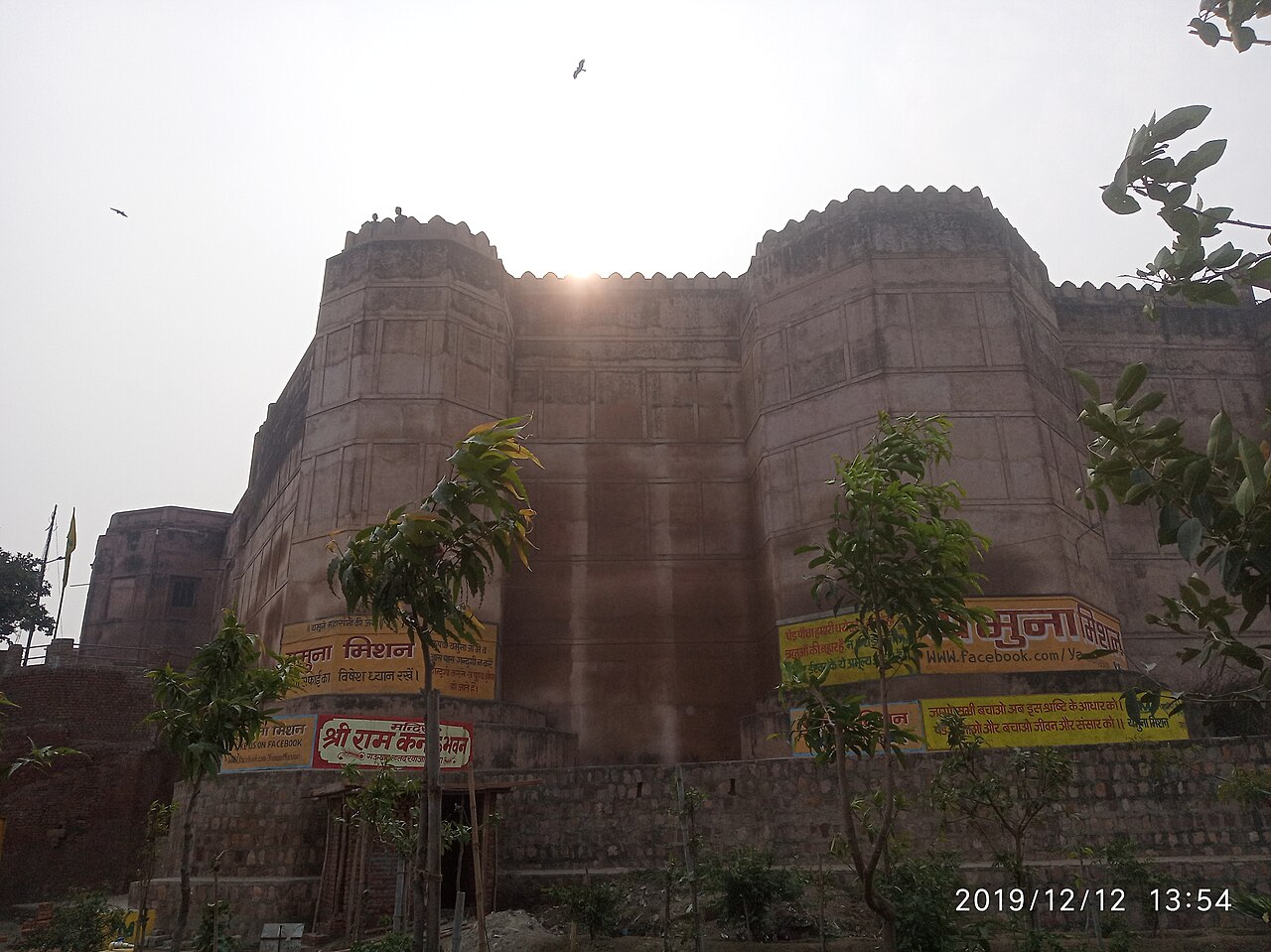
Most visitors rush through Mathura on the way to Vrindavan, and that is a pity. The old city has a way of unfolding if you give it an afternoon: a high wall above the river, a ghat where the boats rock gently, a temple behind a carved wooden door and a bazaar that smells of ghee and flowers.
It is said that Kansa once ruled from a palace on this very bank. Let us walk there, and let the story be told as we go.
The story in a few lines
Kansa, the son of Ugrasena, took the throne of Mathura by force and shut his own father in prison. People knew him as a tyrant who killed newborns to escape a prophecy. When Krishna came to the city with Balarama, they met the washerman, the garland-maker Sudama and the hunchbacked Kubja, broke the great bow in the sacrificial hall and faced the elephant Kuvalayapida (Bhagavata Purana 10.41 to 10.43).
The fort is the place devotees point to when they say Kansa's palace stood. The Bhagavatam does not name the spot, so the identification is local tradition. The end of Kansa is told in chapter 44.
Why it matters on the yatra
A pilgrimage to Braj is not only Vrindavan's sweetness. Mathura gives the other half of the story: the prison and the palace, the wrestling ground and the river where Krishna rested. Standing on the high bank, you see the Yamuna as the Mathura of old would have seen her.
In October and November the Kans Vadh Leela and a mela are held on Kartik Shukla Navami, which is the time when the story is acted out again. Check dates locally.
Getting there from Vrindavan, Mathura and Delhi airport
The fort is about 2.5 km from Mathura Junction, around 13 km from Banke Bihari in Vrindavan and about 165 km from Delhi airport. Vishram Ghat is about 0.8 km, Dwarkadhish about 1 km and Krishna Janmabhoomi about 2 km.
Parking is on the roadside near the ghat lane, a small charge to be checked locally. The approach is narrow, and the drop is at the fort gate lane, a 2 to 5 minute walk.
Timings and what changes by season
There are no reliable published hours. Treat the fort as a daytime visit, and go in the late afternoon when the light is soft and the heat is gone. Access to the interior is not regular, since the fort is a protected ruin. Please check locally whether it is open and whether any ticket applies under the Archaeological Survey rules.
In summer, avoid midday. In winter, the afternoon walk fits well with an evening aarti at Vishram Ghat.
If you are travelling with children, the fort is a good place to let them look over the wall at the river and ask questions. It takes only a few minutes, and the story of the tyrant king is one that children remember.
Why the fort history is layered
The present fort is mostly of the 16th century, built by Raja Man Singh of Amber on older ruins, by common accounts. In the 18th century Sawai Jai Singh II of Jaipur built an observatory, a yantra, on the fort, but little survives. This is how Mathura is: each age has built over the one before.
The same layering is found in the city's temples. Dwarkadhish, for example, was built in 1814 to 1815 and Krishna Janmabhoomi saw several rebuildings. Do not expect one clean story, and let the stones carry several.
Which parts are accessible
The ground is uneven and the approach narrow, so the fort is not easy for wheelchairs. The fort walls, the gate and the views of the Yamuna can be seen from outside. The old ghat below is reached by steps. There are no known toilets, so use them before you come.
Dress modestly and keep your voice low in the lanes. Exterior photographs are fine, but ask about rules if a guard stops you. Unofficial guides sometimes offer a tour for a fee, so agree a price first or decline.
Where to eat nearby
The Holi Gate bazaar and Chhatta Bazaar run east from the old city gate, and they are Mathura's food heart. Kachori and jalebi are best in the early morning, and chaat is best in the evening. Named shops from our research include Shriji Chat Bhandar in Chhatta Bazaar for chaat and Annapurna Khaman Dhokla House for Gujarati snacks, both to be checked locally.
Our Mathura food guide and the post on Mathura peda help you choose well.
Plan it with nearby stops
Allow 20 to 30 minutes at the fort, then walk to Vishram Ghat for the river, to Dwarkadhish for darshan and into Chhatta Bazaar for shopping. A guide who knows these lanes makes the walk much richer, and lala:Cab can arrange one, together with a car waiting at the right lot.
Questions, answered
Is Kans Qila open to visitors?
Access varies. It is a protected ruin, so check locally before you go.
Was Kansa's palace really here?
That is local tradition. The Bhagavatam does not name the spot.
Who built the present fort?
By common accounts it is mostly 16th century, built by Raja Man Singh of Amber on older ruins.
How long should I stay?
About 20 to 30 minutes, with time for Vishram Ghat close by.
Timings, entry rules and fees change. Please confirm on the day with the temple or your driver.
- Whether the fort interior is open and any ticket
- Fort history details (Man Singh, Jai Singh yantra)
- Kans Vadh mela dates
- Parking charge
- Wikipedia: Kans Qila
- Srimad Bhagavatam 10.41-10.44 (Vedabase)
- Mathura Gazetteer (historical, edition to verify)
Walking this path soon?
If you would like a driver who knows the lanes and the timings, the lala:Cab app is there when you are ready. No advance, no pressure.