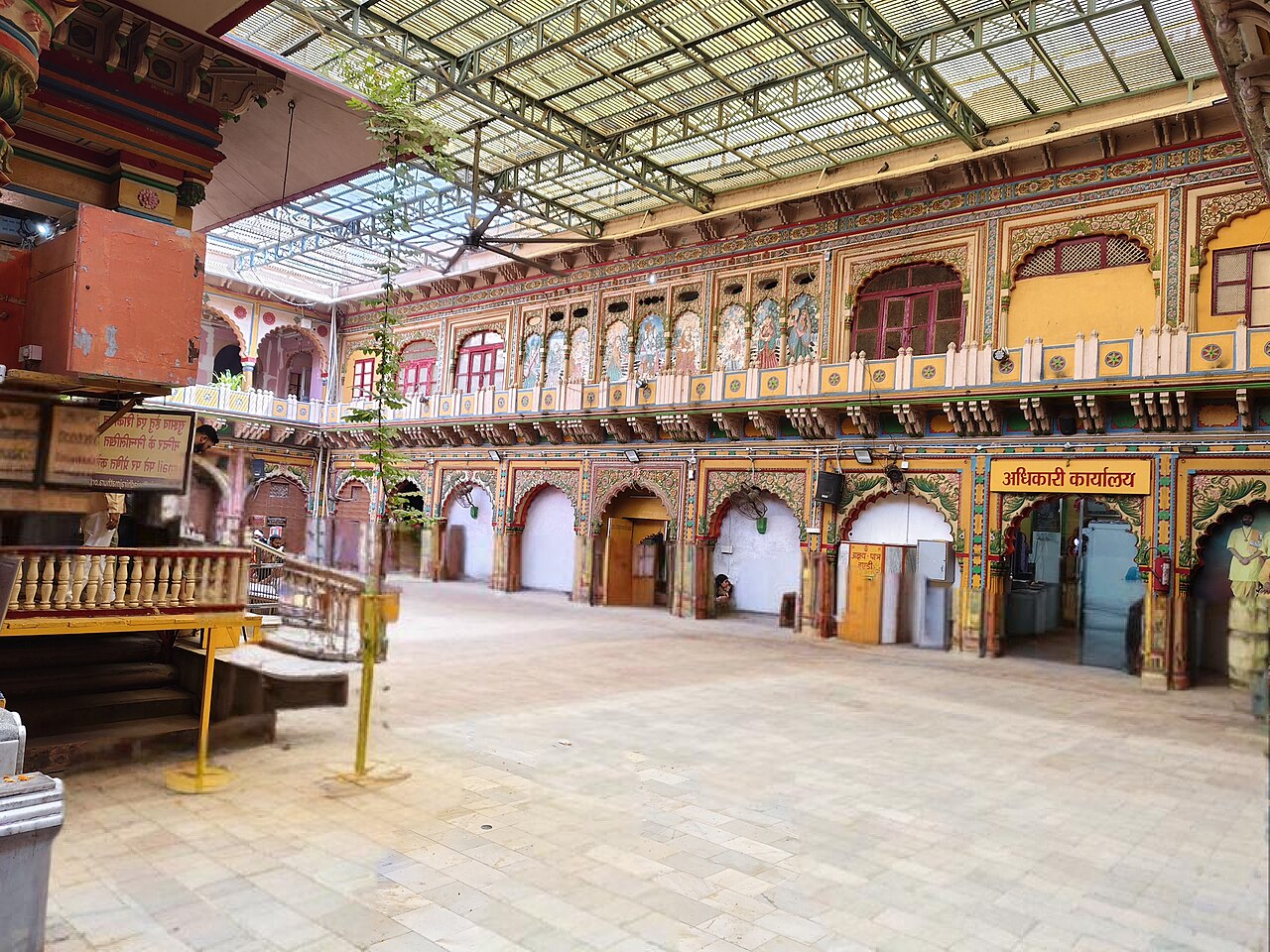
Walk a few minutes from Vishram Ghat, past the sweet shops and the garland sellers, and a tall carved wooden gate appears at the end of the lane. This is Dwarkadhish, the haveli temple of Mathura, and the first thing most visitors notice is how different it feels from the other temples of Braj.
Here Krishna is not the butter thief or the cowherd boy. Here he is remembered as the king, the lord of Dwarka, and the whole temple is run like a royal household that wakes, bathes, dresses and feeds its master with great care. It is a good place to slow down, so let us walk through it gently.
The story in a few lines
It is said that after Krishna ended Kansa in Mathura, he placed his grandfather Ugrasena back on the throne. The Bhagavata Purana tells this around chapters 44 and 45 of the tenth canto. Later, when Jarasandha kept attacking the city, Krishna led the Yadavas west and founded the island city of Dwarka (canto 10, chapter 50). The name Dwarkadhish simply means lord of Dwarka.
The temple here was built in 1814 to 1815 by Seth Gokuldas Parikh, who served as treasurer to the Scindia rulers of Gwalior, by most accounts. It is a Rajasthani-style building with a carved wooden gate and an open courtyard, and it is looked after by the Pushtimarg Goswami family.
Why it matters on the yatra
Braj has many faces of Krishna, and this temple shows one that is easy to miss: the royal one. Most pilgrims come for Vrindavan and the childhood leelas, so a short stop at Dwarkadhish gives the picture its other half, the boy who grew up and became a king.
It also gives a first look at Pushtimarg, the path of loving service founded by Vallabhacharya. In this tradition the Lord is tended like a royal child. Even if you follow another sampradaya, the care and the music are moving to watch.
Getting there from Vrindavan, Mathura and Delhi airport
From Mathura Junction the temple is about 2.5 km, a drive of 15 to 20 minutes depending on the bazaar. From Banke Bihari in Vrindavan it is about 13 km, and from Delhi airport about 165 km, which most families treat as a half-day road journey with a break.
The old bazaar around Vishram Ghat is too narrow for cars. The cab usually waits at the Holi Gate or Chowk Bazaar approach, or at the river road parking lot, and you walk the last 5 to 10 minutes. Parking is a small charge, roughly Rs 30 to 60, but this should be checked on the day.
- The chowk and bazaar roads are mostly closed to cars from mid-morning until night, so only walking and e-rickshaws go through.
- On festival days even e-rickshaws can be stopped, so allow extra time and let the driver choose the drop point.
Timings and the Pushtimarg service
Pushtimarg darshan does not stay open all day. The curtain opens for a few minutes at a time, and the service follows eight periods named Mangala, Shringar, Gwal, Rajbhog, Utthapan, Bhog, Sandhya and Shayan. Each one is a small scene of the Lord's day, and each is a jhanki, a short glimpse behind the curtain.
In summer the windows are roughly 6:30 am to 10:30 am and 3:30 pm to 7:30 pm. In winter they shift to about 7:00 am to 11:00 am and 3:00 pm to 6:30 pm. The temple rests in the middle of the day, and this is when many visitors arrive to find a closed door, so plan around it. Every one of these hours should be confirmed locally, since the exact jhanki times change with the day and the season.
Dress, phones, crowds and kind manners
Dress modestly, with shoulders and knees covered. Leather items, belts and shoes are not taken inside. A shoe stand at the gate looks after footwear, or your driver can keep them in the cab.
Cameras and video are not allowed in the sanctum, and a phone deposit may be asked at the door, so travel light. Women can carry a small cloth bag; larger bags are best left in the car. Crowds are moderate on ordinary days and heavy in Shravan and on Janmashtami.
Many steps lead up to the sanctum and the temple is not step-free. Elders who cannot manage stairs should ask locally about the easiest approach before the day.
Holi and Hindola festivals here
The monsoon is when this temple shines. In Shravan, roughly July to August, the Hindola and Ghata festivals fill the rooms with dark cloud colours, swings of flowers and gold, and devotional music. It is a rich cultural experience whatever your sect.
Janmashtami, Holi and the Phagun festivals bring their own decorations, and in November the Annakut after Diwali is celebrated. These are also the days of the thickest crowds, so those who dislike a press of people may prefer an ordinary morning.
Where to eat nearby
The Holi Gate bazaar is the old food street of Mathura, known for peda and kachori. Brijwasi Mithai Wala is mentioned by many travellers as a familiar name here. Note that other shops with a similar name exist, for example one near the Janmasthan, so confirm which outlet you are walking into.
Hygiene and labelling can vary from shop to shop, so choose a busy counter with a quick turnover and ask for sweets made that day. Our Mathura food guide goes deeper into what to order.
Plan it with Vishram Ghat and a guide
Set aside under an hour for the temple, then walk down to Vishram Ghat for the river. Krishna Janmabhoomi is about 1.5 km away, Kans Qila about 1 km and Potra Kund about 1.8 km, so a morning in old Mathura can hold all of them if you start early.
At the ghat, some pandas insist on a sankalp for a fee, and flower and prasad sets are sometimes overpriced. A local guide who knows the lanes keeps this simple, and lala:Cab can send one along with your car so you can focus on the darshan instead of the planning.
Questions, answered
Why does the darshan open for only a few minutes?
The curtain stays closed between the eight services of the day, because the Lord is considered to be resting or being prepared.
Is this the same Dwarkadhish as in Gujarat?
No. This is a separate temple in Mathura that honours Krishna as the king of Dwarka.
Can I take my phone inside?
Usually not. Ask at the gate, as the rule is applied firmly.
How long should I plan here?
Roughly an hour, then a short walk to Vishram Ghat.
Timings, entry rules and fees change. Please confirm on the day with the temple or your driver.
- Darshan windows and jhanki times today
- Phone and bag rule at the gate
- Parking charge and the no-entry hours
- Exact build dates (1814 to 1815 per common accounts)
- Wikipedia: Dwarkadhish Temple, Mathura
- Srimad Bhagavatam 10.44-10.45 and 10.50 (vedabase.io)
- Pushtimarg tradition (Vallabhacharya sampradaya)
Walking this path soon?
If you would like a driver who knows the lanes and the timings, the lala:Cab app is there when you are ready. No advance, no pressure.