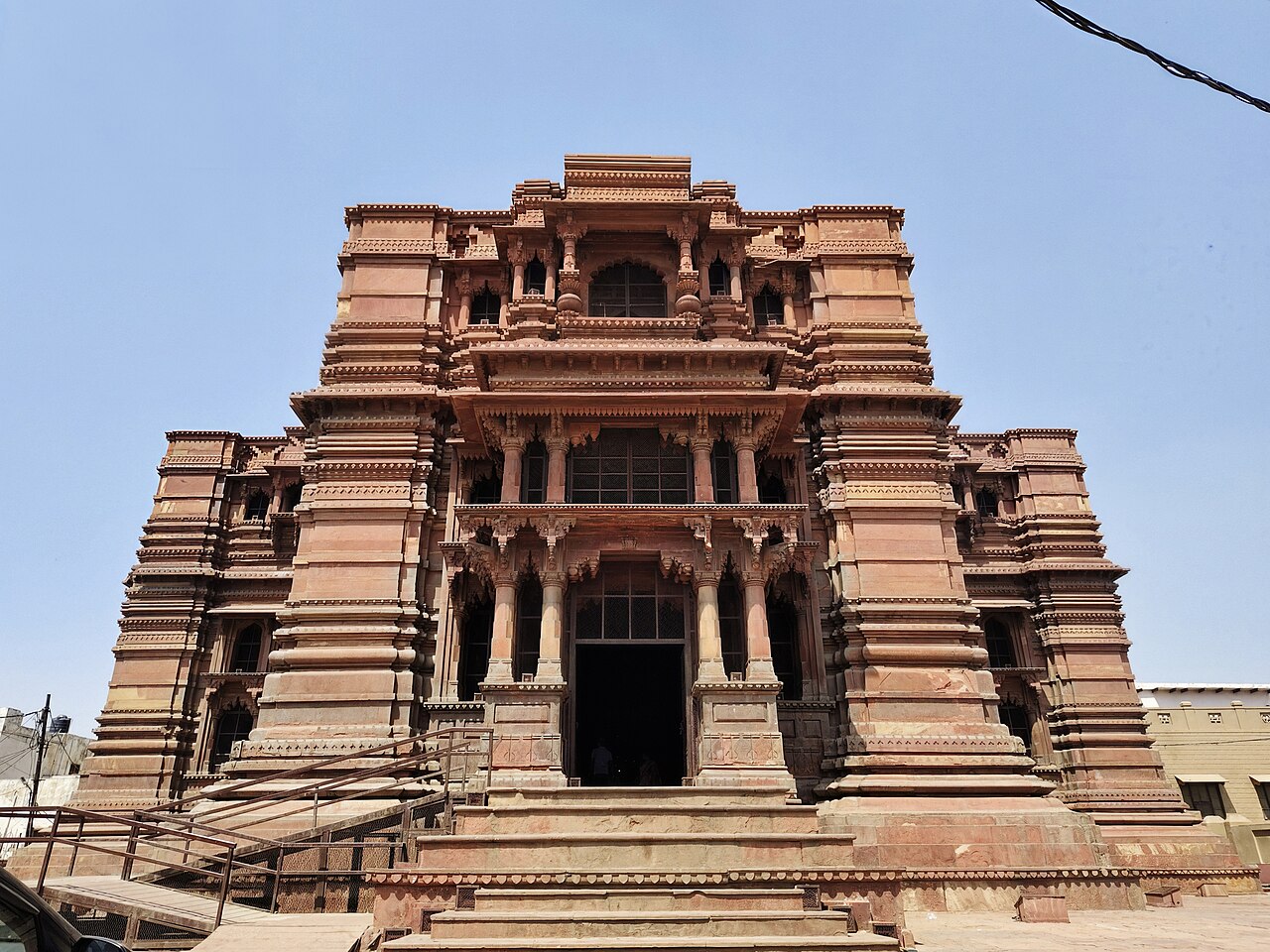
Walk a short way from the old town and a wall of red sandstone rises over the lane, with tall arches that have no roof and a hall that seems far too grand for Vrindavan. It looks like a lost cathedral. This is Govind Dev, once the greatest temple in North India, and now a ruin that still holds its breath.
It is said that the Lord who lived here left in the night, carried to safety. Here is the story of the temple, its deity and what a visitor can still see.
The story in a few lines
Rupa Goswami, a disciple of Chaitanya Mahaprabhu, is said to have received a vision that the original Govind Dev, a form that Krishna's great-grandson Vajranabha had installed, lay hidden at Gomatila. A cow was seen pouring milk every day on the mound. Rupa dug there, and the lost deity emerged, smiling. This is local tradition.
The name Govind means one who brings joy to the cows and the senses. It comes from the Bhagavata Purana (10.27), when Indra and the divine cow Surabhi crown Krishna as Govinda after the Govardhan lila. Devotees say the deity's left foot is tilted like a child's.
Why it matters on the yatra
Govind Dev is one of the great Thakurs of the Gaudiya Vrindavan, and its story is a reminder of how much was built in a short time after Chaitanya's disciples came. The temple was built in 1590 by Raja Man Singh I of Amber under Akbar, with a tower of seven storeys, by common accounts.
In the late 17th century, Aurangzeb's army damaged the upper storeys. The tower is mostly gone, but the arches and the hall remain, and the effect is of a vanished glory. It is a good place to feel how fragile and how persistent Braj has been.
The arches reward a slow walk. The sandstone changes colour through the day, from a warm rust at dawn to a deep gold before sunset, and the empty openings frame the sky in a way that makes many visitors fall silent. It is among the few places in Vrindavan where silence comes without effort.
Getting there from Vrindavan, Mathura and Delhi airport
The ruin lies about 1.5 km from Banke Bihari, 1.2 km from Radha Raman and Radha Damodar, and about 1 km from Rangji. Mathura Junction is around 12 km and Delhi airport about 170 km.
There are a few spaces on the road in front of the temple, for a small fee to check locally. The road is narrow, so avoid large vehicles. Drop at the front, and the walk is two minutes.
Timings and what changes by season
Indicative hours are about 5:00 am to 12:00 pm and 4:30 pm to 8:30 pm in summer, and about 5:30 am to 12:00 pm and 4:00 pm to 8:00 pm in winter, with a midday break. The ruin is looked after by the Archaeological Survey of India, so entry rules and timings for the ruin may differ from the shrine. Check locally.
The best light for the stone is the morning or the golden evening, which photographers love.
Dress, phones, crowds and kind manners
Dress modestly and leave shoes at the gate. Photographs of the ruin are usually fine, but not in the shrine. The crowd is quiet. Some monkeys live here. Steps and uneven stone make it hard for wheelchairs, and toilets are limited.
Touts sometimes claim that the place is closed. Check at the gate yourself.
Come with water in summer, since there is little shade in the open hall. A hat or a light cloth over the head helps. In the cooler months a late afternoon visit is lovely, and the lane outside is calm.
What remains today
You can see the red sandstone mandapa and arches, the ruined towers, and a copy of the deity in a small active shrine. The scale of the hall is the main sight. Walk slowly, look up and imagine the tower that once stood above.
A small shrine continues the worship, so the ruin is also a living place, and not only a monument.
Why the deity is in Jaipur
The first Govind Dev ji was moved to Jaipur during the disturbances of the late 17th century, and is now the family deity of the Jaipur royal house. A copy stands in its place. This is the usual account, and details of dates should be verified. Other Braj deities were moved to Rajasthan too, for the same reason of safety.
So the answer to a common question is that the original went away to Jaipur. The faith of Vrindavan did not stay in one place, and the Lord went where he could be served.
Another point to remember is that the ruin teaches humility. The grand temple fell, the Lord moved, and worship went on in small rooms and in hearts. Many pilgrims say that this thought, more than the architecture, is what they carry away from the place.
Where to eat and what to plan with
Chai and snacks on the road are enough. Our Vrindavan food guide lists more. Allow 30 minutes, ideally in late afternoon light, and pair with Radha Raman, Radha Damodar and Rangji. lala:Cab can send a guide who tells the Rupa Goswami story where it happened.
Questions, answered
Is the original deity here?
No. The original lives in Jaipur, and Vrindavan keeps a copy.
Who built the temple?
By common accounts, the Amber king Man Singh I, in 1590, under Akbar.
Why is it a ruin?
The upper storeys were damaged in the late 17th century, and the great tower was lost.
How long should I stay?
About 30 minutes.
Timings, entry rules and fees change. Please confirm on the day with the temple or your driver.
- ASI entry rules and timings
- Build date 1590 and the patron
- Date of the deity's move to Jaipur
- Photo rule
- Wikipedia: Govind Dev Ji Temple
- Srimad Bhagavatam 10.27 (Vedabase)
- Chaitanya Charitamrita on Rupa Goswami (the Gomatila discovery is local tradition)
Walking this path soon?
If you would like a driver who knows the lanes and the timings, the lala:Cab app is there when you are ready. No advance, no pressure.