Ask five people in Braj where Radha was born and you may hear two answers, each given with complete love. Some say Raval, a village by the Yamuna near Gokul. Others say Barsana, up on the hill. The wise ones smile and say both, because Braj has room for many tellings.
This post is not here to settle the matter. It is here to tell the stories as they are told, and to be honest about where the books are silent.
What the Bhagavatam says, and does not say
The Bhagavata Purana never names Radha. It speaks, however, of one gopi who is singled out by Krishna during the Rasa dance. When he disappears from the circle, the gopis follow his footprints and see another set beside them. They say that she must have worshipped him better than all of them (canto 10, chapter 30, verse 28). The word the verse uses for worship, aradhita, is the root from which tradition draws the name Radha.
So Radha's story comes mainly from other texts and from the saints: the Brahma Vaivarta Purana (Krishna Janma Khanda), the Garga Samhita, and later Gaudiya and Pushtimarg tradition. They do not always agree on details.
The Raval story
The older village tradition holds that Radha was born at Raval, a village across the Yamuna from Gokul, to King Vrishabhanu and Queen Kirti. One account says she appeared on a lotus in a pond; another says she was found in the king's field. The Brahma Vaivarta Purana tells of her birth and of an infancy in which, it is said, her eyes stayed closed until the day she first saw Krishna.
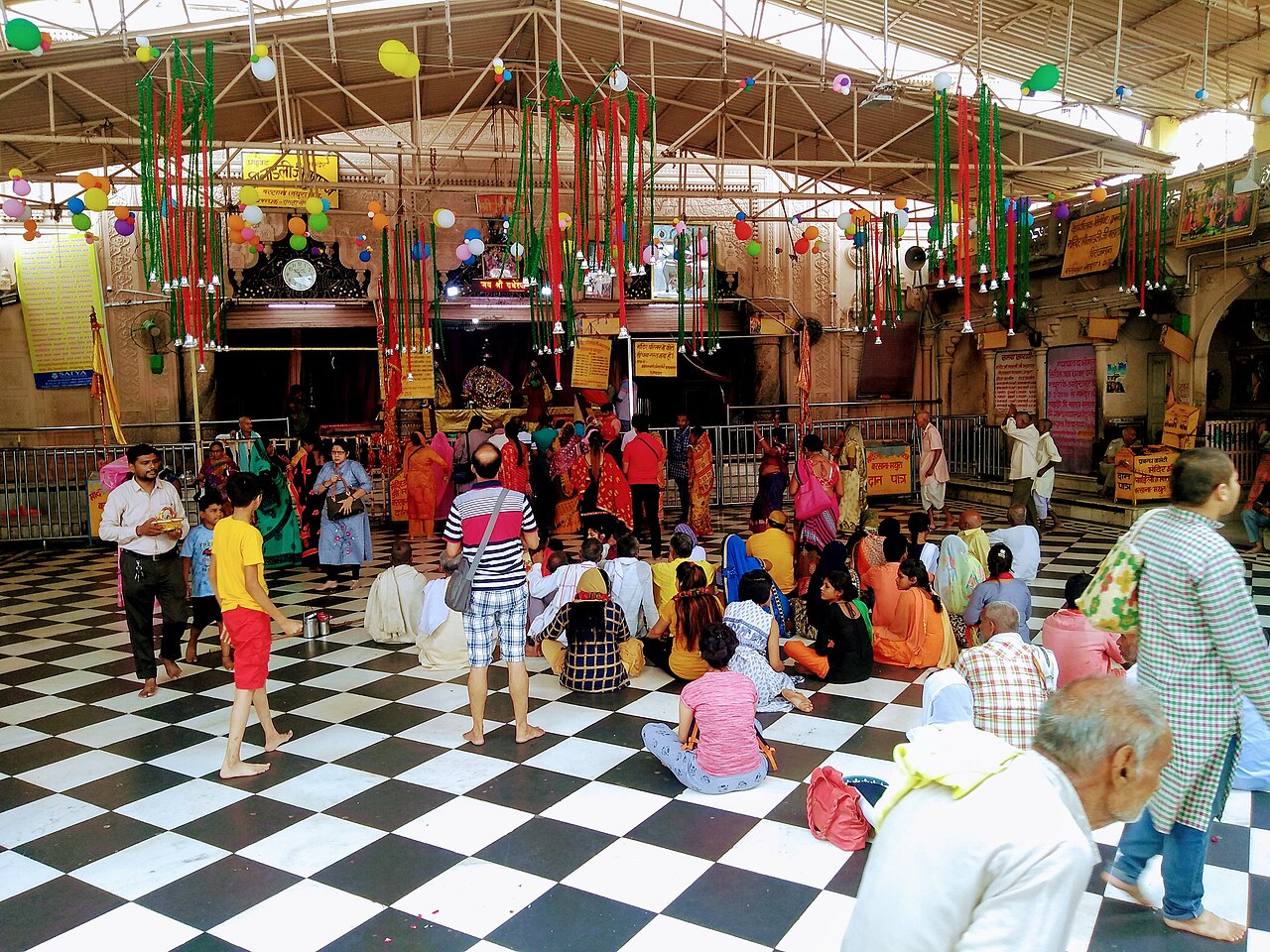
Raval today has a Radha Rani temple and an old kadamba tree, which pilgrims visit especially on Radhashtami. The builder and dates of the temple were not found in the sources we checked, so they should be asked locally.
The Barsana story
Barsana was the home of Vrishabhanu and Kirti, and there Radha grew up. A strong local belief, and the devotion of many saints, places her birth here too, and the hill temple of Shriji is the spiritual centre for lakhs of devotees. The hills are said to be Brahma in stone, with four peaks called Bhanugarh, Vilasgarh, Danagarh and Mayurgarh.
The two views are often reconciled in a gentle way: born at Raval, raised and loved at Barsana. When she was still a child, the family moved to the hill, and Raval became the village of memory.
Vrishabhanu and Kirti
The parents are remembered as devout people of rank, a king and queen of the cowherd community. Vrishabhanu is the name from which Barsana is sometimes said to take its own, as Vrishabhanupura. That derivation is a popular one and not proven here.
Their house on the hill is the temple today, and Kirti Mandir below the steps is dedicated to the mother, so the family is honoured as a whole.
Why the stories differ
Braj is not a place where one authority speaks for everyone. Each sampradaya keeps its own books, songs and memories, and the saints who rediscovered the holy places in the 16th century walked among villages that already had their own oral accounts. A village remembers what its grandmothers said, and a hill remembers what its pilgrims sang.
The Brahma Vaivarta Purana and the Garga Samhita are the texts most often quoted for Radha, though scholars place them later than the Bhagavatam. For a traveller, the useful way to hold this is simple. The tradition is deep, the details vary, and no one needs to win the argument to feel the place.
Radhashtami: the birthday
Radhashtami comes in the bright fortnight of Bhadrapada, roughly two weeks after Janmashtami. At Barsana the whole hill fills with singing, flowers and dancing, and the crowd is very heavy. At Raval the celebration is smaller and closer.
For the exact date each year, look to a panchang. For a quiet feeling, go to Raval; for the grandest scene, climb to Barsana.
Visiting both places
Raval lies some 10 km out of Mathura and is usually paired with Gokul, 4 km beyond. Barsana is far to the north-west, around 50 km, and goes best with Nandgaon. They lie in opposite directions, so they are normally done on different days.
Keep the heat of the day in mind as well. Raval and Barsana both involve walking on open ground, so a morning start, a hat and a bottle of water make either visit more pleasant. In the winter months, between November and February, the air is clear and the hill is a joy. Whichever you choose, carry the story with you gently, and let the place add to it.
lala:Cab can build a day for each, with a guide who tells the story of Radha as you stand in these places.
Questions, answered
Is Radha mentioned in the Bhagavatam?
Not by name. A verse in chapter 10.30 speaks of one gopi who worshipped Krishna best, and tradition reads this as Radha.
Where was Radha really born?
Tradition says Raval, and Barsana also claims her birth. Both are respected in Braj.
When is Radhashtami?
In late August or September, a fortnight after Janmashtami. A panchang gives the exact date.
Which place should I visit first?
Most pilgrims go to Barsana. Raval is a quiet addition on a Gokul day.
Timings, entry rules and fees change. Please confirm on the day with the temple or your driver.
- Raval temple builder and dates
- The eyes closed until she saw Krishna (Brahma Vaivarta tradition)
- Vrishabhanupura derivation
- Radhashtami date each year
- Srimad Bhagavatam 10.30.28 (Vedabase)
- Wikipedia: Radha
- Brahma Vaivarta Purana, Krishna Janma Khanda (as cited in the lala:Cab guide)
- Garga Samhita on Barsana
Walking this path soon?
If you would like a driver who knows the lanes and the timings, the lala:Cab app is there when you are ready. No advance, no pressure.